Best DC Power Transfer Switches for Uninterrupted Power Supply and Reliability
Answering the need for continuous power to routers, Starlink, CCTV, and small industrial devices, these DC power transfer switches provide seamless switching with minimal or no reboot. The top picks below are suited for off-grid setups, RVs, solar or backup systems, and smart home networks. Each option is evaluated for speed, voltage range, and suitability to different loads.
| Product | Best For | Key Benefit |
|---|---|---|
| Frasiu DC Automatic Transfer Switch 5–40V 13A | Heavy-duty DC gear | Seamless ≤300μs switching |
| Frasiu DC Automatic Transfer Switch 8A | Routers and cameras | No reboot, adjustable display |
| OONO F-1080 DC 6-36V | Compact setups | Low-latency <10ms transfer |
| ZXWATC Dual Power Automatic Transfer Switch | Critical networks | 0.007s ultra-fast switching |
| Ensoft DC 5-60V Dual Power Automatic Transfer Switch | General purpose | 0.007s transfer with safety design |
Frasiu DC Automatic Transfer Switch 5–40V 13A
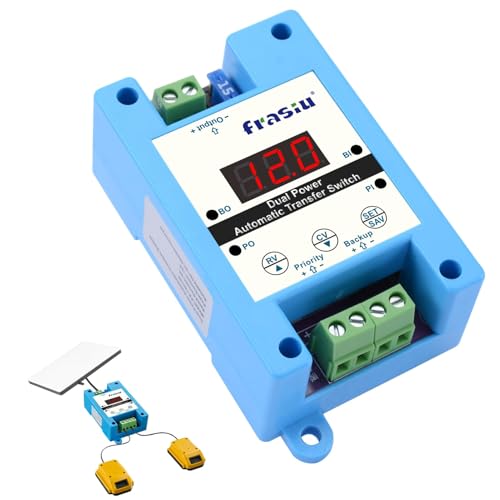
Best for high-demand devices, including Starlink Minis and industrial gateways. This switch offers a wide 5V–40V DC range and 13A continuous current, enabling seamless failover during power interruptions. The ultra-fast ≤300μs switching reduces the risk of reboots for critical equipment. Ideal for RVs, solar backups, and CCTV setups that require reliable power without interruption.
- Best for demanding DC loads that need quick swap during outages.
- Better for setups where a single device or gateway draws more current.
Limitation: The higher current rating is beneficial, but ensure wiring and connectors support 13A continuous load to avoid overheating.
Frasiu DC Automatic Transfer Switch 8A

Best for routers, Starlink Mini, and security cameras in medium-duty systems. It supports seamless switching under 300 microseconds with no reboot, and features a digital display to monitor cut-off and back-up voltages, plus delay settings. This makes it well-suited for RV systems, off-grid cabins, and mobile internet setups that demand stable uptime.
- Choose this if you need adjustable monitoring alongside fast switching.
- Avoid if your load occasionally exceeds 8A for extended periods.
Limitation: Real-time voltage display is helpful, but ensure your backup source meets the minimum voltage requirements to avoid false triggers.
OONO F-1080 DC Transfer Switch 6-36V

Best for compact, easy-install setups. Operating between 6V and 36V with up to 8A, it switches sources quickly (less than 10 milliseconds). The device is designed to prevent downtime for smart devices and computers, making it a good fit for small off-grid rigs or vehicle-based systems.
- Better for tight spaces where simplicity matters.
- Limitations include a narrower current range than some larger units.
Limitation: The 5–10 ms transfer window is sufficient for most devices but not all extremely sensitive equipment; verify device tolerances before deployment.
ZXWATC Dual Power Automatic Transfer Switch

Best for critical networks and devices needing ultra-fast transfer. It enables seamless switching between main and backup power with a 0.007s rate, which is ideal for routers, CCTV, dash cams, and PLCs. Safety design disconnects live and neutral lines during transfer, enhancing protection for connected equipment.
- Choose this if ultra-fast switching minimizes downtime for sensitive systems.
- Avoid if you don’t need the extra safety features or the compact form factor.
Limitation: The speed is excellent, but confirm compatibility with your existing power sources to ensure smooth handoffs.
Yinhing DC Auto Transfer Supply Controller

Best for automatic battery back-up in varied voltage systems (12V–48V). It automatically switches to battery when mains fail and reconnects when power returns, with straightforward screw-terminal wiring for easy installation. Suitable for essential devices in homes or small cabins that require reliable continuity.
- Choose this if you value simple wiring and straightforward operation.
- Limitation: Some users may require more advanced monitoring features found in higher-end models.
Limitation: The lack of digital readouts means you may rely on external monitoring for precise battery state awareness.
Buying Guide: How To Choose A DC Power Transfer Switch
What load will you protect? Identify the devices that cannot tolerate power interruptions, such as routers, gateways, CCTV, and RV appliances. Match the switch’s current rating to the total load you plan to support.
What voltage range do you need? Choose a model that supports your system’s voltage (DC 5–60V variants cover most consumer and small industrial needs). Consider future expansion to avoid replacement later.
How fast must switching be? Ultra-fast switching (sub-1 ms) is best for equipment sensitive to voltage dips; otherwise, a few milliseconds are often sufficient.
Does the product offer safety features? Look for simultaneous disconnection of live and neutral lines, and protections against short circuits, overloads, and reverse polarity where available.
Is installation simple? Screw terminals and clear front-panel controls help with easy setup and maintenance, especially in off-grid and RV environments.
What about monitoring capabilities? Some models provide digital displays or indicators to monitor cut-off, recovery voltages, and delay times, aiding precise battery management.
Frequently Asked Questions
- What is a DC automatic transfer switch? A device that automatically switches between two DC power sources to prevent downtime when one source fails.
- Can these switches handle solar power systems? Yes, many models are designed for solar, RV, and off-grid configurations with 5–60V ranges.
- Do I need a high current rating? Yes, choose a rating that meets or exceeds your peak load to avoid overheating or nuisance tripping.
- Do they prevent device reboot during outages? Many models claim seamless switching with minimal reboot risk for sensitive devices.
- Are digital displays important? They help you monitor voltages and set thresholds, improving battery management.
- Is waterproofing important? For outdoor or exposed installations, IP-rated enclosures add protection against moisture.