Best 60Hz to 50Hz Frequency Converter Sales for Reliable Power Conversion
Answering the common search: you want a dependable way to convert 60Hz power to 50Hz for appliances or equipment that require 50Hz operation. This guide highlights five practical options suited for different power needs—from compact home devices to larger industrial drives. Each product is assessed for who it’s best for, why it was selected, and a key caution. A quick summary table follows to compare core specs at a glance.
| Product | Best For | Power Range | Notes |
|---|---|---|---|
| GoHz 500VA Single Phase 120V 60Hz to 220V 50Hz | Small household appliances needing 50Hz from 60Hz input | 500 VA | Includes overload and temp protections |
| Angisy 2.2KW 380V 3-Phases Input/Output, 50Hz to 60Hz | Three-phase equipment that must switch between 50Hz and 60Hz | 2.2 kW | 3-phase, supports 50/60 Hz |
| GoHz 5kVA 240V 50Hz to 120V 60Hz | Mid-size loads needing voltage and frequency conversion | 5 kVA | Includes overload and protection features |
| GoHz 5kVA 50/60 Hz Bidirectional Frequency Converter | Global appliances or labs requiring flexible 50/60 Hz | 5 kVA | Bidirectional, solid sine-wave output |
| XVKPQUJA 11kW 220V to 380V 3P Drive Inverter | Higher-power single-to-three-phase conversion needs | 11 kW | Inverter/drive type; suitable for motors |
GoHz 500VA 60Hz To 50Hz Converter

Best for compact, non-continuous loads such as small household devices that require 50Hz operation from a 60Hz supply. The GoHz 500VA converter provides a 120V input with a 50Hz output setting or a 240V output setting, depending on the setting selected. It offers protections for overload, short circuit, overheating, and instantaneous power loss. This is a practical choice for travelers, students, or homeowners with 50Hz electronics in a 60Hz country.
Who it’s best for: Individuals with limited power needs, travelers or households that run a mix of 60Hz/50Hz appliances. Choose this if your load is under roughly 500 VA and you need a simple, low-cost solution without external transformers.
Limitations: Not suited for high-power machinery or motors; the dual-voltage/dual-frequency operation is limited by the 500 VA rating, and it may drop voltage under heavier loads.
Angisy 2.2KW 380V 3-Phases 50Hz To 60Hz Converter

This unit supports 50Hz to 60Hz conversion for a three-phase 380V input/output setup and is aimed at setups where three-phase motors or equipment must operate on the alternate frequency. It is better for industrial or workshop environments with higher power needs than a typical consumer device. The product description emphasizes a CPLD-based inverter approach for robust frequency control.
Who it’s best for: Businesses or hobbyists with three-phase equipment that must switch between 50Hz and 60Hz without changing wiring topology. This is a suitable bridge for equipment that cannot run on a single-phase supply at the other frequency.
Limitations: Complex three-phase systems can require careful electrical installation; ensure compatibility with your motor or drive’s input/output voltage and phase requirements.
GoHz 5kVA Frequency Converter 240V 50/60 Hz
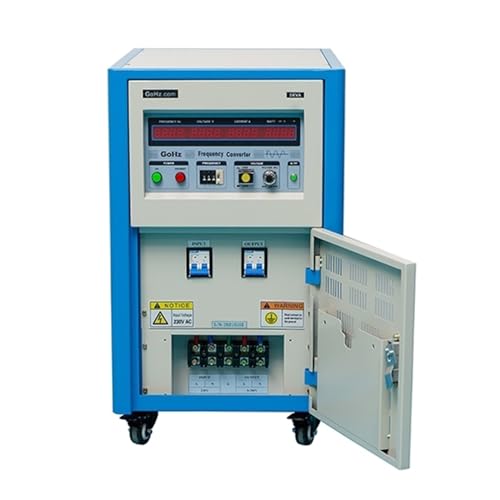
Designed for higher-demand loads, this 5 kVA converter accepts 240V input and can output 120V at 60Hz or 150V- beyond for the 120V setting. It is a pure sine-wave converter with built-in protection against overload, short circuit, over-temperature, and instant power loss. The unit is advantageous for running modest commercial equipment or power tools that require precise 50Hz or 60Hz operation from a different local supply.
Who it’s best for: Small workshops, tools, or equipment that draw noticeable power but do not exceed several kilowatts. Opt for this if you need reliable frequency conversion without external transformers.
Limitations: Ensure your load does not exceed the rated 5 kVA to maintain steady 50/60 Hz output; large inductive loads may demand more margin.
XVKPQUJA 11kW 220V To 380V 3P Drive Inverter

This high-power solution converts 220V single-phase input to a three-phase 380V output with a drive inverter configuration. It targets heavy-duty applications, such as motors and industrial drives, where a robust 11 kW capability supports consistent 50/60 Hz operation across phases. The unit is designed for applications that demand stable frequency and voltage performance in more demanding environments.
Who it’s best for: Industrial customers or facilities needing to power 3-phase equipment from a 1-phase supply while preserving 50/60 Hz operation. This option is chosen when motor drive consistency and higher power are essential.
Limitations: Installation and integration require electrical expertise; verify motor compatibility, enclosure ratings, and cooling requirements for 11 kW operation.
Buying Guide — Key Purchase Considerations
- Load Type and Power Rating: Match the converter’s VA/kW rating to your load. Inductive motors and heaters draw surge currents that can exceed nominal ratings, so pick a converter with a comfortable margin.
- Voltage and Phase Compatibility: Confirm whether you need single-phase or three-phase input/output. Some units are optimized for 120/240V single-phase while others support 380V three-phase outputs.
- Frequency Range: Ensure the converter explicitly supports 50 Hz and 60 Hz and that the desired frequency is selectable or fixed as needed for your devices.
- Protection Features: Look for overload, short-circuit, over-temperature, and instantaneous power loss protections to safeguard both the converter and the connected equipment.
- Output Waveform: For sensitive electronics, a pure sine-wave output is preferred over a modified sine wave to minimize performance issues or device wear.
- Installation Environment: Consider enclosure, cooling, and whether the unit is intended for desktop, cabinet, or industrial mounting. Higher-power models may require professional installation.
- Future Needs: If you anticipate growth or shifting frequency requirements, a bidirectional or higher-capacity converter may reduce future upgrade needs.
Frequently Asked Questions
- What is a frequency converter used for? It changes the frequency of AC power (50 Hz or 60 Hz) to match a device’s operating requirements, often alongside voltage adjustment.
- Can I run 60Hz equipment on 50Hz power? Yes, with a frequency converter designed to output 50Hz from a 60Hz input, keeping within the device’s voltage and power ratings.
- Is pure sine-wave output important? Yes, for sensitive electronics and equipment with motors, a pure sine-wave output minimizes ripple and improves performance and longevity.
- Do converters protect connected devices? Reputable converters include overload, short-circuit, and temperature protections; always follow safety guidelines and load limits.
- Do I need a separate transformer? Some units incorporate a built-in transformer; others rely on external transformers. Check the product specs for your setup.
- What installation considerations are there? Higher-power models may require electrical expertise, proper enclosures, and adequate cooling to prevent overheating.
For buyers seeking flexible and scalable options, the listed products offer a range of capacities and configurations from compact 500 VA units to high-power 11 kW drive inverters. Each selection is geared toward reliable 60Hz to 50Hz conversion with attention to protection, efficiency, and practical use cases in American environments.