Best 355 Watt Solar Panel Solutions for RVs and Off-Grid Homes
If you’re shopping for a 355 watt class solar panel, you’re likely seeking high efficiency, reliable performance, and a setup that scales for RVs, tiny houses, or off-grid cabins. The top options below cover high-efficiency monocrystalline modules, bifacial designs, and N-type cells. They’re suitable for off-grid charging, rooftop arrays, and portable kits. This guide helps you compare which are best for different use cases—from compact RV roofs to larger off-grid systems—and explains the key factors buyers should consider.
Summary table of selected products
| Product | Brand | Key Strengths | Best For |
|---|---|---|---|
| Futuresolar 720W (2×360W) | Futuresolar | High efficiency 19.5%, half-cut mono cells, great shade tolerance | RV, marine, off-grid farms needing compact, high-output modules |
| DOKIO 800W (2×400W) | DOKIO | Outdoor-ready, wide 24V compatibility, fewer connections | Backyard sheds, cabins, grid-tixed installations |
| 860W Bifacial 430W Panels | STAR | Bifacial design, high power density, rugged build | Small spaces needing maximum output |
| Renogy 320W Pair (N-Type, 18BB) | Renogy | High efficiency, durable class, strong off-grid performance | RVs, rooftops, boats |
| HQST N-Type 200W Bifacial | HQST | Compact, lighter, bifacial with up to 30% more output | Vans, campers, limited roof space |
Futuresolar 360W Solar Panel Pair

The Futuresolar 360W panel uses Mono PERC Half-Cut technology, delivering up to 19.5% module efficiency. Half-cut cells improve shading tolerance and overall performance, making this option better for RVs, marine applications, and off-grid systems where roof space is limited. The design supports 12/24V configurations, and the 2×360W setup increases total output without demanding excessive surface area. Best for: compact, high-output installations where space is at a premium.
Limitation: larger arrays require careful wiring and mounting to optimize shade tolerance and series/parallel configurations.
DOKIO 800W (2×400W) Mono Panels

These panels are designed with outdoor readiness in mind, featuring tempered glass and an aluminum frame with sealed junction boxes. They’re compatible with 24V battery banks (AGM/Gel/LiFePO4) via PWM/MPPT and connect to many portable power stations. Fewer connections than eight 100W panels means cleaner arrays and reduced risk of failure. Best for: backyards, cabins, or off-grid setups where durability and straightforward wiring matter.
Limitation: the system relies on proper controller compatibility and may require MC4 adapters for certain setups.
860W Bifacial Panels (2×430W)

STAR’s bifacial 860W system uses dual-glass encapsulation and high-efficiency A+ cells to deliver substantial output in a compact footprint. The bifacial design pulls power from both sides, maximizing daily energy harvest in sunny, reflective conditions. It’s UL61730 certified with a long service life and robust weather tolerance. Best for: limited roof space or installations where every watt matters, such as tiny homes or RV rooftops.
Caution: performance gains from bifacial panels depend on surface reflectivity and installation height, so real-world outputs can vary.
Renogy 320W Dual Panels (18BB, N-Type)

Renogy’s 320W dual panels use N-Type 18BB cells for high efficiency and reduced hot spots. The 6.7% higher power than standard 300W models translates to more usable energy daily, especially in RVs and rooftop setups. The rugged construction and multi-layer encapsulation offer durability in challenging environments. Best for: RVs, boats, and off-grid homes where long-term reliability is essential.
Limitation: the higher efficiency cells can come with a higher upfront cost compared to standard P-Type modules.
HQST 200W Bifacial N-Type Panel
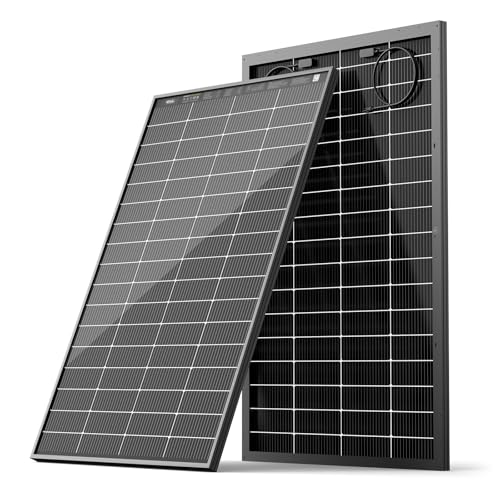
HQST’s compact 200W bifacial panel uses N-Type cells and a lighter, space-saving design. It captures light from both sides, potentially adding up to 30% more energy under favorable conditions. Its 30-year service life and IP65 rating address longevity in RVs, vans, and small off-grid cabins. Best for: tight roof spaces where a single 200W unit can meet most daily needs.
Caution: actual bifacial gains depend on mounting height and surface reflectivity; under modest conditions, gains may be modest.
Buying Guide
Key factors to consider when choosing a 355 watt class solar panel setup
- Cell technology: Mono vs. bifacial, P-Type vs. N-Type. N-Type cells offer higher efficiency and better performance in heat and shade.
- Panel efficiency and footprint: Higher efficiency panels provide more power per square foot, which matters on limited RV or rooftop spaces.
- System voltage compatibility: Ensure panels match your 12V, 24V, or higher battery bank and controller (PWM vs MPPT).
- Durability and mounting: Look for tempered glass, robust frames, and weatherproof seals for outdoor use.
- Shade tolerance: Half-cut cells and parallel wiring can improve output under partial shading.
- Space and layout: If you have limited roof space, consider bifacial or higher-watt packages to maximize output with fewer panels.
- Expansion potential: Think about future additions; some systems are easier to expand with modular panels.
Frequently asked questions
- What is a 355 watt solar panel best used for?
– It’s well-suited for RVs, campers, tiny homes, and off-grid cabins where space is limited but higher output is required. - Are bifacial panels worth it for RV use?
– They can be, when installation height and reflective surfaces support rear-side gains; real-world results vary by site. - Do I need a specific controller with these panels?
– Yes, MPPT controllers generally maximize output with higher-wattage panels; verify compatibility with your battery bank. - What’s the advantage of N-Type cells?
– N-Type cells offer higher efficiency and better performance in hot or shaded conditions, improving long-term energy yield. - Can I mix different brands on the same system?
– It’s possible but not ideal; mismatched voltages and tolerances can reduce overall performance and safety margins. - How do I estimate daily energy from these panels?
– Multiply panel watts by equivalent full-sun hours per day for your location, then account for system losses.