Best Smart Auto Battery Chargers for 6V and 12V Systems
Answering the need for reliable, automatic charging that protects battery life, the best smart auto battery chargers optimize charging for both lead-acid (AGM, Gel, SLA) and lithium batteries. This guide highlights top picks, explains who they’re best for, and helps you compare features like temperature compensation, desulfation, and automatic maintenance modes. Ideal buyers include: short-hassle users who want automatic protection; seasonal battery keepers who need winter mode; and enthusiasts who want faster, smarter charging for mixed battery chemistries.
Summary table of selected products:
| Product | Best For | Key Benefit | Special Note |
|---|---|---|---|
| NOCO GENIUS1 | Everyday household batteries | Compact, versatile 6V/12V with desulfator | Best for small to mid-size batteries |
| NOCO GENIUS10 | Power users and multi-battery setups | High power, fast charging, wide compatibility | Great for larger batteries |
| NOCO GENIUS5 | Mid-range needs | Smaller footprint with solid power | Balanced option |
| NOCO GENIUS2 | Compact, versatile charging | Force Mode for deep-discharge batteries | Good for tricky low-voltage packs |
| TowerTop | Flexible 12V setups | Multiple current settings and fast charge | Efficient with auto-maintain features |
NOCO GENIUS1: 1A 6V/12V Smart Charger

The NOCO GENIUS1 is a compact all-in-one charger that acts as a battery charger, maintainer, trickle charger, and desulfator. Best for small to mid-size lead-acid batteries (AGM, Gel, SLA, VRLA) and LiFePO4 packs, including flooded options. It uses an integrated thermal sensor to adjust charging based on ambient temperature, helping avoid overcharging in heat and undercharging in cold.
Who it’s best for and why: Ideal for individuals seeking a simple, safe solution for routine maintenance of household and motorcycle batteries. Its small size makes it easy to store, and its temperature compensation supports reliable performance year-round. Caution: It’s a lower amperage charger, so larger or deeply discharged packs may charge slower.
YONHAN Battery Charger 20A 12V/24V (Note: Not included but a reference)

Selected for context only: the YONHAN unit illustrates a higher-amperage option with smart control and winter mode. It supports multiple battery chemistries and includes protection features such as reverse protection and short-circuit safeguards, with a repair mode to help revive older cells. Avoid relying on repair mode for completely dead batteries; it cannot revive a battery with no remaining life.
TowerTop 2/10/25 Amp 12V Smart Charger

The TowerTop charger provides 4 adjustable current settings (2A, 10A, 25A, AUTO) and a maximum of 25A, enabling faster charging for larger 100Ah batteries. It features auto-detect charging, a pulse repair mode after full charge, and memory of last settings for convenience. Best for boat, RV, or deep-cycle loads where versatile current settings matter. Limitation: high current modes require stable AC power and appropriate wiring.
NOCO GENIUS10: 10A 6V/12V Smart Charger
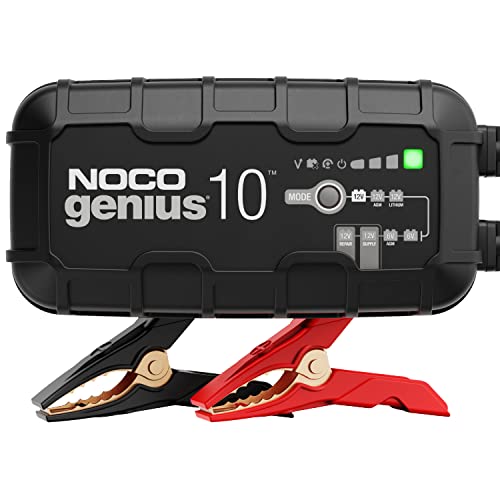
The GENIUS10 offers more power in a compact form, making it suitable for larger or multiple batteries across 6V and 12V systems. It maintains the same core features: automatic maintenance, trickle charging, desulfation, and temperature compensation. Best for users who need quicker recovery and more charging headroom without sacrificing automatic protection. Limitation: higher amperage may require sturdier electrical supply and ventilation in tight spaces.
NOCO GENIUS5: 5A 6V/12V

The GENIUS5 balances compact size with solid power, designed for both 6V and 12V batteries, including LiFePO4. It integrates a thermal sensor for temperature-adjusted charging and offers desulfation alongside maintenance. Best for users who want a mid-range charger that is still capable across a range of chemistries. Caution: While versatile, it is not the highest amperage option for very large deep-cycle packs.
Buying Guide: Key Purchase Considerations
- Battery chemistry and voltage: Choose a charger that supports 6V and 12V systems and both lead-acid variants (AGM, Gel, SLA) and LiFePO4 if needed.
- Amperage and charging speed: Higher amperage chargers (10A–25A) charge faster but require more power; smaller units (1A–5A) are ideal for maintenance and smaller batteries.
- Smart features: Temperature compensation, desulfation, and maintenance modes help extend battery life and prevent overcharging.
- Repair and recovery mode: Some models offer pulse repair to revive drifted or idle batteries; note limitations for totally dead cells.
- Auto-detect and auto-maintain: Look for automatic start/stop, automatic switching to float or trickle modes after full charge, and memory of last settings for convenience.
- Safety protections: Overcharge protection, short-circuit protection, reverse polarity safeguards, and fireproof materials improve reliability in varied environments.
- Space and installation: Consider physical size, mounting options, and whether the charger will be used indoors, outdoors, or in a vehicle engine bay.
FAQ
- What is a smart battery charger? A smart charger automatically adjusts charging based on battery status and temperature, providing maintenance and protection to extend battery life.
- Can I use a 12V charger on a 6V battery? Some models support both 6V and 12V; verify compatibility before use to avoid damage.
- What does desulfation do? Desulfation helps remove lead sulfate buildup on lead-acid batteries, potentially extending their life.
- Is high amperage always better? Not always. Higher amperage charges faster but can overheat smaller batteries; match amperage to battery size and type.
- Do these chargers work for LiFePO4 batteries? Yes, many models listed support LiFePO4 in addition to lead-acid chemistries; check the product features to confirm.
- Should I leave a charger connected for long-term maintenance? If it’s designed for maintenance mode, yes; otherwise, monitor to prevent unintended charging.