Best Oscillating Wall-Mounted Fans for Outdoor and Workshop Use
Answering buyers seeking reliable, oscillating air movement from wall-mounted units for patios, garages, workshops, or greenhouses. This guide highlights five strong options, who they suit best, and practical buying tips. If you need broad air coverage with adjustable speeds, these models offer 90-degree oscillation, durable construction, and remote or wired controls to fit various spaces and budgets. The selection prioritizes models with weatherproof or heavy-duty builds for outdoor or industrial environments.
Overview of chosen products:
| Product | CFM | Key Features | Best For |
|---|---|---|---|
| iLiving 20″ Outdoor Oscillating Wall Fan | Up to 4750 | Weather-sealed motor, 90° oscillation, pull-chain speed control | Large patios, workshops requiring high airflow |
| VEVOR 18″ Wall Mount Fan Oscillating | Up to 4000 | ETL listed, 90° oscillation, sturdy metal housing | Industrial spaces, warehouses, greenhouses |
| BILT HARD 20″ Wall Mounted Outdoor Fan | Up to 4750 | Three-speed, wired remote, durable all-metal construction | Garage, workshop, outdoor patios |
| CAMMOO 20″ Wall Mount Fan Oscillating | Three speeds | Remote control, dust cover, extended cords | Garage, gym, shop with flexible setup |
| iLiving 18″ Outdoor Oscillating Wall Fan | Up to 4150 | Weather-sealed motor, 90° oscillation, rust-resistant | Smaller patios or compact workshops |
iLiving 20-Inch Outdoor Oscillating Wall Fan

Best for: larger outdoor spaces and workshops that require high airflow. The 20-inch blade diameter delivers strong gusts, with a UL-certified oscillator motor and a 90-degree swing for broad coverage. The weather-sealed construction offers rust resistance in varying climates. The pull-chain speed control lets you switch between high, medium, and low to adapt airflow to changing conditions. Limitation: heavy-duty build may be bulkier to install in low-clearance areas.
VEVOR 18-Inch Wall Mount Oscillating Fan
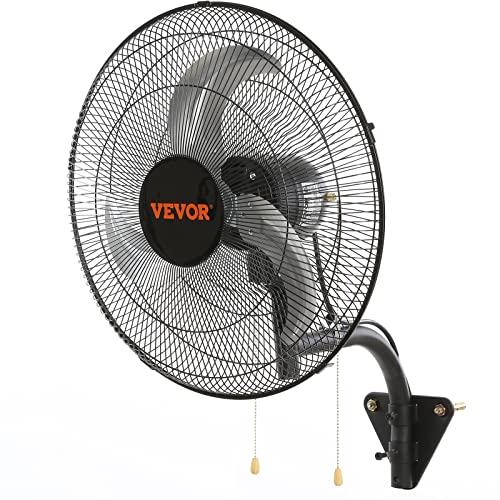
Best for: indoor or semi-outdoor spaces like workshops and warehouses that need reliable airflow with lower noise. This model offers three speeds up to 4000 CFM, a 90-degree oscillation, and a fully sealed metal motor housing for durability. It includes a 6-foot power cord for flexible placement. Caution: keep the cord and remote/adjustment area clear to avoid snagging during operation.
BILT HARD 20-Inch Wall Mounted Outdoor Fan

Best for: heavy-duty outdoor or workshop use where high airflow and simple control are priorities. Features three speeds (up to 5900 CFM) and a wired remote for convenient operation. Its all-metal construction and powder-coated housing resist rust and dust. The 90° oscillation and 65° tilt help cover large areas. Limitation: heavier remote and power cord lengths may require planning for placement.
CAMMOO 20-Inch Wall Mount Oscillating Fan

Best for: spaces needing remote control and dust protection. This CAMMOO model includes a 600D Oxford dust cover and a long 3.3-foot wired remote plus a 6.6-foot power cord. The remote enables quick speed changes without reaching for a cord, while the cover extends the fan’s life by keeping debris out. Choose this if you want easier maintenance and flexibility in placement. Limitation: 20-inch fan with remote may have a higher price point than basic pull-cord models.
iLiving 18-Inch Outdoor Oscillating Wall Fan
Best for: compact spaces where strong airflow is still needed. The 18-inch blade size and 90-degree oscillation provide effective cooling for small patios or garages. The weather-sealed construction ensures rust resistance for outdoor use, and the pull-chain speed control lets you select from multiple airflow levels. Limitation: lower maximum CFM compared to 20-inch models, which may affect coverage in larger spaces.
Buying Guide: Key Considerations For Oscillating Wall-Mounted Fans
- Airflow capacity (CFM): Higher CFM moves more air; ideal for large spaces. Match CFM to square footage and ceiling height.
- Oscillation angle and tilt: A 90-degree swing typically covers more area; tilt helps direct airflow where needed.
- Construction and weather resistance: Outdoor or workshop use benefits from weather seals, rust resistance, and durable housings.
- Controls: Pull-chain, wired remote, or wireless remote options affect convenience in busy spaces.
- Power and installation: Check voltage (120V common in U.S.), cord length, and mounting compatibility with walls or studs.
- Noise: Look for motors designed for quieter operation if the space is near offices or living areas.
- Maintenance: Dust covers, corrosion protection, and easy blade access reduce long-term upkeep.
Frequently Asked Questions
- What distinguishes a wall-mounted fan from a ceiling fan for outdoor spaces?
Wall-mounted fans offer flexible placement, easier installation, and are often built for higher static pressure and outdoor resilience, while ceiling fans require ceiling mounting and broader coverage patterns. - Can these fans be used indoors?
Yes, most models are suitable for indoor use in garages, workshops, or basements, provided they have appropriate protection and clearance. - Do wall-mounted fans require professional installation?
In many cases no, unless wiring or mounting to structural beams is needed. Always follow vendor instructions and local codes. - What is the advantage of a remote control on a wall fan?
Remote controls offer convenient adjustments without reaching the fan, especially in tight or high-placed installations. - Are outdoor-rated fans necessary for patios?
Outdoor-rated fans with weather seals and rust resistance provide durability against humidity, rain exposure, and temperature swings. - What should I consider when choosing between 18-inch and 20-inch models?
Larger blades move more air (higher CFM) and cover larger spaces, but they require more mounting space and may cost more.