Best Power Meter Fiber Optic Tools for Precise Signal Testing
If you’re shopping for a power meter fiber optic tool, your best options balance accuracy, ease of use, and compatibility with different connector types. This guide helps buyers choose devices that cover common needs—from field technicians requiring multi-function meters to network engineers needing reliable measurement across multiple wavelengths. The top picks below are suited for professionals who test live fiber deployments, diagnose signal loss, or locate faults with built-in VFL functions. A quick summary table follows to compare core specs at a glance.
| Product | Best For | Key Wavelength Range | Typical Use |
|---|---|---|---|
| OFCN Mini 4 in 1 | Field technicians | 800–1700 nm | OPM, VFL, RJ45 testing |
| D YEDEMC Optical Tester | All-in-one jobs | 850–1650 nm | OPM, VFL, RJ45 |
| QWORK Optical Power Meter | General purpose labs | 850–1625–1650 nm | OPM with multiple wavelengths |
| Jonard FPM-50A | Portable field kits | −50 to +26 dBm | Adapter flexibility, carry case |
| Karvinger KPMOY9 | Integrated testing | 800–1700 nm | 4-in-1: OPM, VFL, RJ45 |
OFCN Mini 4 In 1 Portable Optical Power Meter With VFL

- Reference features: OPM covers 800–1700 nm with InGaAs detector; power range -70 dBm to +6 dBm; VFL at 650 nm; two AA batteries power; connectors SC/FC/ST (LC with adapter).
- Best for: Field technicians who need a compact tool with both optical power measurement and visual fault locating in one device.
- Why chosen: Combines essential metering with a visible fault locator, reducing tool count on-site.
- Caution: Requires correct connector adaptation (SC to LC) for some setups; verify compatibility before use.
D YEDEMC Fiber Optic Cable Tester Portable OPM-VFL-1

- Reference features: Measures 8 standard wavelengths (850/980/1300/1310/1490/1550/1625/1650 nm); test range -70 dBm to +6 dBm; integrates OPM, VFL, and RJ45 testing; supports memory and user calibration.
- Best for: Technicians needing a robust all-in-one meter with RJ45 diagnostics for hybrid fiber/copper networks.
- Why chosen: Broad wavelength support and memory features aid repeatable measurements in varying field conditions.
- Caution: Interface compatibility varies; ensure FC/SC/ST adapters fit your cables.
QWORK Optical Power Meter With 2.5 mm Interface

- Reference features: Linear and logarithmic displays; seven calibration wavelengths including 850, 1300, 1310, 1490, 1550, 1625 nm; universal 2.5 mm interface for FC/SC/ST.
- Best for: Professionals who need straightforward, multi-wavelength power measurements with a common connector standard.
- Why chosen: Simplicity and compatibility with common fiber connectors make it a reliable workhorse tool.
- Caution: Limited details on detector type; confirm detector sensitivity for your precise needs.
Jonard Tools FPM-50A High Precision Meter

- Reference features: Power meter range −50 to +26 dBm; FC/SC/LC adapters; includes carry case and batteries; auto-off and backlit LCD for low-light use.
- Best for: Portable field kits needing durable packaging and multiple adapter options.
- Why chosen: Portable size with a tested accessory set supports quick deployments in the field.
- Caution: Lower end range may be limiting for high-power tests; verify expected dBm levels in your environment.
Karvinger Optical Power Meter KPMOY9

- Reference features: 4-in-1 tool with OPM, VFL, RJ45 tester, and LED inspection light; 800–1700 nm range; supports 0.01 dB resolution; USB charging and portability emphasized.
- Best for: Techs needing an all-in-one device with field-ready durability and multiple testing modes.
- Why chosen: All-in-one design reduces tool clutter and speeds on-site fault finding.
- Caution: Feature claims rely on compact internal design; verify battery life for long field sessions.
BoltBlaze Portable 5-in-1 Fiber Tester

- Reference features: Combines OPM, VFL, RJ45 tester, Cable Finder, and LED flashlight; supports 10 wavelengths from 850 to 1650 nm; -70 dBm to +10 dBm range; FC/SC/ST with LC adapter compatibility.
- Best for: Technicians who need a single, comprehensive device for fiber fault locating and network testing.
- Why chosen: High versatility and a broad wavelength scope make it suitable for diverse fiber networks.
- Caution: Some users may prefer a dedicated VFL if only locating faults is required; multi-function devices can be heavier.
YGGYM Optical Power Meter With VFL
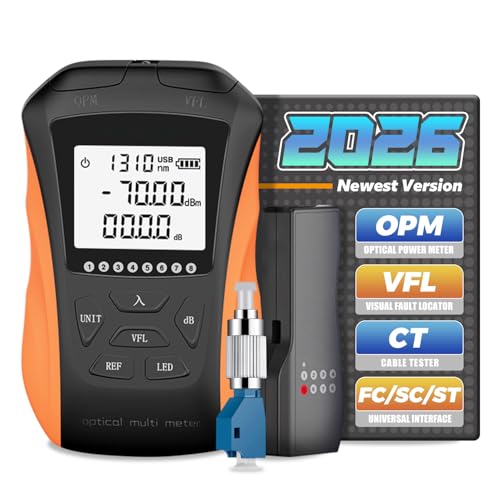
- Reference features: 4-in-1 multi-function includes OPM, VFL, and cable tester; supports multiple wavelengths including 850–1625 nm; USB charging and Li-ion power.
- Best for: Professionals needing integrated testing with visual fault locating and cable verification in one device.
- Why chosen: Combines essential metering with a built-in fault locator for efficient field work.
- Caution: Battery reliability is important for extended field use; plan for charging options during long jobs.
Groword 5-in-1 Fiber Optic Tester

- Reference features: 5-in-1 includes 2.5 mm universal interface, test wavelengths, data saving, backlight, auto shut-off, and power options; tested ranges from −70 dBm to +6 dBm.
- Best for: Buyers needing a compact all-in-one tool with data storage for field testing and later analysis.
- Why chosen: Data saving supports reporting and traceability of measurements on projects.
- Caution: Some statements emphasize features rather than long-term reliability; verify service expectations in your region.
Buying Guide: Choosing The Right Power Meter Fiber Optic Tool
What should you consider when selecting a power meter? Start with wavelength coverage: most professional meters measure 850–1650 nm, but specific installations may require up to 1700 nm or more. Detector type (InGaAs is common) affects sensitivity and dynamic range. Look at display options (linear mW vs. dBm) and whether the device offers both absolute and relative power with a reference function. If you work with copper and fiber networks, an integrated RJ45 tester can save time. Finally, assess portability, battery life, and whether a VFL is included for locating faults in the same tool.
Connector compatibility matters: ensure the device supports FC, SC, ST, and LC adapters or includes the appropriate adaptors. If your work involves live networks, verify the unit supports a wide dynamic range and provides a backlit LCD for dim environments. For on-site reporting, choose meters with data storage or memory function to capture multiple readings. If you need long battery life in the field, consider devices that run on standard AA or USB-rechargeable Li-ion batteries.
Usage scenarios:
- Field installation: prefer compact 4-in-1 or 5-in-1 meters with VFL to quickly locate faults.
- Laboratories and maintenance: look for higher sensitivity, wider wavelength coverage, and easy export of test data.
- Hybrid networks: RJ45 testing capabilities help diagnose copper/fiber segments without extra tools.
Frequently Asked Questions
- What is the main purpose of a fiber optic power meter?
To measure optical signal power at various wavelengths, helping verify link integrity and troubleshoot loss. - Do I need a VFL if I already have a power meter?
Not always, but a VFL helps locate breaks or bending faults in fiber quickly during installation or repair. - Which wavelength range is most common for testing?
Most meters cover 850–1650 nm; this range supports typical SMF/UPC applications. - What connector types should I expect to support?
Common interfaces include FC, SC, ST, and LC; adapters may be required for certain setups. - Is data storage important for field work?
Yes, it enables reporting and traceability of measurements across multiple sites or jobs. - Should I buy a dedicated meter or a 4-in-1/5-in-1 tool?
4-in-1/5-in-1 tools save space and speed up troubleshooting, but ensure the device meets your wavelength and accuracy needs.