Best Quality Carbon Monoxide Alarms for Safer Homes and Travel
When choosing a carbon monoxide alarm, prioritize devices that clearly indicate CO levels, offer reliable alerts, and provide practical placement guidance for homes, apartments, or on the go. This guide highlights five top options from Kidde, tailored for different needs—homeowners, travelers, and those who want extra indoor air quality insights. Read on to identify which model fits your living situation and safety priorities, and compare features side by side.
Buyer profiles at a glance:
- Best for Smart Home Integrators: CO alarms with real-time notifications and indoor air quality monitoring.
- Best for Travel or Occasional Use: Portable, battery-powered alarms that work during outages.
- Best for Quick Local Readouts: Plug-in with a backlit display for at-a-glance CO levels.
- Best for Alexa-Enabled Homes: Voice and app alerts with smart integrations.
- Best for Outage Resilience: Plug-in with battery backup and digital display.
Product Comparison Snapshot
| Product | Key Benefit | Best For |
|---|---|---|
| Kidde Smart Carbon Monoxide Detector & Indoor Air Quality Monitor (COPDLQW) | Real-time notifications, IAQ insights, humidity and TVOC monitoring | Smart homes with IAQ awareness |
| Kidde Carbon Monoxide Detector, AA Battery Powered (Portable) | Battery-powered portability, no wiring | Travel or temporary setups |
| Kidde Carbon Monoxide Detector with Digital Display (COPD) | Backlit CO levels, rotating plug, easy testing | Clear local readouts at a glance |
| Kidde Smart CO Detector with IAQ Monitor, Alexa Compatible | 2-in-1 CO and IAQ alerts, voice alerts | Smart homes with voice control |
| Kidde CO Detector with Digital Display and Battery Backup | Digital readouts, backup power | Reliability during outages |
Kidde Smart Carbon Monoxide Detector & Indoor Air Quality Monitor

Best for tech-forward homes that want proactive safety. This model streams real-time CO alerts and tracks indoor air quality, humidity, and TVOC levels via 2.4 GHz Wi-Fi. It supports app-based notifications without a subscription and offers a rotating plug for flexible placement. The device uses an 85 dB alarm for CO detection and provides weekly IAQ trends with optional advanced insights. It’s ideal for households with children, seniors, or pets who benefit from ongoing air quality monitoring.
Who it’s best for: Homeowners seeking integrated CO monitoring and IAQ data in one device. Why selected: Combines early CO detection with indoor air quality insights for proactive safety. Caution: Advanced IAQ features require optional subscription for extended insights.
Kidde Carbon Monoxide Detector, AA Battery Powered
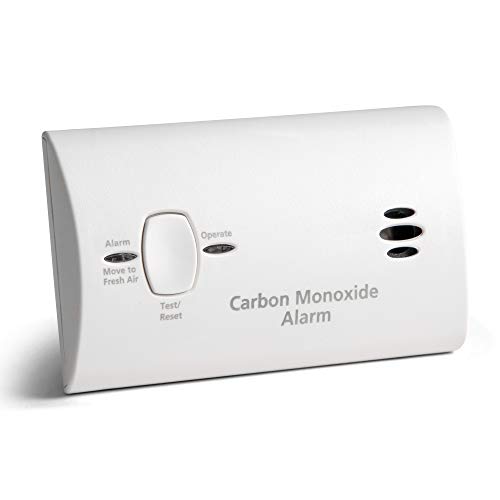
Best for travel or temporary home setups where wiring is not available. This compact unit runs on 2 AA batteries and still provides an 85 dB alarm when CO is detected. It features simple wall mounting or tabletop placement and a green power indicator along with a red alert indicator for easy status checks. Choose this if you need a portable CO alarm you can move between rooms or locations.
Who it’s best for: Travelers or renters needing portable CO protection. Why selected: Battery operation ensures detection during outages, and compact design eases transport. Caution: Battery-dependent devices require periodic replacement and testing to remain reliable.
Kidde Carbon Monoxide Detector, Plug-in with Battery Backup

Best for households that want seamless power and backup power during outages. This plug-in CO detector includes a 120V AC supply with 2 AA backup batteries and a rotating plug to fit vertical or horizontal outlets. A backlit display shows CO levels for quick monitoring, while an 85 dB alarm sounds at detection. This model also includes power surge immunity for stable performance. Choose this if you value constant coverage during blackouts and prefer a clear CO readout.
Who it’s best for: Homes needing continuous protection with battery backup during outages. Why selected: Combines plug-in convenience with reliable backup power and a visible CO level display. Caution: Battery replacement is required to maintain outage protection.
Kidde Carbon Monoxide + Explosive Gas Alarm with Digital Display
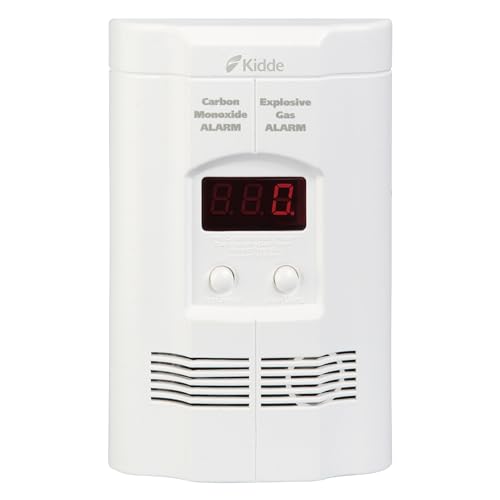
Best for detection versatility in one device. This plug-in alarm provides 9-volt battery backup and a digital display showing the CO level, or “GAS” when explosive gas is present. It features an 85 dB alarm and LED indicators for quick status checks. It’s suitable for homes where a single unit addresses both CO and potential gas hazards, simplifying safety management. Caution: If you’re specifically monitoring only CO, a dedicated CO model may be more straightforward for some users.
Kidde Smart CO Detector & Indoor Air Quality Monitor (Alexa Compatible)

Best for homes already using voice assistants. This model offers 2-in-1 detection for CO and IAQ in a single device, with voice alerts that state the hazard type and status. It supports easy installation through the Kidde app and QR code activation. Best for households seeking hands-free alerts and integration with Alexa-enabled setups. Caution: Advanced IAQ features may require app setup and consistent Wi-Fi connectivity to deliver timely notifications.
Buying Guide: How To Choose The Right Quality CO Alarm
- What type of power is best for you? Consider plug-in models with battery backup for outage resilience, or battery-powered portable options for travel or rentals.
- Do you want indoor air quality (IAQ) monitoring? If yes, choose a 2-in-1 CO+IAQ device with real-time analytics and optional app insights.
- Is smart home integration important? Look for devices that provide app alerts, voice announcements, and compatibility with ecosystems you use (Alexa, Google Home, etc.).
- How clear should CO readings be? For quick verification, prefer a backlit digital display showing current CO levels along with status indicators.
- What about the alarm sound and patterns? A loud, distinct 85 dB alarm with separate signaling at dangerous CO thresholds improves safety clarity for all occupants.
- Placement and coverage: Install units near sleeping areas and in main living spaces, following the manufacturer’s recommendations for optimal coverage.
FAQ
- What does IAQ stand for? Indoor Air Quality, including readings like humidity and TVOC along with CO.
- Can I use a CO alarm with my smart home? Yes, several models offer app-based alerts and voice notifications when CO is detected.
- Do CO alarms require subscriptions? Some IAQ features may offer optional subscriptions for extended insights, but alerts and core CO detection do not require them.
- How often should I test a CO alarm? Test the device monthly to ensure the alarm, display, and indicators function properly.
- Is a digital display necessary? A display helps you quickly read current CO levels, but many models also alert audibly without reading the exact ppm level.
- What if the alarm goes off? Leave the area immediately and call emergency services if you suspect dangerous CO levels; do not ignore the alarm.