Best 12V Folding Solar Panels for RVs, Campers, and Backup Power
Answering the common buyer question “Which 12V folding solar panel should I pick?” this guide compares five compact options that balance portability, setup ease, and real-world output. These panels are best for travelers, off-grid campers, and emergency preparedness kits. Each option includes a separate controller, USB ports, and a long cable for safe shade placement. The right choice depends on space, weight, and how quickly you need power on the road.
| Product | Best For | Key Benefit |
|---|---|---|
| DOKIO 100W Portable Foldable Solar Panel Kit | Lightweight RVs and micro-camps | Separate controller; long 9.84 ft cable |
| DOKIO 150W Portable Foldable Solar Panel Kit | Solo travelers needing more power | Compact design; safer shaded setup |
| Renogy 200W Portable Solar Panel IP65 | Off-grid shade-friendly setups | Industry-leading efficiency; 9-fold design |
| DOKIO 200W Portable Foldable Solar Panel Kit | Medium-sized RVs and boats | Long cable; safe charging with PWM controller |
| Renogy 200W Solar Panel Blanket | Small spaces and flexible mounting | 8-fold, backpack-size; 25% efficiency |
DOKIO 100W Portable Foldable Solar Panel Kit

The 100W kit weighs 6 lb when folded and measures 19×26 inches with a slim 0.5-inch profile. It includes a separate PWM controller to protect a 12V system from reverse polarity, overcharge, overload, and short-circuit. This configuration is best for light travel gear, casual camping, and emergency backups where space is at a premium. The long 9.84-foot cable supports installing the panel in full sun while keeping the controller shaded.
Best for: Solo travelers, small campers, and emergency backups where portability matters more than maximum wattage. Caution: The 100W rating may limit charging speed for high-demand devices or larger power stations in low-light conditions.
DOKIO 150W Portable Foldable Solar Panel Kit

This 150W kit reduces weight to a manageable level while expanding output. It folds to about 19.3×20.9×1.1 inches and weighs 7.3 lb. Like the 100W model, it uses a standalone PWM controller and a 9.8-foot cable for flexible siting. The improved wattage makes it a better fit for mid-size rigs, small trailers, or extended off-grid stays when more energy is needed without stepping up to a larger panel.
Best for: Campers who need more power without a big upgrade in size. Caution: Performance depends on sun exposure; multi-device charging may require planning around peak sun hours.
Renogy 200W Portable Solar Panel IP65

Renogy’s 200W option emphasizes high efficiency with 16BB N-Type cells, achieving up to 25% efficiency. It folds compactly to a backpack-like size and weighs 13.89 lb, the lightest in its class for a 200W panel. The magnetic closure design simplifies on-vehicle storage and setup. It offers MC4 output for charging power stations or 12V batteries and supports multiple devices via USB-C PD and USB-A ports. This is ideal for tight spaces where maximizing output per footprint is critical.
Best for: RVs, SUVs, and campers needing reliable high-output performance in limited space. Caution: At 13.89 lb, it’s heavier than smaller panels and may require more careful mounting in windy locations.
DOKIO 200W Portable Foldable Solar Panel Kit

The 200W kit balances portability and power with a 9.7 lb frame and a compact fold to 20x27x1.1 inches. It includes a standalone PWM controller to safeguard the 12V system against reverse polarity, overcharge, overload, and short circuits. A 9.84-foot cable enables sitting the panel in sun while keeping the controller shaded, improving safety and setup versatility. This option suits mid-sized RVs, boats, or mobile workspaces that require steady power delivery.
Best for: Medium-sized RVs and trailers needing solid wattage without stepping up to a larger, harder-to-mount panel. Caution: Larger footprint may require more mounting space on some vehicles.
Renogy 200W Solar Panel Blanket
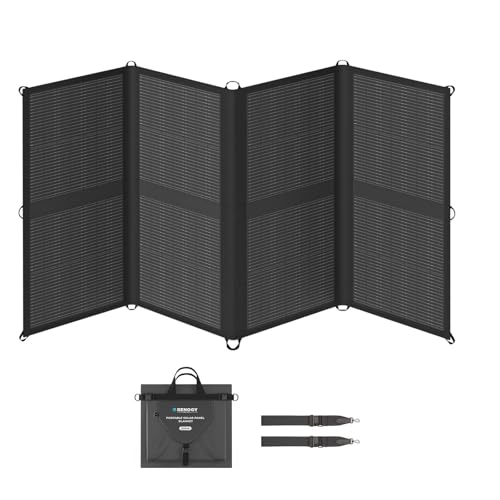
The Renogy 200W Blanket uses an ultra-lightweight 8-fold design that packs to a compact size, weighing 8.82 lb. It offers multiple installation methods for flexibility in SUVs, pickup campers, and marine settings. Efficiency remains among the best in its class at 25%, with power delivery to USB-C PD, USB-A ports, and MC4 outputs for power stations or 12V systems. It’s particularly useful when space is severely limited or you need a quick setup in tight quarters.
Best for: Vehicle ambients with tight spaces or quick-deploy camping setups. Caution: The eight-fold design can take a moment longer to deploy compared with simpler panels.
Buying Guide
Key considerations when choosing a 12V folding solar panel kit include power needs, space, and setup convenience. Use these practical questions to guide your selection.
- What is my typical daily power consumption, and which devices will I charge (phones, tablets, power stations, lights)?
- How much space do I have for storage and mounting, both when folded and deployed?
- Do I prefer a lighter panel for quick setup, or a higher wattage panel for faster charging in limited sun?
- Is a separate PWM controller acceptable, or do you need additional safety features like reverse polarity protection and short-circuit safeguards?
- How important are connector options (MC4, USB-C PD, USB-A) for your devices?
- Will this panel be used in varying weather, and is IP65 or other weatherproofing a priority?
FAQs
- Q: Do these panels require a separate controller? A: Most listed models include a standalone PWM controller to protect 12V systems.
- Q: Can I charge multiple devices at once? A: Yes, many models provide USB-C PD and USB-A outputs in addition to MC4 connectors.
- Q: Are folding panels suitable for cold climates? A: They are generally versatile, but extreme cold can affect battery efficiency and wiring flexibility.
- Q: Which wattage should I choose for a typical RV setup? A: A 150–200W panel often balances space, weight, and charging speed for mid-size rigs.
- Q: What maintenance is required? A: Keep panels clean, check wiring connections, and inspect seals after exposure to moisture.