Best Automatic Transformer Testing Equipment for Efficient Winding and Dielectric Verification
Choosing the right automatic transformer testing equipment helps engineers quickly verify winding integrity, insulation strength, and turns ratio across various transformer types. The top picks below are suited for professionals who need reliable, automated tests with clear results and minimal manual intervention. If you’re evaluating for routine maintenance, field testing, or lab-grade analysis, these options cover a range of voltage ratings, data collection capabilities, and user interfaces. The table below summarizes five strong contenders.
| Product | Brand | Best For | Key Feature |
|---|---|---|---|
| U9845 4-Channel Impulse Winding Tester | M&A INSTRUMENTS | Four-channel impulse winding tests | Multiple waveform comparison methods and 32-bit CPU |
| Yokoma 80kV Transformer Oil Dielectric Tester | Yokoma | Oil dielectric strength testing | Automatic operation with real-time printing |
| BHYIQI Digital DC Winding Resistance Meter | BHYIQI | DC winding resistance measurements | High automation and wide measurement range |
| ETCR ETCR3670B DC Resistance Tester | ETCR | Transformer winding resistance and insulation context | Built-in battery, two measurement modes |
| U9813 Single Channel Impulse Winding Tester | M&A INSTRUMENTS | Single-channel impulse testing | High-speed testing and 7″ display |
U9845 Four-Channel Impulse Winding Tester

The U9845 Impulse Winding Tester delivers four high-voltage channels with pulse voltages from 100V to 5000V in 10V steps, enabling precise comparison across windings. Its four waveform comparison methods—area, differential area, corona, and differential phase—support robust fault detection in transformer windings. The device uses a 32-bit CPU and a memory depth of 6500 bytes for reliable data processing, with a 65k color 7-inch high-definition display offering English and Chinese interfaces. This model is best for laboratories or field teams performing multi-channel winding diagnostics.
Who it’s best for: engineers needing multi-channel impulse tests with clear waveform analysis and bilingual UI. Why selected: high stability and precision in high-voltage tests, plus versatile waveform options. Limitation: the unit’s complexity may require training for optimal use.
Yokoma 80kV Transformer Oil Dielectric Tester

This tester automates the oil dielectric strength process, including oil cup stirring, rest, and voltage control, with a built-in printer for real-time results. It features a large LCD display for straightforward digital operation and a temperature/humidity sensor to improve measurement accuracy in varying environments. The device is designed for oil-immersed transformers and insulation oil testing scenarios, providing a practical, end-to-end solution for dielectric breakdown verification.
Who it’s best for: technicians conducting dielectric strength tests in oil-filled transformers. Why selected: automatic operation and on-site printing streamline test workflows. Limitation: focus on oil dielectric testing may limit applicability for non-oil insulation systems.
BHYIQI Digital DC Winding Resistance Meter
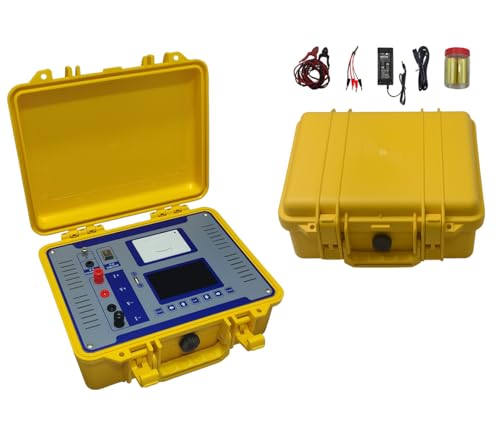
The BHYIQI model focuses on DC winding resistance with an automated data refresh, offering 10A, 5A, 1A, 300mA, and 100mA ranges with a 0.1 μΩ resolution. It is controlled by a fast microcontroller to support convenient operation and broad measurement coverage. Built-in protection helps guard against back-EMF effects, contributing to reliable measurements in automotive, power, or lab settings.
Who it’s best for: technicians needing precise low-resistance DC measurements across multiple current ranges. Why selected: automated data refresh and wide range coverage improve efficiency. Limitation: data presentation may require alignment with other test formats for cross-compatibility.
ETCR ETCR3670B DC Resistance Tester

ETCR’s 3670B model measures transformer winding DC resistance and conductor resistance, powered by a built-in rechargeable battery for field work. It provides two measurement modes: automatic and manual. The compact design and battery operation are well-suited for on-site testing where access to mains power is limited. This unit is a practical choice for maintenance crews and field service engineers needing quick resistance readings with portable operation.
Who it’s best for: field technicians needing a portable DC resistance tester with flexible measurement modes. Why selected: battery-powered operation and dual test modes improve adaptability. Limitation: battery life and function rely on proper calibration and may require periodic maintenance checks.
ALLANSON Transformer/Ignitor Tester

The Allanson tester is designed to verify two-pole electronic igniters and iron-core transformers. It is a simple, purpose-built device with clear LED indicators, and is listed as a cost-effective option for basic transformer ignition and igniter checks. While straightforward, it offers essential diagnostic capability for quick field assessments.
Who it’s best for: maintenance teams needing a quick, low-cost tester for ignition and transformer components. Why selected: simplicity and targeted use for common residential or commercial equipment. Limitation: does not provide broader winding or insulation test capabilities found in more advanced equipment.
Buying Guide
What to consider when selecting automatic transformer testing equipment:
- Test scope: Do you need winding impulse tests, DC resistance, or insulation/ dielectric testing? Choose devices that cover your primary needs, with an option to expand later.
- Voltage range: Ensure the unit supports the voltage levels used in your applications. High-voltage impulse testers are essential for modern transformers, while DC resistance meters are useful for windings.
- Automation level: Look for automatic operation, data logging, and real-time printouts if you require efficient batch testing and documentation.
- Display and interface: A clear color display and bilingual or multilingual UI can reduce interpretation errors in the field or lab.
- Portability vs. bench-top: Battery-powered devices suit fieldwork; powered bench-top models suit controlled environments with extended sessions.
- Data handling: Check whether the device exports data in standard formats and how it integrates with your reporting workflows.
- Safety features: Over-voltage protection, back-EMF protection, and robust housing are important for high-voltage testing scenarios.
Frequently Asked Questions
- What is impulse winding testing used for?
It verifies insulation integrity and winding integrity by applying a high-voltage pulse and analyzing response signals. - Why choose a multi-channel tester?
It enables simultaneous testing of several windings, improving throughput and consistency across units. - What is dielectric oil testing?
It assesses the strength of insulation oil to withstand electrical stress, often used for oil-filled transformers. - Can DC resistance testing indicate winding faults?
Yes, abnormal resistance can suggest winding damage, loose connections, or winding degradation. - Are built-in printers necessary?
They streamline documentation for field audits and maintenance records, but are not strictly required. - How important is data export compatibility?
It facilitates integration with maintenance-management systems and standard reporting formats.