Best Portable Power Meter Data Loggers for Real-Time Electrical Monitoring
If you need accurate, portable data logging for electrical systems, these power meter data loggers deliver real-time voltage, current, and power insights. They’re ideal for contractors, facility managers, and DIYers who want to monitor compressors, motors, panels, and three-phase systems on site. The top picks below cover single- and multi-channel logging, data export, and long-term recording to support maintenance and energy management goals.
| Product | Best For | Key Strength |
|---|---|---|
| Supco LCV LOGiT Current and Voltage Tester | Single-phase electrical monitoring | High-capacity data logging up to 10,750 points |
| Triplett ACDL200 Dual Input True RMS Datalogger | Dual-channel voltage/current logging | Wide recording range with selectable sampling |
| 2 Pieces AC Current Voltage Amperage Power Energy Panel Meter | Panel-level monitoring for energy management | Split-core CT, multi-parameter display |
| BQHHWTZ Mi550 Three-Phase Power Quality Analyzer | Three-phase power quality analysis | High-range measurements with three-phase capabilities |
| Apera TN500 Portable Turbidity Meter with Data Logger | Integrated data logging for water/process turbidity contexts | EPA-compliant testing with automated reads |
Supco LCV LOGiT Current And Voltage Tester

The Supco LCV LOGiT is a real-time current and voltage data logger combined with a clamp probe. It is best for monitoring single-phase electrical circuits, such as compressor and fan run cycles, in a compact handheld form. The device measures voltage from 0 to 500 volts AC and stores up to 10,750 data points for later review, making it suitable for long-term tracking and detailed analysis of electrical performance. It’s especially useful for electricians and facility technicians who need a portable meter with built-in data storage.
Best for: contractors and facility technicians needing immediate single-phase monitoring with substantial data storage. Better for long-run data capture compared to simple handheld meters. Choose this if you require a single-channel, high-capacity logger with direct voltage insights.
Caution: Data management relies on the device’s internal memory; if memory fills, you may need to offload data promptly to avoid gaps in longer projects.
Triplett ACDL200 Dual Input True RMS Datalogger

The Triplett ACDL200 supports dual input logging, capturing True RMS voltage and current across two channels. It offers flexible sampling from 1 second to 24 hours, enabling both short-term surge analysis and longer energy surveys. With high-capacity storage (up to hundreds of thousands of measurements depending on mode), this datalogger is well-suited for monitoring how two circuits interact — such as a feeder and a downstream load — or for comparing two phases in a simple three-phase setup when a second channel is used for a reference. It’s a practical pick for electricians and engineers evaluating multi-channel behavior.
Best for: users who need simultaneous dual-channel monitoring and flexible sampling rates. Better for comparing two circuits or two phases in a compact, portable form. Choose this if you require dual-channel logging with True RMS accuracy.
Caution: For best results, ensure the sampling rate aligns with the events you want to capture; very slow rates can miss short transients.
2 Pieces AC Current Voltage Amperage Power Energy Panel Meter

This two-pack panel meter set measures voltage, current, active power, energy, frequency, and power factor at once, using a split-core current transformer (CT) for easy installation. It’s ideal for panel-mounted energy monitoring and power management across three-phase or single-phase systems. The device supports automatic data storage after data collection and offers alarm features to notify when limits are exceeded. It’s best for ongoing energy audits or home improvement projects where visible panel-level data is beneficial.
Best for: users installing or upgrading panel-level monitoring. Better for quick, multi-parameter readings in a compact form. Choose this if you want a cost-effective, two-unit solution for energy awareness and alerts.
Caution: Installation requires proper CT placement and wiring according to the product’s instructions to ensure accurate readings.
BQHHWTZ Mi550 Three-Phase Power Quality Analyzer

The Mi550 from BQHHWTZ is a three-phase power quality analyzer designed to capture detailed power metrics across multiple phases. It’s a robust choice for engineers needing higher-range measurements and three-phase visualization. The device emphasizes accuracy across a broad measurement spectrum and supports analyzing power quality issues such as voltage dips, harmonics, and phase imbalances. It’s suited for electrical rooms, data centers, and industrial settings where three-phase monitoring is critical.
Best for: professionals analyzing complex three-phase systems and power quality. Better for comprehensive three-phase insights than single-phase meters. Choose this if you need deeper phase-level diagnostics and long-term data logging for reliability assessment.
Caution: Three-phase monitoring can be more complex to configure; ensure correct setup and phasing to avoid misinterpretation of results.
Apera Instruments TN500 Turbidity Meter With Data Logger
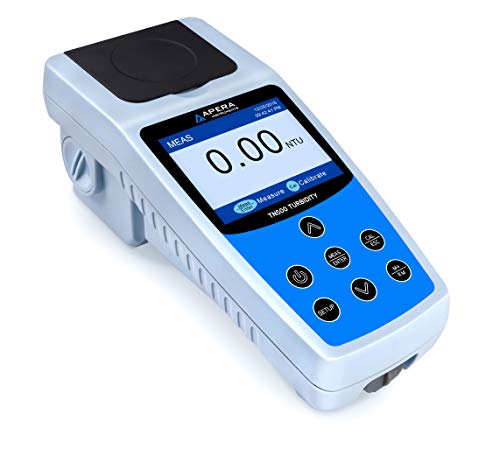
While primarily a turbidity meter, the TN500 offers a data logging feature and automated measurements that can complement electrical monitoring in environments where process turbidity is relevant to electrical systems (such as water treatment or cooling circuits). It includes a TruRead mode for consecutive readings and prints concise test reports. The EPA 180.1-compliant turbidity standard solutions accompany the kit for calibration and validation. It’s best for integrated process monitoring where turbidity and electrical data are both of interest.
Best for: users needing combined process monitoring (non-electrical parameters) and data logging. Better for integrated lab or field work where fluid turbidity affects equipment performance. Choose this if you require automated data capture in a broader monitoring context.
Caution: Data relevance to electrical logging is indirect; use this primarily for turbidity-focused tasks with awareness of its data logger limitations in electrical contexts.
Buying Guide: Key Considerations for Portable Power Meter Data Loggers
- What will you monitor? Determine whether you need single-channel, dual-channel, or three-phase data logging. This guides the choice between simple voltage/current meters and multi-channel analyzers.
- Measurement scope and range. Check voltage (AC), current, power (W), energy (kWh), frequency, and power factor. For three-phase systems, confirm three-phase support and synchronization between channels.
- Data storage and export. Look for devices with large internal memory and easy data export to CSV, XML, or compatible software for analysis and reporting.
- Installation ease. Consider whether a clamp-on CT is required, whether permanent panel mounting is needed, or if handheld operation suffices for temporary checks.
- Accuracy and compliance. True RMS measurements improve accuracy for non-sinusoidal signals. For specialized environments, confirm compliance with relevant standards or measurement methods.
- Alerts and alarms. If real-time warnings are important, choose meters with adjustable alert thresholds and clear indicator lights or audible alerts.
- Usability and portability. Weigh device size, battery life, and display clarity. Portable units are ideal for on-site troubleshooting, while larger units with panels support ongoing monitoring.
FAQ
- What is the main purpose of a portable power meter data logger?
It records voltage, current, and power data over time for analysis, troubleshooting, and energy management, often in real-time or with stored sessions. - Do I need True RMS measurement?
Yes, True RMS improves accuracy for non-sinusoidal waveforms common in modern electrical systems. - Can these loggers monitor three-phase systems?
Some models support three-phase monitoring; check whether the device explicitly lists three-phase capabilities and required wiring. - What data formats are supported for export?
Many loggers export to CSV or other standard formats; verify compatibility with your analysis software before purchase. - Are these meters safer for on-site use?
Portable meters with proper CAT ratings and clamping CTs facilitate safer on-site measurements, but users should follow all safety guidelines and disconnect power when required. - Is memory capacity important?
Yes. Higher data point allowance enables longer logging without offloading, reducing gaps in data across extended monitoring periods.