Best Low Energy Pool Pumps for Quiet, Efficient Circulation
If you’re shopping for a low-energy pool pump, these models emphasize energy savings, quiet operation, and reliable circulation. This guide highlights five top options, ideal for residential pools of various sizes and configurations. Look for variable speed or timer features to maximize efficiency and tailor performance to your schedule.
Buyer type summary:
- Budget-conscious homeowners: choose Doheny’s 1.5 HP Above Ground or 1 HP Above Ground for solid value.
- Energy-savvy users: consider Aquastrong variable-speed or dual-speed with timer pumps for the biggest long-term savings.
- Small to mid-sized above-ground pools: CIPU and Doheny’s 1 HP cover basic circulation with reliable efficiency.
| Product | Best For | Key Energy Feature |
|---|---|---|
| Doheny’s 1.5 HP Above Ground Pool Pump | Medium-sized above-ground pools; budget-minded buyers | Low-noise, high efficiency motor |
| Aquastrong Variable Speed Pool Pump | Pools needing major energy savings | Up to 80% energy reduction with variable speed |
| CIPU Pool Pump with Timer | Residential pools needing timer control | Eight run-time options; timer operation |
| Aquastrong In/Above Ground Dual-Speed with Timer | Flexibility for day/night use | Dual-speed with timer for automation |
| AQUASTRONG Pure Copper Motor (Grey) | Long-term durability with high headroom | Pure copper motor; high efficiency |
Doheny’s 1.5 HP Above Ground Pool Pump

Best for: Homeowners with mid-sized above-ground pools who want reliable performance at a lower upfront cost. This model uses a stainless steel shaft and reinforced thermoplastic body to deliver durability with lower noise output, supporting efficient operation without excessive energy use.
Why selected: It combines value, long life, and energy-conscious design while meeting common safety standards. The internal threading and compatibility with standard piping simplify installation in many above-ground setups.
Caution: This pump’s efficiency is strong, but for very large or heavily loaded systems, a higher-capacity or variable-speed option may offer greater long-term savings.
Aquastrong Variable Speed Pool Pump
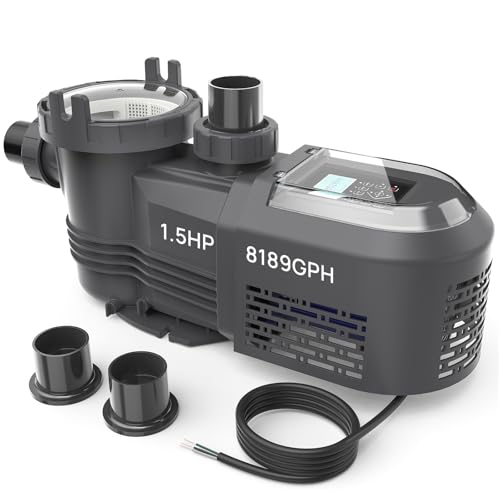
Best for: Pools where energy savings are the top priority; suitable for various pool sizes due to adjustable RPM range.
Why selected: Variable speed pumps can dramatically cut electricity use by adapting flow to need, with a wide RPM range and low-noise operation. Ideal for homeowners seeking long-term cost reductions.
Caution: Requires understanding of sequencing and control wiring; compatibility with existing controllers should be verified before purchase.
CIPU Pool Pump with Timer

Best for: Residential pools seeking convenient timer-driven operation and easy installation.
Why selected: Includes a timer with multiple run-time options, plus a 2-adapter setup for common hose sizes, and a viewable filter basket. This makes scheduling filtration straightforward while maintaining steady flow.
Caution: The timer is helpful, but overall energy savings depend on matched pump speed and pool usage patterns.
Aquastrong Dual-Speed With Timer (Blue)
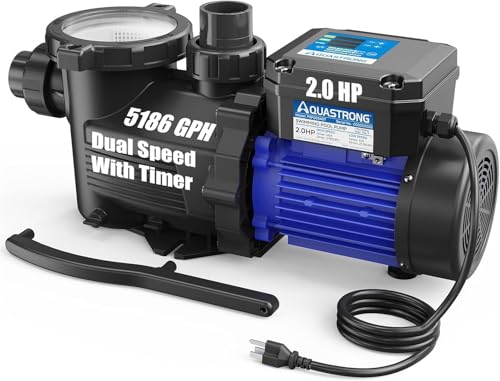
Best for: Pools that require day/night efficiency, combining high flow for cleaning with economical low-speed circulation.
Why selected: Dual-speed with a built-in timer enables automated filtration and energy-conscious cycling, making it a strong all-around option for mixed-use environments.
Caution: Dual-speed systems can be more complex to install; ensure adapters and wiring match your pool setup.
AQUASTRONG Pure Copper Motor (Grey)

Best for: Long-lasting performance and higher efficiency requirements in both in-ground and above-ground systems.
Why selected: A pure copper motor can improve efficiency and heat resilience, contributing to steadier operation and reduced energy use over time.
Caution: Copper-motor designs may come at a higher upfront cost; compare long-term energy savings to upfront price for value accuracy.
Buying Guide
- What type of pool do you have? Above-ground pumps are typically smaller and less costly, while in-ground needs demand higher flow and sometimes dual-speed options.
- Do you benefit from variable-speed or timer features? Variable-speed pumps offer the greatest long-term energy savings, especially for pools with variable usage.
- Which flow and head pressure are appropriate? Match GPH/heads to your pool size to avoid over- or under-circulation and to maximize efficiency.
- How important is noise level? Look for stainless steel shafts, insulated housings, or low-noise motors if the pool is near living spaces or bedrooms.
- What are your installation constraints? Check hose sizes (1.5″, 2″), adapters, and cord length to ensure compatibility with your setup.
- Maintenance considerations: Pumps with clear lids or larger strainers simplify debris management and reduce maintenance time.
Frequently Asked Questions
- What makes a pool pump energy efficient?
Energy efficiency comes from optimal motor design, variable speeds, and the ability to adjust flow to match pool needs, reducing unnecessary energy use.
- How do I choose between single-speed and dual-speed pumps?
Single-speed is simple and reliable but uses more energy on average. Dual-speed or variable-speed options save more money over time by adapting to demand.
- Is a timer necessary for pool pumps?
A timer helps automate filtration, ensuring consistent circulation while avoiding wasted run-time, especially when you have a fixed schedule.
- Will a higher horsepower pump always be better?
No. A pump with too much flow can waste energy and cause plumbing issues. Choose a pump sized to your pool and piping.
- Can copper motors improve efficiency?
Pure copper motors can offer improved thermal performance and reliability, contributing to sustained efficiency in some models.