Best Solar Irrigation Pump Kit Solutions for Efficient Watering
Answering the hunt for easy, off-grid plant care, a solar irrigation pump kit can automate watering for balconies, patios, and gardens. The top picks below suit different buyers: busy homeowners needing 10–20 plant coverage, small-space balcony gardeners, and pet-friendly or outdoor-only setups. Each product is chosen for solar operation, reliability, and practical features like timing modes or anti-siphon protection. The brief buying table that follows highlights who each kit is best for and the standout benefit.
| Product | Best For | Key Benefit |
|---|---|---|
| JIYANG Solar Automatic Drip Kit | Medium to large plant collections on patios | Up to 30 pots support with 12 timer modes |
| Brightown Solar Drip System | Vacation watering and indoor/outdoor mix | Long operation on cloudy days with 2000mAh panel |
| HEKIWAY 49FT System | All-season outdoor and indoor use | 25 timer modes, flexible interval/duration |
| AnseTo 12-Mode System | Budget DIY setups for small to medium gardens | Split solar panel design with 12 modes |
| RAINPOINT Compact Kit | Low-maintenance drip irrigation for 10–20 plants | Easy dial programming and high lift pump |
JIYANG Solar Automatic Drip Irrigation Kit System

The JIYANG kit is designed for hassle-free, solar-powered plant care. It automatically waters at preset times and volumes, making it ideal for balconies or small gardens without fixed power or faucet access. The system supports up to 30 pots and offers 12 timer modes, enabling precise scheduling. It includes a ground stake for soil insertion or wall mounting hardware for fences. A caution: ensure enough sunlight exposure for optimal performance, and verify the number of drippers matches your plant count.
Best for: Gardeners with multiple pots and a need for customizable irrigation schedules. Why selected: versatile, solar-powered, and scalable to larger setups.
Brightown Solar Drip Irrigation System

Brightown offers a fully automatic solar-powered watering solution with a 2000mAh panel. It is suitable for indoor/outdoor use and can service potted plants across patios, gardens, and greenhouses. The system is CE and RoHS certified and includes a ground stake for quick setup. It advertises up to 5–8 days of operation on cloudy days, making it a practical choice for travel or vacations. A potential limitation is the reliance on consistent sun for peak performance.
Best for: Vacation-ready watering and mixed indoor/outdoor use. Why selected: durable build, clear DIY setup, and long cloudy-day operation.
HEKIWAY 49FT Solar Drip Irrigation System

HEKIWAY emphasizes indoor/outdoor versatility and all-season operation. It uses a 25-timer mode platform to tailor durations from 3–20 minutes and intervals from 12–96 hours. The system is designed to adjust watering based on plant size and environmental conditions, with guidance for small, medium, and large plant groups. A limitation is that some users may need to fine-tune intervals for hot weather or long dry spells.
Best for: All-season gardeners who want flexible scheduling. Why selected: extensive timer options and clear guidance for different plant groups.
Anseto Solar Drip Irrigation System

Anseto’s design centers on a split solar panel approach with a “10-minute” simple setup. It provides a 49-foot hose and 15 drippers, making it a practical DIY option for patios, balconies, and greenhouses. The anti-siphon feature helps prevent backflow, which is advantageous for plant health. A caveat: the kit’s expansion potential should be checked if you plan to scale beyond 15 pots.
Best for: DIY fans who want quick setup and anti-siphon protection. Why selected: split-panel design and user-friendly installation.
RAINPOINT Compact Programmable Solar System
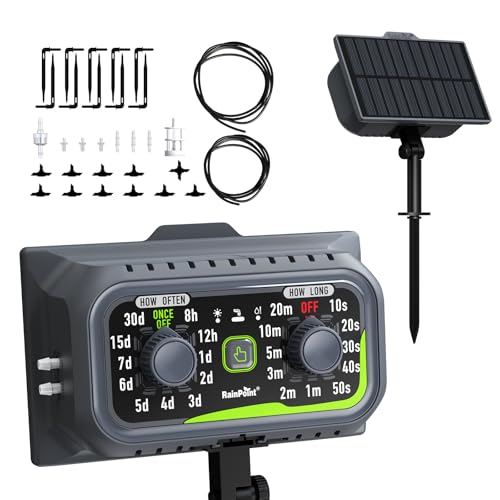
RAINPOINT focuses on ease of use with a simple dial to set schedules, automating daily watering for 10–20 plants. It’s marketed as a low-maintenance solution that expands coverage with accessories. The kit includes a high-lift pump to reach higher containers, which is helpful for varied garden layouts. A limitation is that the standard kit covers about 10 pots, so expansion may be necessary for larger setups.
Best for: Busy gardeners needing straightforward, dial-based programming. Why selected: reliable pump performance and expandable framework.
Buying Guide
What to consider when choosing a solar irrigation kit:
- Coverage: How many pots or plants do you need to water? Look for kits that state pot capacity and an option to expand.
- Power and durability: Check solar panel size, battery capacity, and IP rating for outdoor use. Higher wind or rain exposure benefits from IP44 or IP67 ratings.
- Timer versatility: More timer modes provide finer control over watering frequency and duration, which matters for diverse plant types.
- Anti-siphon and water flow: Anti-siphon features prevent backflow, protecting your water source and plants. Flow rate should match your drip emitters’ needs.
- Installation: DIY-friendly kits with clear instructions, split panels, or ground stakes simplify setup on balconies or in greenhouses.
- Environment and maintenance: Consider auto shut-off features, ease of cleaning, and materials suited to your climate (indoor, outdoor, or greenhouse use).
FAQ
- Q: Can these kits work on cloudy days? A: Many kits continue to operate during overcast days with sufficient solar input, but performance may vary with sun exposure.
- Q: Do these systems need an external power source? A: No, they run on solar energy, though some models offer dual-power options or battery support.
- Q: How many plants can a kit water at once? A: It varies by model; typical kits support 10–30 pots, with expansion options advised for larger setups.
- Q: Are anti-siphon features common? A: Several models include anti-siphon valves to prevent backflow and cross-contamination.
- Q: What maintenance is required? A: Regular inspection of drippers, hoses, and emitters is recommended, plus cleaning to prevent clogging.
- Q: Is it safe for indoor use? A: Yes, most systems are designed for indoor and outdoor use, with appropriate mounting or staking options.