Best Industrial Electric Hot Water Heaters for Quick, Reliable Domestic Use
Direct answer: these five electric hot water heaters offer strong capacity, fast heating, and dependable safety features for industrial or heavy-use environments. They’re suited for small commercial kitchens, workshops, RV parks, and multi-user settings where steady hot water is essential. The top picks balance power, efficiency, and ease of installation while addressing space constraints and safety needs.
Overview of selected products:
| Product | Capacity / Power | Best For | Key Benefit |
|---|---|---|---|
| VEVOR 10 Gallon Electric Water Heater | 10 gal, 1600W | Small families, compact spaces | LED display, adjustable 30–75°C |
| AIYEZIDT Tankless Water Heater (110V, 3000W) | On-demand, 3–5 seconds | Point-of-use, apartments, RVs | Compact, digital display, IPX4 safety |
| 2000W Immersion Water Heater | 2kW | Buckets, tubs, portable setups | Fast heating, 5 gallons in minutes |
| Rheem 18kW Tankless Electric Water Heater | 18kW | High-demand households | External digital thermostatic control, up to 4.4 GPM |
| Orbek 14kW Tankless Water Heater | 14kW | Mid-size homes, heavy-use fixtures | High flow, practical installation notes |
VEVOR 10 Gallon Electric Water Heater

The VEVOR model combines a 10-gallon storage capacity with 1600W heating power. An extended immersion element delivers continuous hot water for around the clock, with an LED display and knob-style temperature control ranging from 30°C to 75°C (86°F–167°F). An enamel coating adds safety against leaks or burns, making it suitable for small households or light commercial use where space is limited. Best for families or small offices needing immediate hot water at multiple taps without a large footprint.
Best for: compact spaces that still require dependable, on-demand hot water. Limitation: storage capacity is modest for very high concurrent hot water demand.
AIYEZIDT Tankless Water Heater (110V, 3000W)
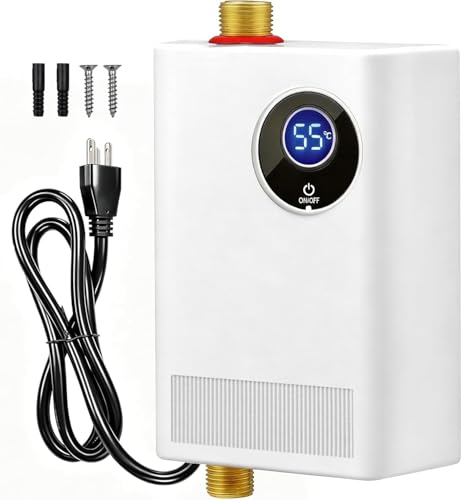
This 110V tankless unit delivers instant hot water with 3000W of heating power and a 55°C/131°F maximum, producing hot water within 3–5 seconds. Its compact, wall-mounted design makes it ideal for kitchens, bathrooms, RVs, or under-sink installation. A digital LCD display provides status monitoring, and IPX4 waterproofing plus leakage and dry-burning protection support safer operation. Best for: point-of-use needs where space is at a premium and quick hot water is essential. Limitation: on-demand performance depends on water supply temperature and line distance.
2000W Immersion Water Heater

The 2000W immersion heater is designed for rapid heating in a bucket or tub, capable of heating 5 gallons of water in minutes. It uses a 304 stainless steel guard for safety and includes an LCD thermometer to monitor water temperature. Best for: portable or temporary hot water boosts in baths, camping setups, or DIY projects where a quick heat is needed. Limitation: not suitable for continuous high-demand use or permanent plumbing installations.
Orbek 14kW Tankless Water Heater

The Orbek 14kW tankless model provides up to 3.38 GPM of on-demand hot water at 240V with IPX4 protection and safety features. It’s suitable for households needing reliable hot water at several fixtures simultaneously without storing hot water. Best for: mid-sized homes or spaces where a compact, high-flow heater is preferred. Caution: installation requires an appropriate 240V circuit capacity and proper wiring.
Buying Guide
What should you consider before buying an industrial electric hot water heater?
- Hot water demand: Evaluate peak simultaneous usage. Tank heaters suit steady usage; tankless models excel at on-demand needs with unlimited supply when sized correctly.
- Power and electrical capacity: Check available amperage and circuit capacity. Higher-wattage units require larger breakers and proper wiring (often 240V).
- Space and installation: Consider under-sink, wall-mounted, or stand-alone configurations. Compact units save space but may have lower total capacity.
- Temperature controls: Look for precise thermostats or digital displays to maintain consistent water temperature and energy usage.
- Safety features: IPX ratings, dry-fire protection, over-temperature shutoff, and enamel or corrosion-resistant elements improve safety and longevity.
- Maintenance and serviceability: Field-serviceable elements and accessible components reduce downtime and repair costs.
Installation and compatibility questions
- Do you have the required electrical service for a high-wire heater? Many 240V units demand dedicated circuits.
- Is your plumbing ready for a tankless unit that relies on flow rate and temperature rise? Ensure piping is appropriately sized.
- Will you use point-of-use (under-sink) or whole-home solutions? Point-of-use can save space but limits overall hot water capacity.
Cost and efficiency considerations
- Operating cost depends on power usage and hot water demand. Tankless models may save energy with on-demand heating.
- Durability is influenced by heating elements, materials (stainless steel vs. copper), and safety protections.
Frequently Asked Questions
- What is the main difference between a tank and a tankless electric water heater?
Tank heaters store hot water in a tank for ready access, while tankless heaters heat water on demand, reducing standby energy loss. - Can I install a high-wattage heater myself?
Installation may require professional electrical work to meet code and safety standards. - How do I determine the right GPM for my home?
Estimate the number of fixtures used simultaneously and their flow rates to choose a suitable GPM rating. - Are safety features essential?
Yes. Look for IPX ratings, anti-dry-fire protection, and automatic shutoffs to prevent hazards. - Is it better to buy a smaller unit now and upgrade later?
Consider current demand and potential future needs; undersized units can lead to insufficient hot water during peak times. - Do these units work with standard household electrical systems?
Most require 240V service or dedicated circuits; verify compatibility with your home wiring.