Best Large Solar Panel Kits for Home and Off-Grid Power
When searching for large solar panel kits, you want systems that deliver substantial daily power, scalable storage, and ease of installation. This guide highlights five top options that are well-suited for homes, RVs, and off-grid setups. Each product is evaluated for who it’s best for, why it stands out, and any notable limitations. Use these details to compare capacity, inverter compatibility, and expansion potential before making a choice.
Buyer-friendly snapshot: the table below summarizes the featured large solar panel kits, focusing on system size, energy storage, and primary use case.
| Product | Approximate System Size | Storage | Best For |
|---|---|---|---|
| Up to 10kW output | 16.1 kWh LiFePO4 | Home power backup with multi-unit parallel capability | |
| 800W panel array | Up to 7.168 kWh (stated) | RV trips and off-grid travel | |
| 200W panel kit | Single 100Ah battery | Compact off-grid needs | |
| 400W | Includes MPPT controller | Expanded grid alternative for cabins or RVs | |
| 400W panel configuration | 40A MPPT setup with 100Ah battery | Small to medium off-grid RV backup |
ECO-WORTHY 10kW All-in-One Solar Kit

The ECO-WORTHY all-in-one kit delivers up to 10kW of continuous power with 120V/240V split-phase support, ideal for whole-home backup. It bundles five 590W solar panels (2950W PV capacity) plus a 48V 314Ah LiFePO₄ battery offering about 16.1 kWh of storage. The system includes cables and supports up to six inverters in parallel, enabling scalable expansion. A built-in 7-inch display and wireless connectivity provide real-time monitoring. This solution is best for homeowners seeking a large, central power source and the ability to scale to meet higher daytime demand. A limitation to note: the highest performance depends on favorable sun conditions, and initial setup is more involved than smaller kits.
Who it’s best for: Homeowners needing a high-capacity, scalable off-grid or grid-tied backup with parallel operation for added resilience. Choose this if you anticipate expanding beyond a single unit and want robust monitoring.
Key considerations:
- High continuous power output with split-phase capability
- Large storage capacity supports whole-house operation during outages
- Upgradable for additional inverter units
ECO-WORTHY 800W RV Complete Solar Kit

This 800W kit is designed for RV and mobile off-grid use. It includes four 200W bifacial panels, a 3000W UPS inverter/charger, and two 12.8V 280Ah lithium batteries (totaling up to 7.168 kWh). Quick installation and compatibility with both solar and mains power enable a flexible energy solution for travel. A potential limitation is that peak daily output depends on sunlight duration, so longer trips in overcast regions may yield less energy.
Who it’s best for: RV owners and travelers seeking a self-contained, user-friendly system with a robust battery bank for off-grid adventures. Choose this if you prioritize mobility and a ready-to-run kit.
Product highlights:
- Includes a UPS inverter charger for seamless transition between power sources
- All-in-one kit designed for novice-friendly setup
- Suitable for powering most RV appliances during travel
ECO-WORTHY 200W 12V Solar Panel Starter Kit
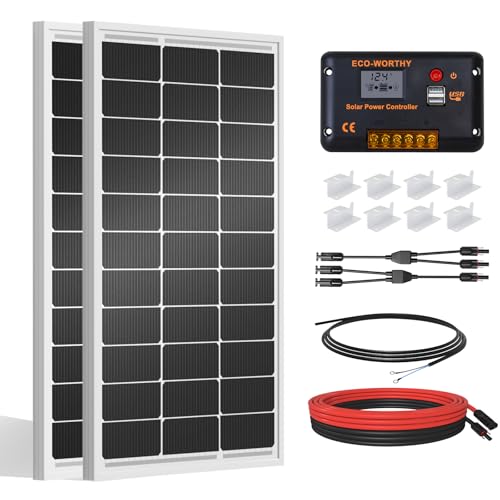
This starter kit focuses on practical off-grid power with a 200W solar panel, a 30A PWM charge controller, and a 12V 24V capable battery option. It’s suitable for RVs, campers, boats, and other off-grid applications where limited space and budget are factors. The kit emphasizes ease of installation and straightforward operation. Caution: PWM controllers are less efficient than MPPT controllers, especially in partial shading or complex charging scenarios.
Who it’s best for: Beginners or small off-grid setups where a simple, affordable solution is desired. Choose this if you want a compact starting point with room to grow later.
ECO-WORTHY 200 Watt 12V Complete Starter Kit For RV
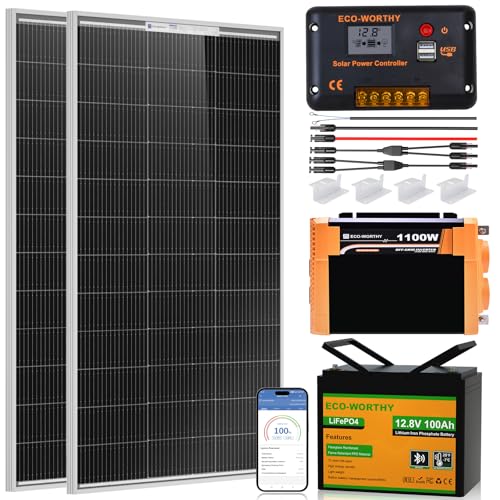
This complete 200W starter kit for RVs includes 2x100W panels, a 12.8V 100Ah lithium battery, an 1100W inverter, and a 30A PWM controller. It is marketed as a novice-friendly, all-in-one solution designed for quick setup and off-grid operation, ideal for RV trips or backup power for cabins. A potential limitation is the 200W scale, which may not meet higher daily power demands in larger loads or longer outages.
Who it’s best for: RV enthusiasts needing a compact, ready-to-deploy system with a solid battery and inverter for travel. Choose this if space and weight are primary constraints.
Renogy 400W Premium Kit

The Renogy 400W Premium Kit provides a solid 400W system with four 100W panels, a 40A MPPT charge controller, BT module, fuse, mounting brackets, and cabling. It emphasizes higher efficiency with MPPT tracking, a longer-term warranty, and durable components designed to withstand wind and snow loads. It’s better for cabins, tiny homes, or RV setups that require more sustained power than basic starter kits. Caution: MPPT kits can require more careful tuning during cold weather to maximize output.
Who it’s best for: Off-grid enthusiasts who want reliable power with good scalability and strong performance in varied weather. Choose this if you plan to expand beyond a single panel and value advanced controller features.
ECO-WORTHY 1.6kWh RV Complete Kit

This kit assembles 400W of solar panels with a 40A MPPT controller and a 100Ah lithium battery, delivering around 1.6 kWh of daily output under favorable sunlight. It is positioned for RV usage and small off-grid backup scenarios, offering Bluetooth monitoring for easy oversight. A limitation to watch is that total daily energy may be limited for higher-demand loads, especially on cloudy days.
Who it’s best for: RV users needing a compact, efficient system with Bluetooth monitoring and moderate storage. Choose this if you want a portable, yet capable, off-grid solution.
Buying Guide: Large Solar Panel Kits For Home Or Off-Grid Use
- System size and capacity: Match kit capacity to your daily electricity needs and planned backup duration. Big homes may need multi-kW systems with substantial storage, while RVs or cabins can often suffice with hundreds of watts and several kilowatt-hours of storage.
- Inverter type and output: Pure sine wave inverters handle sensitive appliances smoothly. Split-phase inverters enable 120V/240V operation suitable for whole-house use. Consider parallel capability if you anticipate expanding later.
- Storage technology: LiFePO4 batteries offer longer life, safer chemistry, and higher cycle counts than many alternatives. Assess usable capacity and the feasibility of future expansions.
- Controller technology: MPPT controllers extract more energy than PWM controllers, especially in partial shade or cooler conditions. For larger systems, MPPT is typically worth the extra cost.
- Installation and maintenance: Look for included cables, mounting hardware, and monitoring features. Bluetooth or Wi-Fi monitoring helps you track system health and energy production in real time.
- Mobility vs. permanence: RV and trailer kits prioritize compactness and lighter builds, while home kits emphasize scalability and durability for long-term use.
- Warranty and service plans: Consider kits with robust warranties on panels, batteries, and inverters, along with accessible technical support.
FAQ
- What defines a “large” solar panel kit?
A large kit generally refers to systems capable of delivering several hundred to several thousand watts of PV generation and substantial storage, suitable for whole-home backup or long off-grid sessions. - Is MPPT better than PWM for large kits?
Yes. MPPT controllers optimize voltage and current to maximize energy harvest, especially useful in larger systems with longer cable runs or variable sunlight. - Can these kits power a full home during outages?
Kits with high-capacity storage and high inverter output can support many essential loads, but actual performance depends on daily sun, load size, and battery capacity. - Are lithium batteries necessary for large kits?
Lithium batteries offer longer life and higher depth of discharge, which is advantageous in larger, long-term installations, though they are typically more expensive than lead-acid options. - Do I need professional installation for a 10 kW system?
High-capacity systems often require electrical permits, proper grounding, and professional wiring to ensure safety and code compliance. - Can I expand these kits later?
Several kits in this list support parallel inverter setups and battery expansions, making future growth feasible if space and budget permit.