Best Digital Multimeters for Home and Workshop
The following digital volt-ohm meters (DMMs) are popular choices for electrical hobbyists, automotive work, and DIY electronics. This guide highlights five models that balance accuracy, safety, and ease of use. Each product section includes a link to the Amazon listing, an image, and key features to help you compare at a glance.
Summary of chosen products
| Product | Brand | Key Capabilities | Display |
|---|---|---|---|
| AstroAI Digital Multimeter Tester Blue | AstroAI | AC/DC voltage, current, resistance, diode, continuity | 3½-digit with backlight |
| AstroAI Digital Multimeter Tester Black | AstroAI | AC/DC voltage, resistance, diode, battery test modes | Backlit LCD |
| AstroAI TRMS 6000 Counts | AstroAI | AC/DC voltage, current, capacitance, frequency, duty cycle, temperature | Large backlit display |
| Crenova MS8233D Multimeter | Crenova | Voltage, current, resistance, capacitance, frequency, NCV | 6000-count LCD with backlight |
| Klein Tools MM325 | KLEIN TOOLS | AC/DC voltage, current, resistance, diodes, continuity | Backlit display |
AstroAI Digital Multimeter Tester Blue

The AstroAI Blue model provides essential measurements for common electrical tasks. It supports AC/DC voltage, DC current, resistance, and diode testing, with a backlit 3½-digit display for easier reading in dim environments. The meter is designed to help diagnose issues in household outlets, automotive circuits, and electronics projects. Practical tips warn that improper probe insertion or incorrect selector positions can yield misleading results, and it notes certain AC current measurement limitations in some conditions. This meter is suitable for beginners and DIY enthusiasts seeking a straightforward tool.
AstroAI Digital Multimeter Black
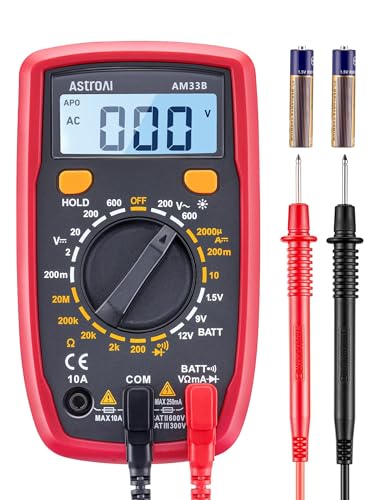
This black variant offers versatile DMM capabilities with AC/DC voltage and resistance measurements, plus a dedicated battery test mode for common battery chemistries. It emphasizes user safety with protective design elements and a low-battery indicator. The device is well-suited for automotive and household troubleshooting, including testing automotive electronics and charging systems. The included battery test modes simplify quick checks on 1.5V, 9V, and 12V batteries, making it helpful for field and shop use.
AstroAI TRMS 6000 Counts Multimeter

Designed for more demanding measurements, this TRMS meter offers auto-ranging, true RMS for AC voltage and current, and a broad capability set including capacitance, frequency, duty cycle, and temperature. It features a large LCD backlit screen, data hold, auto shut-off, and a kickstand for convenient hands-free operation. This model is a solid option for automotive diagnostics, electrical installations, and complex electronics projects where accuracy under varying waveforms matters.
Crenova MS8233D Multimeter

The MS8233D from Crenova expands measurement capabilities to include frequency, duty cycle, capacitance, and NCV live-wire testing. It features a 6000-count LCD with a bright backlight for clear readings in dim conditions, along with IEC61010-1 CAT III 600V safety compliance and dual fuses for overload protection. An insulated rubber holster provides added protection against accidental shocks, making it a practical choice for home maintenance and automotive tasks alike.
Klein Tools MM325 Multimeter

The Klein Tools MM325 is a compact, manual-ranging meter that covers up to 600V AC/DC voltage, 10A DC current, and 2MΩ resistance. It includes a battery test function, diode test, and continuity with audible feedback. A backlit display enhances readability in low-light environments, while the device’s protective design emphasizes safety and accuracy with lead-alert indicators that guide proper probe placement. This model is well-suited for professionals who value reliability and a straightforward, no-fruss approach to measurements.
Buying Guide
When selecting a digital volt-ohm meter, consider the following factors to match your needs and safety requirements:
- Voltage and current range: Ensure the meter covers the expected voltage (AC/DC up to at least 600V is common) and current ranges for your projects. For automotive work, higher current ranges are useful.
- True RMS vs. average-responding: True RMS meters provide more accurate readings on non-sinusoidal waveforms, which is important for modern electronics and variable-speed drives.
- Auto-ranging vs. manual-ranging: Auto-ranging is easier for beginners and faster for quick checks; manual-ranging can offer faster operation for experienced users but requires knowledge of expected ranges.
- Safety rating and protection: Look for IEC/UL safety standards, CAT ratings (e.g., CAT III 600V) and protective features such as fuses, non-slip housings, and NCV (non-contact voltage) where applicable.
- Display and readability: A clear backlit display helps in dim workspaces. Larger numbers and data hold features improve usability during diagnostics.
- Durability and accessories: Rubber holsters, test leads, and batteries add long-term value. Consider whether the kit includes leads suitable for automotive use and resistance testing.
- Special features: NCV testing, temperature measurement, capacitance, frequency, duty cycle, and live-wire detection expand utility for different tasks.
- Maintenance and calibration: Regular checks and proper storage extend accuracy. Some models offer easy fuse replacement and robust protection against overloads.
- Price and support: Compare warranty terms, customer support quality, and available replacement parts when choosing between models with similar features.
Across these options, buyers can balance a user-friendly entry point with more advanced capabilities for recurring projects. For beginners, a basic, auto-ranging meter with a clear display and essential safety features may be ideal. For enthusiasts and professionals, a TRMS meter with broad measurement capabilities, data hold, and durable construction provides greater flexibility for automotive, electrical, and electronics work.