Best Mini Wave Soldering and Reflow Machines for Small PCB Projects
If you’re seeking compact, reliable solutions for surface mount and through-hole soldering on small boards, a mini wave soldering or reflow machine can be a fit. This guide highlights five practical options for hobbyists, makers, and small workshop setups. Each product is evaluated for who it’s best for, why it’s a strong choice, and any notable limitations to consider before purchase.
Buyer profiles:
– Hobbyists and startup makers needing affordable, easy-to-use units.
– Small shops requiring dependable, repeatable soldering with adjustable controls.
– Projects with compact boards where space is at a premium.
Summary of top picks you’ll see below includes best overall value, best for precise temperature control, and best for drawer-style compact design.
| Product | Best For | Notes |
|---|---|---|
| GZPUYAN 1000W Micro Selective Wave Soldering Pot | Budget-conscious hobbyists | Solid power, compact tin furnace; 3-6 KG capacity |
| GZPUYAN 1500W Micro Selective Wave Soldering Pot | Medium-duty small shops | Higher power, same capacity range |
| INTSUPERMAI Reflow Oven T-937 | Fully automatic reflow with profiles | Microcomputer control, 8 preprogrammed curves |
| OREKPOT T962A Compact Reflow Oven | Drawer-style, versatile reflow | 8 waves, 0-280℃, dual voltage compatibility |
| Qiokoith 1500W Reflow Oven | All-in-one SMD efficiency | Large welding area, 0-280℃, fast cycle |
GZPUYAN 1000W Micro Selective Wave Soldering Pot

Best for small, budget-friendly projects, this 1000W model focuses on basic selective wave soldering for compact PCBs. It offers a 220V supply and a tin furnace capacity between 3 and 6 kilograms, suitable for light to moderate batch runs. The unit is a practical starting point for hobbyists who want a dedicated wave pot without unnecessary features.
Who it’s best for: hobbyists and makers who need a compact, affordable soldering pot with straightforward operation. Why chosen: strong balance of cost-to-capability for small batches. Limitation: limited advanced automation features; plan for slower cycles on larger runs.
GZPUYAN 1500W Micro Selective Wave Soldering Pot

This higher-power 1500W option is well-suited for small shops or more demanding hobby projects. With 220V operation and a 3-6 KG tin capacity, it supports faster processing of modest batch sizes. It’s a practical upgrade for users who outgrow the 1000W model but don’t need a full production line.
Who it’s best for: users expanding their DIY production or needing quicker turnaround on moderate runs. Why chosen: higher wattage improves heating responsiveness while keeping a compact footprint. Caution: ensure electrical availability and cooling ventilation match the increased heat output.
GZPUYAN 1000W Micro Selective Wave Soldering Pot (Different Model)

This variant provides similar core specs with a compact footprint suitable for tight workstations. The 1000W setup remains a strong option for simple wave soldering tasks on small PCBs and double-checks for accuracy in localized heating. It’s a solid choice when you want a simple, reliable pot without extra frills.
Who it’s best for: operators needing a spare or backup wave pot, or new users starting with a proven 1000W platform. Why chosen: dependable performance without complexity. Limitation: identical core features may not justify upgrading from the 1000W model for some users.
INTSUPERMAI Reflow Oven T-937 Micro-computer Control
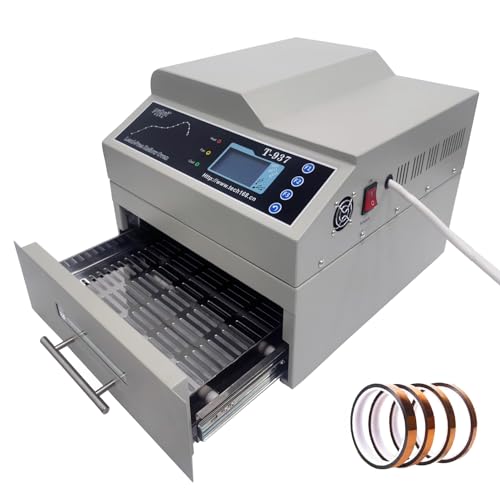
Intelligent control and eight programmable profiles make this 110V/2300W reflow oven a robust choice for precise soldering. It features temperature correction, dedicated heating and forced cooling, and a 306 mm×322 mm drawer size for larger workpieces. It’s best for users seeking repeatable, multi-profile reflow cycles with solid automation.
Who it’s best for: professionals and serious hobbyists needing consistent, programmable soldering. Why chosen: strong automation and temperature management reduce manual intervention. Limitation: higher price point and larger footprint compared with ultra-compact models.
OREKPOT Compact Reflow Oven with Adjustable Temperature (T962A)

This drawer-style reflow oven emphasizes a compact, visible workbench and adjustable temperature control. It supports currents from 0–280℃ with a cycle time of 1–8 minutes and is compatible with 110/220V. Eight predefined waves streamline the soldering process, making it a fit for consistent, repeatable results on small or double-sided PCBs.
Who it’s best for: users who value a compact, drawer-based design with straightforward operation. Why chosen: versatility across materials and efficient cycle times. Limitation: might lack advanced profiling depth compared with higher-end units.
OREKPOT T962A Series (T962A Variant)

Another member in the OREKPOT compact line, this variant shares the same microcomputer-driven control and robust thermal performance. It is designed for reliable SMD rework and double-sided PCB welding, with a setup aimed at efficient, repeatable cycles. Best for: users who want a proven drawer-based reflow with strong temperature control.
Limitation: identical core features across variants can make it challenging to distinguish among models without specific spec checks for power or dimensions.
Qiokoith 1500W Reflow Oven

With a 1500W power rating and a large 300 x 320 mm welding area, this all-in-one reflow oven is designed for higher throughput and varied PCB sizes. It operates up to 280℃ with 1-8 minute cycles and includes a smoke vent to aid cooling and board safety during removal. Best for: small shops seeking high efficiency in a single, adjustable unit.
Caution: ensure the smoke vent and exhaust installation are appropriate for your workspace to avoid ventilation issues. Advantage: faster heating and broader compatibility with different PCB layouts.
Buying Guide
What should you consider when choosing a mini wave soldering or reflow machine?
- Power and heat capacity: Higher wattage (1000W vs 1500W) affects heating speed and cycle time. Choose based on your expected batch size.
- Voltage compatibility: Look for 110/220V compatibility if you operate in varied locations or with mixed tooling.
- Work area and footprint: Drawer-style or compact bench units save space but verify the usable welding area fits your PCBs.
- Temperature range and control: 0-280℃ is common; ensure it supports your solders and fluxes. Programs and curves improve repeatability for multiple materials.
- Automation and profiles: Units with multiple pre-programmed curves or microcomputer control reduce manual tuning and improve joint consistency.
- Ventilation and safety: Reflow ovens with built-in smoke exhaust help maintain a safer, cooler workspace, especially in tight setups.
- Upgrade path: If you expect growing needs, consider a model with more profiles or higher maximum temperatures for future boards.
FAQ
- What is the difference between a wave soldering pot and a reflow oven?
– A wave soldering pot uses a wave of molten solder to connect through-hole components, while a reflow oven heats solder paste applied to SMD pads to form joints. - Which device is best for SMD boards?
– Reflow ovens are generally best for SMD components, providing precise temperature profiles and uniform heating. - Do these machines require special safety setups?
– Yes. Provide proper ventilation, follow flux and solder handling guidelines, and ensure electrical safety for 110/220V operation where applicable. - Can I use these for large or multiple PCBs at once?
– Most mini units are designed for small batches or single panels. Larger production needs may require higher-capacity equipment or multiple units. - Are there maintenance tips to extend life?
– Regularly clean residue, check nozzle or heating elements, and calibrate temperature profiles to keep soldering consistent. - Is it better to buy a higher-wattage model now or later?
– If you anticipate frequent runs or larger PCBs, opting for a higher-wattage model early can reduce cycle times and improve throughput.