Best 2000-Watt Grid Tie Inverter for Solar Power Systems
Yes, a 2000-watt grid-tie inverter is a strong option for homeowners who want to convert solar panel energy to usable AC power and feed it back into the grid. This guide highlights five top choices, including models designed for 240V North American grids, MPPT efficiency, and easy monitoring. Best for: homeowners expanding a small to mid-size solar setup, off-grid hybrid users, and installers seeking scalable options.
Summary table of selected products:
| Product | Brand | Input Range | Best For |
|---|---|---|---|
| Y&H 2000W Grid Tie Inverter SUN-2000GTIL2-H | Y&H | DC 45-90V | American 240V systems; stacking for higher output |
| EpyGnom 1600W/1800W/2000W/2400W/2800W Grid Tie Micro Inverter | EpyGnom | 120V/230V auto | Flexible single-phase or 3-phase integration |
| Lakenbroade 2000W Micro Grid Tie Inverter | Lakenbroade | 120V/230V auto | Wide compatibility; modular stacking |
| Y&H 1000W Grid Tie Inverter Power Limiter | Y&H | DC 25-60V | Smaller, limiter-based setups |
| Fockety Solar Grid Tie Micro Inverter 2000W | Fockety | 120V US Plug | Module-level control with real-time status |
Y&H 2000W Grid Tie Inverter SUN-2000GTIL2-H

The Y&H SUN-2000GTIL2-H operates with a DC input of 45-90V, designed for 240V American grids. It supports up to 1000W solar input for reliable MPPT-based power conversion with efficiency up to 99%. Best for: homeowners pairing a dedicated 240V grid connection and higher-voltage panels. Better for scalable setups where multiple inverters can be stacked to increase total output. Caution: ensure the startup voltage is met (around 49V) and use compatible solar panels with similar specs for optimal performance.
Key features:
- DC input range: 45-90V; startup around 49V
- Battery-ready option with a 60V/72V configuration
- MPPT efficiency up to 99%; direct 240VAC output
EpyGnom 1600W/1800W/2000W/2400W/2800W Grid Tie Micro Inverter (Silver-2000W)

This micro inverter uses built-in MPPT to maximize panel power and can increase generation by more than 25%. It supports 120V/230V auto-adaptation and is monitorable via WiFi or a mobile app. Best for: small to medium residential installs or balcony systems aiming for modular expansion. Limitation: performance depends on proper parallel stacking and sufficient solar panel count—not ideal for very large single-source inverters.
Key features:
- Automatic 120V/230V mode; modular stacking
- Built-in MPPT for higher panel efficiency
- Remote monitoring via app
EpyGnom 1600W/1800W/2000W/2400W/2800W Grid Tie Micro Inverter (Silver-1800W)
This model mirrors the 2000W version but provides 1800W capacity with the same MPPT-based efficiency and monitoring features. Best for: users with a smaller array needing reliable, scalable micro-inverter performance. Caution: ensure you stay within the 4-8 panel range for optimal operation and grid compatibility.
Key features:
- MPPT optimization for each module
- Remote monitoring via WiFi/app
- Auto 120V/230V adaptation
EpyGnom 1600W/1800W/2000W/2400W/2800W Solar Micro Inverter (Black-2000W)

This black variant provides similar MPPT-driven gains with 120V/230V automatic adaptability and app-based monitoring. Best for: private and commercial installations that require a compact, scalable micro inverter. Consideration: check the specific wiring and panel count to ensure balanced grid input.
Key features:
- Independent MPPT per module
- WiFi/app monitoring
- Versatile voltage compatibility
Lakenbroade Micro Grid Tie Inverter (2000W)
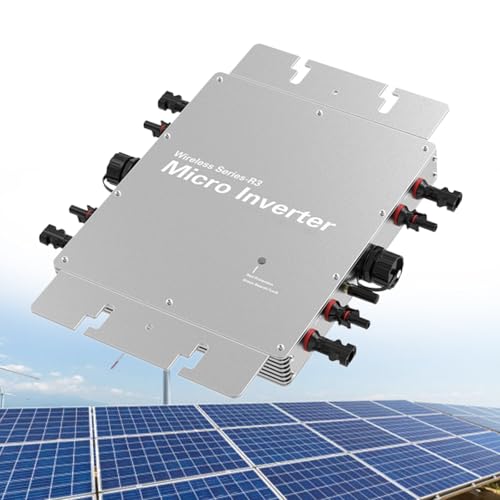
The Lakenbroade model emphasizes a strong MPPT algorithm with a wide 120V/230V auto-recognition. It provides safety through isolation of input and output and supports monitoring via WiFi or a mobile app. Best for: systems needing reliable, modular expansion with straightforward integration. Limitation: still best used in multi-inverter arrays rather than a single, large continuous output.
Key features:
- MPPT for higher energy capture
- Auto 120V/230V recognition
- Remote monitoring and control
Buying Guide: What to Consider When Choosing a 2000W Grid Tie Inverter
- Grid compatibility: Confirm your local grid voltage (120V vs 240V) and whether the inverter is designed for your service. Some models support both 120V and 230/240V, while others are fixed to one standard.
- Input voltage range and startup voltage: Look for a wide DC input range (for example 45-90V) and a reasonable startup voltage to ensure reliable commissioning from your solar array.
- MPPT efficiency and tracking: Higher MPPT efficiency increases real-world energy harvest. Models with multi-point tracking adapt better to panel variability and shading.
- Modularity and stacking: If you plan to expand, choose inverters that stack easily and maintain efficiency when paired with multiple units.
- Monitoring and control: WiFi/app monitoring helps you verify performance, detect anomalies, and schedule maintenance without onsite visits.
- Safety features: Isolated input/output, built-in protections, and the availability of circuit breakers when using battery power can reduce risk during operation.
- Application fit: Micro inverters are excellent for balcony or small installations and allow module-level control, while string/grid-tie units suit larger roof setups.
FAQ
- What is a grid-tie inverter?
– It converts DC from solar panels into AC and feeds it to the home grid, often with the grid acting as the reference for synchronization. - Do I need a battery with a grid-tie inverter?
– Some models offer battery-ready configurations, but many grid-tie units are designed to feed power directly to the grid without storage. - Is MPPT necessary?
– MPPT improves energy harvest by tracking the panel’s maximum power point, especially under changing conditions. - Can multiple inverters be stacked?
– Yes, several models are designed for parallel operation, increasing total system capacity without a single limiting unit. - What safety considerations matter?
– Ensure proper wiring distances, circuit protection, and compliance with local electrical codes, particularly when combining with batteries. - Which inverter is best for a balcony setup?
– Micro inverters (module-level) are often better for balcony or small, modular installations due to easy expansion and monitoring.