Best Most Powerful Solar Fence Charger for Large Pastures and Livestock
Finding the right solar fence charger means matching power, range, and reliability to your fencing needs. This guide highlights five high-performance options designed for large pastures, multi-wire setups, and active predator control. It targets farm operators, ranch managers, and homesteaders seeking durable, maintenance-friendly solutions that can operate off-grid.
Summary table of selected products:
| Product | Best For | Key Power | Coverage | Notes |
|---|---|---|---|---|
| Solar Electric Fence Charger 1.2J (1.2J Stored Energy) | Large pastures, multi-wire setups | 1.2J | Up to 45 miles | High-energy pulses for big operations |
| FarmNix 30 Miles Solar Fence Charger | Long perimeter fences | 1.5J | Up to 30 miles | Adjustable output for grazing |
| Solar Fence Charger LD03 1.0J | Rotational grazing, remote pastures | 1.0J | Up to 45 miles | Durable, weatherproof |
| ANDMON MINI400 30 Miles Solar Fence Charger | Smaller farms with longer fences | 0.4J | Up to 30 miles | Day/Night mode, easy install |
| 24 Hour Solar Electric Fence Charger 10 Miles | Medium pastures, livestock control | 0.18J | Up to 10 miles | Consistent day/night operation |
Solar Electric Fence Charger 1.2J — 45 Miles Coverage

This unit stores energy to deliver a strong 1.2 joules of output with a pulse range of 7–11kV, suitable for large pastures or multi-wire fencing. It is designed for ranch-grade demand and is best for operations needing reliable, high-energy pulses across extended fence lines. It is especially effective where predators or roaming wildlife threaten the fence line. A caution: performance depends on a robust grounding system and consistent sun exposure.
Who this is best for: large ranches, multi-zone fencing, and farms with substantial livestock. Why selected: the 1.2J stored energy and broad 45-mile coverage provide the power and reach needed for expansive properties, reducing the risk of livestock escapes or predator breaches.
Limitation: may require optimal weather and proper grounding; cloudy periods can affect peak pulse consistency.
FarmNix 30 Miles Solar Fence Charger
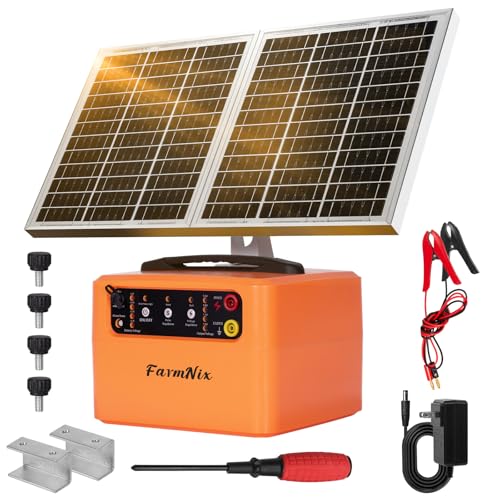
This model provides up to 30 miles of fence coverage with adjustable output up to 1.5 joules. It targets large pastures and multi-wire systems, with a 15W solar panel and a sealed lead-acid battery for multi-day operation. It supports 24-hour protection and is designed for durability across seasons. Limitation: high-mileage setups require careful layout planning to maximize reach.
Who this is best for: farms with long perimeter fences and diverse livestock. Why selected: high energy and adjustable output help tailor pulses to varying pasture conditions and wildlife pressure.
Limitation: longer fences may demand more than one charger for uniform coverage.
Solar Fence Charger LD03 — 1.0J, 45 Miles

LD03 delivers a steady 1.0 joule energy and a voltage pulse range of 8,000–12,000V. It emphasizes reliability in remote pastures with an upgraded 8W solar panel and large-capacity battery. It can cover up to 45 miles, making it suitable for large farms and rotational grazing. Caution: performance relies on weather and fence grounding integrity.
Who this is best for: operators prioritizing可靠 long-range performance with dependable night operation. Why selected: the combination of high pulse voltage and broad coverage makes it a strong all-around option for sizable properties.
Limitation: ensure proper grounding and fence wire configuration to maximize output.
ANDMON MINI400 30 Miles Solar Fence Charger
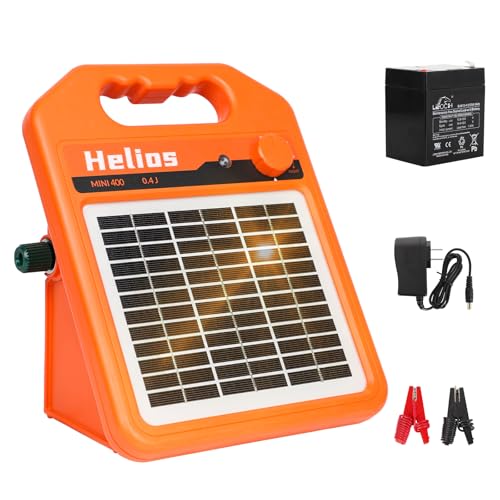
This compact charger powers up to 30 miles of fencing with a 0.4 joule output, featuring day/night mode and dual power options (solar or DC charger). It is designed for flexible installation and quick setup, making it ideal for smaller operations with long fences. Caution: lower joule output compared to top-tier designs means it’s best for moderate predator pressure and smaller livestock herds.
Who this is best for: small to medium farms seeking dependable day/night pulses with easy installation. Why selected: compact form and dual power options provide flexibility where solar access is variable.
24 Hour Solar Electric Fence Charger — 10 Miles
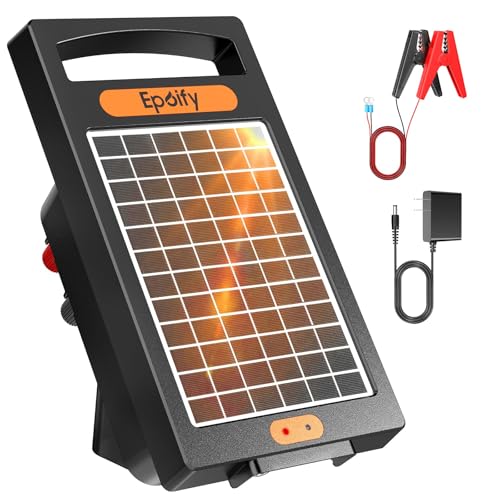
This unit delivers 0.18 joules with a 10-mile coverage, designed for 24/7 operation. It stores energy during daylight for overnight protection, ideal for small-to-medium pastures. It suits buyers who want a straightforward, easy-to-maintain solar option with reliable day/night performance. Limitation: lower energy may not deter larger predators or very dense vegetation near the fence.
Who this is best for: livestock keepers with moderate fencing needs and a focus on around-the-clock protection. Why selected: simple, robust design that maintains fence voltage through daily cycles.
Buying Guide: Key Considerations For Solar Fence Chargers
- Coverage vs. Joule: Higher joules offer stronger pulses, but coverage distance depends on fence type, wire, and grounding. Match joule output to pasture size and livestock type.
- Solar Panel And Battery Quality: Larger panels and higher-capacity batteries improve performance during cloudy days and at night. Look for models with weatherproof enclosures.
- Mode Options: Day/Night modes save energy; dual-power inputs (solar + DC) provide flexibility in variable environments.
- Grounding And Fence Design: A solid grounding system enhances pulse effectiveness. Fence wire layout and knotting can affect performance, so plan multi-wire routes accordingly.
- Maintenance: Choose units with clear indicators for battery health and short-circuit alarms to simplify routine checks and troubleshooting.
- Predator Management: If predator pressure is high (wolves, foxes, bears), prioritize higher joule outputs and longer coverage to deter intrusion across long fence lines.
Frequently Asked Questions
- What determines how far a solar fence charger can energize?
Answer: The combination of joule output, voltage pulse, fence type, wire layout, ground quality, and environmental conditions. - Do I need a sunny location for best results?
Answer: Yes; solar panels charge best with direct sun, and cloudy days require larger batteries or higher-quality panels. - Can I use these chargers for large predators?
Answer: Higher joule models are generally more effective; always assess local wildlife and fence design before installation. - What maintenance is required?
Answer: Regularly inspect grounding connections, clean panels, verify battery health, and check alarms or indicators. - Are dual-power options worth it?
Answer: Yes, they add reliability in low-sun periods and remote locations. - How long do these units last in harsh weather?
Answer: Durable enclosures and proper sealing extend life; choose models rated for all-weather use.