Best 4000 Watt Inverter Chargers for Reliable Off-Grid Power and RV Setups
Answering the question “which 4000 watt inverter charger is best for my needs?” this guide focuses on dependable pure sine wave inverters that combine AC power, battery charging, and transfer switching. It targets buyers seeking home backup, RV and off-grid setups, or mobile work sites where sensitive electronics require stable power. The top products below are chosen for versatility, wide battery compatibility, and practical features like remote monitoring and generator start. A quick summary table follows to help you compare core specs at a glance.
| Product | Input Voltage | Output | Key Benefit |
|---|---|---|---|
| SUNGOLDPOWER 4000W Pure Sine Wave Inverter Charger | 12V | 120V | Flexible DIP switches and remote control |
| SUNGOLDPOWER 4000W Inverter Charger (Upgrade) | 12V | 120/240V Split Phase | Remote LCD with battery temp sensor |
| Giandel 4000W Pure Sine Wave Inverter (24V) | 24V | 110-120V | Higher voltage option for certain off-grid layouts |
| AIMS Power 4000W Pure Sine Inverter Charger | 12V | 120V | Multiple battery types and robust protections |
| LANDERPOW 4000W Pure Sine Wave Inverter | 12V | 120V | 4 AC outlets plus USB and PD ports |
SUNGOLDPOWER 4000W Pure Sine Wave Inverter Charger

This unit combines a 4000W DC 12V inverter, a 120A charger, and an automatic transfer switch. It supports 120V AC output with up to 12000W surge for brief start-up loads, making it suitable for home appliances, RVs, boats, and off-grid systems. It offers DIP switch controls for utility priority, charging current, and other settings, along with Automatic Generator Start and remote monitoring. Best for buyers who want a compact, all-in-one system with flexible mode settings.
Best for: RVs and small homes that require a single, integrated inverter-charger with user-accessible settings. Limitations: 88% transfer efficiency means some loss under heavy load; ensure battery bank and generator compatibility match your load profile.
SUNGOLDPOWER 4000W Inverter Charger (Upgrade Version)
This upgraded model features a split-phase 120/240V output, a built-in 120A charger, 30A transfer switch, and a remote LCD with battery temperature sensor. It supports auto Gen Start and an automatic transfer switch between AC sources and battery sources. It’s better for off-grid homes or shops that need higher voltage distribution and a comprehensive monitoring panel. Choose this if you require more configuration options and split-phase capability.
Best for: Off-grid installations needing 120/240V distribution and a true LCD remote interface. Caution: split-phase operation adds complexity—verify your electrical layout accommodates 240V circuits.
Giandel 4000W Pure Sine Wave Inverter (24V)

This Giandel model runs on 24V input with a peak of 7000W surge, making it well-suited for higher current systems where a 24V battery bank is already in use. It emphasizes safety with an LCD screen showing voltage and load, UL-listed components, and GFCI protection on outlets. It’s best for 24V off-grid configurations and users needing higher surge headroom. Limitation: 24V systems require appropriate battery bank setup and wiring.
Best for: 24V off-grid setups requiring strong surge capability and UL-listed protection. Avoid this if your system is strictly 12V unless you convert the battery bank to 24V safely.
AIMS Power 4000W Pure Sine Inverter Charger (12V)

This AIMS Power offering provides 4000W continuous power with a 120A smart charger and a 120VAC pure sine output. It includes an auto transfer switch, multiple battery technology support, and protections against overload, temperature, voltage events, and short circuits. It’s ideal for mixed-battery environments and users needing robust safety protections with straightforward wiring. Use this when you prioritize versatile battery compatibility and an integrated AC terminal block.
Best for: Users with diverse battery chemistries seeking a reliable, feature-rich inverter-charger. Limitation: some setups may benefit from remote panels for easier access to data while installed in a cabinet.
AIMS Power 4000W 24V Inverter Charger
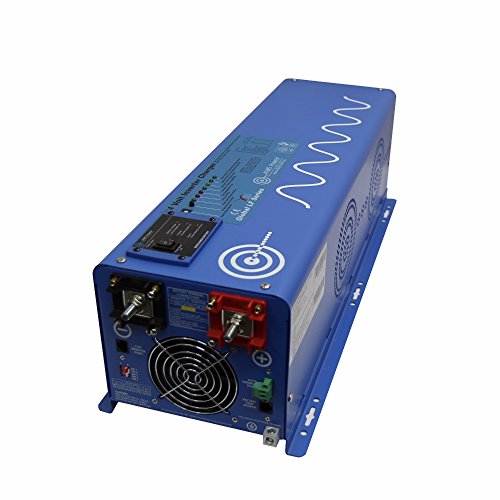
This 24V version delivers 4000W continuous power with 120V output and a 7000W surge. It includes a 50A smart charger, auto transfer switch, and supports eight battery types. It is best for larger off-grid or vehicle installations that already lean to 24V battery stacks. A caution is the need for compatible 24V battery arrays and wiring designed for higher current.
Best for: 24V off-grid systems with diverse battery chemistries and a requirement for multi-stage charging. Choose this if your system runs at 24V and you need strong surge support.
Giandel 4000W 24V Pure Sine Wave Inverter (With 24V input)

This 24V model emphasizes safety with a large LCD screen showing voltage, load, and protection modes, plus UL-listed GFCI outlets. It’s designed for longer, steadier runs in RVs or off-grid homes that rely on a 24V battery bank. It’s best for users prioritizing LCD visibility and UL protection, with the reminder to ensure your 24V system matches the inverter’s input requirements.
Best for: 24V setups seeking simple monitoring and reliable GFCI protection. Limitation: requires a compatible 24V battery bank and appropriate cabling to handle high current.
Buying Guide: Key Considerations For 4000W Inverter Chargers
- Your battery voltage and type. Most 4000W inverters run on 12V, but 24V options exist. Match the inverter to your battery bank (lead-acid, AGM, gel, LiFePO4, etc.).
- Output phase. A 120V single-phase unit covers standard household appliances. Split-phase models (120/240V) suit larger RVs and certain off-grid layouts but require appropriate wiring.
- Surge capability. Look for a high surge rating (often 7000–12000W) to handle motor start-ups, HVAC, and power tools.
- Transfer mechanism. An automatic transfer switch (ATS) minimizes power interruption when switching between AC sources and batteries or generators.
- Battery charger and charging current. Higher charging current reduces recharge time but requires a compatible battery and wiring ballast; check adjustable charging current and multi-stage charging.
- Remote monitoring and control. LCD panels, remote controls, and battery sensors improve visibility and safety in remote installations.
- Protection features. Overload, over-temperature, low/high voltage, and short-circuit protections reduce risk to appliances and the inverter itself.
- Connectivity. Ensure the unit offers sufficient AC outlets, USB or PD ports if you need device charging beyond AC appliances.
- Ventilation and installation. Consider cabinet space, cooling requirements, and whether you need remote mounting capabilities for easy access.
- Compatibility with generator start. If you rely on generators, units with Automatic Generator Start simplify automatic power resumption during outages.
Frequently Asked Questions
- What is a 4000W inverter charger best suited for? It suits RVs, off-grid homes, and backup power setups needing a reliable pure sine wave with integrated charging and transfer switching.
- Do I need a 12V or 24V system? Choose a 12V if your battery bank uses 12V cells; choose 24V for higher efficiency with larger loads or if your system is designed for 24V batteries.
- What is a pure sine wave inverter? It delivers power that mimics grid power, ideal for sensitive electronics like computers and appliances with motors.
- How important is the transfer switch? It minimizes downtime by switching sources automatically, reducing wear on devices and keeping loads stable.
- Can these inverters power high-start devices? Yes, most 4000W units provide 7000–12000W surge for a few seconds to handle startup surges.
- What safety features should I look for? Look for overheat protection, under/over-voltage protection, short-circuit protection, and GFCI outlets where applicable.