Best 15 Amp Breaker Box Solutions for Safe Home and Shop Circuits
Looking for a reliable 15 amp breaker box to protect your circuits? This guide highlights five solid options suited for different buyers, from DIY homeowners to outdoor installers. Each entry explains who it’s best for, why it was selected, and any limitations to consider. Use this summary to compare core specs at a glance, then dive into detailed product sections to decide which is right for your panel and wiring setup.
| Product | Type | Best For | Key Benefit |
|---|---|---|---|
| SIEMENS Q115 15-Amp Single Pole | Single Pole | Household circuits, quick plug-in | Fast install in Siemens enclosures |
| DIHOOL AC/DC Miniature Breaker | DIN Rail, IP65 | Industrial-looking panels, outdoor or damp spaces | High protection and wide voltage range |
| HIITIO 15 Amp GFCI Outdoor Box | GFCI with weatherproof box | Outdoor RV/EV or generator setups | Tamper-resistant and weather-rated |
| DIHOOL Outdoor Breaker Box | DC/AC 15A Mini Breaker | Outdoor solar or DC/AC installations | UV and IP66 rated enclosure |
| SIEMENS Q1515 Duplex 15 Amp | Duplex 2-pole (two singles) | Compact multi-circuit setups | Space-saving plug-in design |
SIEMENS Q115 15-Amp Single Pole Type QP Circuit Breaker

Best for: Home owners upgrading or replacing a single 120V circuit in Siemens load centers. This 15A single pole QP breaker provides 120V operation with a 10,000 AIC interrupting rating, and uses the Insta-wire feature for faster, cleaner connections. It is ideal when a quick, straightforward plug-in replacement is needed in compatible Siemens enclosures. Caution: verify panel compatibility with the QT/QP family and ensure correct bus bar fit before installation.
DIHOOL AC DC Miniature Circuit Breaker with IP65 Din Box, 15 Amp Dual Pole

Best for: Panels requiring IP65-rated protection and dual-pole operation for mixed AC/DC circuits. This DIN rail mounted breaker box combines a 15A miniature breaker with a robust PC+ABS enclosure, offering high impact and heat resistance, flame retardancy, and UV stability. Its three-way box design provides more wiring space than typical two-way layouts. Caution: ensure your system voltage range (DC 12-400V or AC 90-400V) matches device capability before wiring.
UNBRANDED 4-OUTLET BOX C664502001

Best for: Basic workshop or garage setups needing a convenient 15A GFCI-protected outlet box. The unit includes a built-in circuit breaker for overload protection and a lighted on/off switch for easy status checks. Suitable for general-purpose outlets in smaller electrical projects. Caution: not a full main breaker box—use where a dedicated branch-circuit protection and grounded outlets are sufficient.
DIHOOL 15 Amp Circuit Breaker Box DC 1000V
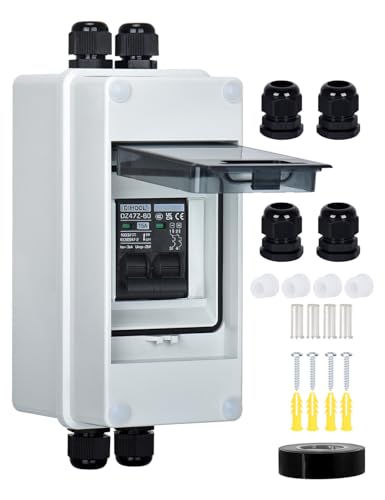
Best for: Outdoor or solar-focused installations requiring DC protection and a rugged outdoor enclosure. This 15A breaker is rated for up to 1000V DC and features a UV-proof PC enclosure with IP66 weatherproofing. It supports 12-500V DC systems and can handle dual-pole or single-pole configurations. Caution: designed primarily for DC applications; verify compatibility with your inverter or PV system wiring and polarity requirements before use.
SIEMENS Q1515 15 Amp Duplex Circuit Breaker

Best for: Small spaces needing two 15A circuits in one compact unit. The Q1515 duplex design gives two single-pole, 15-amp slots in a single 1-inch format, suitable for Siemens load centers and meter combinations rated to accept QT breakers. Caution: not compatible with non-Siemens panels or QO-series panels; confirm panel model and wiring diagram before installation.
Buying Guide
- Panel compatibility: Ensure the breaker type (QP, QT, Q1515, etc.) matches your load center or panel model. Mixing brands or incompatible series can create safety risks.
- Electrical rating: Confirm voltage and current ratings align with your circuits (e.g., 120V, 15A). Outdoor or DC applications may require different ratings like IP66 or DC compatibility.
- Enclosure environment: Outdoor and damp locations benefit from weatherproof, UV-resistant enclosures and GFCI/IP-rated protections. Indoor use may not require rugged housings.
- Pole configuration: Decide between single-pole for individual circuits or duplex/multi-pole options for multiple circuits in a compact space. Consider future expansion as well.
- Safety features: Look for features such as instant wiring access, lockable lids, tamper resistance, and arc suppression where applicable to improve safety and reliability.
Practical considerations
- Installation ease: Breakers designed with plug-on mounting and Insta-wire features shorten setup time and reduce wiring errors.
- Durability: Outdoor-rated and flame-retardant enclosures reduce exposure risks in harsh environments.
- Maintenance: Use components with clear status indicators or visual inspection access to monitor circuit health and tripping behavior.
FAQ
- What is the difference between a single-pole and a duplex 15A breaker?
Answer: A single-pole breaker protects one hot conductor for a single circuit, while a duplex breaker provides two independent 15A circuits in one unit, saving panel space. - Can I mix DIHOOL and SIEMENS breakers in the same panel?
Answer: It depends on panel compatibility. Use breakers only if the panel manufacturer approves the specific brand and model mix; otherwise, stick to the same family as the panel. - Is GFCI protection necessary for outdoor outlets?
Answer: For outdoor receptacles exposed to moisture or rain, GFCI protection is recommended to reduce shock risk; check local codes for requirement. - What cautions should I consider when selecting an outdoor 15A box?
Answer: Verify IP rating, environmental exposure, and UV resistance; ensure DC/AC compatibility if the system uses direct current or solar components. - Do I need a main breaker with these 15A units?
Answer: Not always. Small installations may rely on downstream breakers, but larger or remote setups often require a main service disconnect for safety and code compliance. - How do I verify panel compatibility before purchasing?
Answer: Check the panel’s wiring diagram and the manufacturer’s compatibility list for breakers and series; confirm bus bar design and pole configuration.