Best High-Voltage DC Power Supplies for 250V Projects and Beyond
Answering the need for reliable high-voltage DC power in lab, hobbyist, or industrial settings, these five power supplies cover a range from compact 170–250V options up to 400V. They’re suited for HV experiments, tube displays, LED projects, and precision voltage/current regulation. The best choice depends on your voltage ceiling, current requirements, memory features, and software control needs. Below is a quick comparison to help you pick the right model for your application.
| Product | Key Feature | Best For |
|---|---|---|
| NICE-POWER DC Power Supply Variable, 0-400V 0-1A | Memory storage, encoder knob, 0.01V/0.001A display | Precise experiments with saved voltage/current presets |
| High Voltage DC Converter Module Board for Nixie & Magic Eye | 250V output, compact module for HV clocks/indicators | Nixie tubes and glow indicators |
| NICE-POWER DC Power Supply Variable, 300V 1A | RS232/USB control, memory, encoder knob | Lab setups needing PC control and memory |
| 170V DC High Voltage Power Supply Module Boost | Output up to 250V, compact boost module | HV tube clocks and small displays |
| Jesverty DC Power Supply Variable, 0-120V 0-3A | 4-digit display, CV/CC automatic switching | Versatile bench supply for mixed loads |
NICE-POWER DC Power Supply Variable, 0-400V

The NICE-POWER model provides a wide 0–400V output with current up to 1A. It features four memory slots (M1–M4) to save commonly used voltage and current values for quick recall. The encoder knob allows fast, precise tuning, and pressing the knob selects the digit position for adjustment. An output switch protects the connected load, and the 4-digit color display shows voltage to 0.01V and current to 0.001A. This unit is best for precision HV experiments, tube projects, and testing that benefits from stored presets. Caution: high voltage requires careful insulation and safe handling practices.
Best for: researchers or technicians needing precise, repeatable high-voltage settings and quick recall of favorite configurations.
Limitations: current is limited to 1A; care is required to prevent overcurrent scenarios with heavy loads.
High Voltage DC Converter Module for Nixie & Magic Eye

This module delivers a 250V DC output suitable for Nixie tubes and glow indicators. It’s a compact board suitable for integration into custom HV projects. The module’s DC input is a standard DC power plug with inner positive and outer negative orientation. This option is ideal for hobbyists building small HV displays or clock projects that rely on a stable 250V supply. Limitation: may require additional regulation or current limiting depending on the load and configuration.
Best for: DIY HV projects like Nixie clocks or glow-tube indicators where a compact HV source is needed.
Limitations: not a full bench supply; integration and protection depend on your circuit design.
NICE-POWER DC Power Supply Variable, 300V 1A
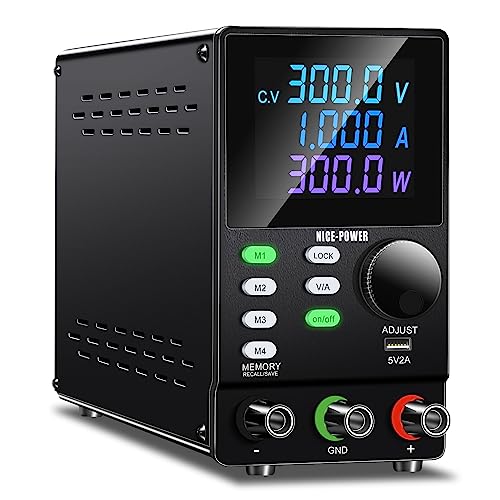
This high-voltage model offers 0–300V at up to 1A with computer-friendly features. It includes an encoder knob for precise setting, a memory storage function for quick recall, and a locking button to prevent accidental changes. The unit supports RS232/USB control when paired with the specified software, enabling data export and charting. It’s well-suited for labs that require PC-based control and repeatable HV outputs. A limitation is that software support is Windows-only and may require installation steps.
Best for: lab environments that value remote control, data logging, and repeatable 300V HV experiments.
Limitations: Windows-only software may require additional setup and driver installation.
170V DC High Voltage Power Supply Module Boost

This boost module provides 90–250V DC output from a 10–24V input, making it a compact choice for driving glass Nixie tubes or similar HV indicators. The higher output voltage comes with lower available current, approximately up to 25mA at 170V. It is a suitable choice where space is limited and a high-voltage source is required for a few tubes or indicators. Better for small, dedicated HV displays; avoid if you need sustained higher current at HV.
Best for: compact HV displays or clocks where limited current is acceptable and space is at a premium.
Jesverty DC Power Supply Variable, 0-120V 0-3A

The Jesverty SPS-12003 provides a 0–120V, 0–3A adjustable output with a four-digit display showing voltage, current, and derived power. It features automatic CV/CC mode switching to maintain stable operation as load varies. This model is versatile for general lab use, battery charging experiments, and electronics repair where consistent regulation matters. Caution: while capable of 0–3A, exceeding the current limit will force a transition to CC mode and limit voltage accordingly.
Best for: versatile bench work with mixed loads needing CV/CC auto-switching and precise readouts.
Limitations: limited to 120V output, so not suitable for higher-voltage HV projects relying on 250V+.
Buying Guide
What voltage range do you actually need?
Choose a unit whose maximum voltage meets or exceeds your target working voltage. If you frequently work near 250V–300V, a supply with a 300–400V ceiling gives headroom for ramping and testing without hitting the limit.
Current requirements matter
Consider your load current. HV tubes and indicators often require only a few milliamps at high voltage, while some experiments or charging tasks need amperes. Pick a supply with a current rating that matches the worst-case load, plus a safety margin.
Control and programmability
Decide if you need memory presets, encoder knobs, or PC control. Memory slots simplify repetitive tests; PC control helps when running data logs or automated test sequences. Note software compatibility to avoid workflow friction.
Protection and safety features
Look for output switches, lock functions, over-voltage and short-circuit protection, and thermal management. HV work benefits from clear labeling, proper insulation, and a robust enclosure to prevent accidental contact.
Display clarity and measurement resolution
Four-digit or higher displays with precise voltage and current readouts reduce measurement error. Ensure the display resolution (e.g., 0.01V, 0.001A) aligns with your precision needs.
Size, cooling, and integration
Higher voltage models may be larger or generate more heat. If space is constrained, compact modules can fit into a custom enclosure, but ensure adequate cooling and safe mounting.
FAQ
- Can I use a 250V supply for 170V tasks? Yes, but ensure the current and regulator limits are not exceeded. Some HV supplies allow safe operation at lower voltages, but check the device specifications.
- What is CV/CC mode? CV keeps voltage constant while current can vary; CC regulates current while voltage may drop as load increases. Many supplies switch automatically between CV and CC.
- Do these supplies require software? Some models offer Windows-only PC control. Others are standalone with knobs and displays. Choose based on whether you need remote control.
- Is high voltage dangerous? Yes. Use proper insulation, avoid touching exposed conductors, and work on non-conductive surfaces with protective gear when necessary.
- Are these suitable for Nixie tubes? Several models support HV outputs suitable for Nixie displays, glow tubes, or similar indicators, but verify current limits to prevent tube damage.