Best 10 Amp Battery Maintainer for Your Vehicles and Gear
If you’re shopping for a 10 amp battery maintainer, you want a device that protects, extends, and maintains your battery with minimal hassle. This guide highlights five top options, detailing who they’re best for and why each stands out. Whether you need marine, automotive, or multi-chemistry support, these models help prevent sulfation, recover weak cells, and keep batteries ready for use.
Summary at a glance: the table below offers quick comparisons to help you choose.
| Product | Best For | Key Benefit |
|---|---|---|
| NOCO GENIUS10 | 6V/12V lead-acid and LiFePO4 enthusiasts | All-in-one charger, maintainer, desulfator with temperature compensation |
| NOCO GENPRO10X1 | Harsh marine environments | Compact onboard, adjustable modes per bank |
| COREBOX Battery Charger 10-Amp | All-weather, workhorse maintenance | All-climate, diagnostic and recovery tech |
| Battery Tender Power Tender 10 Amp | Large batteries in trucks, RVs, marine | Four-stage ISM smart charging, IP67 waterproof |
| DeWalt DXAEC10 | Durable, multi-chemistry maintenance | 3-in-1 with high-frequency charging |
NOCO GENIUS10: 10A 6V/12V Smart Charger
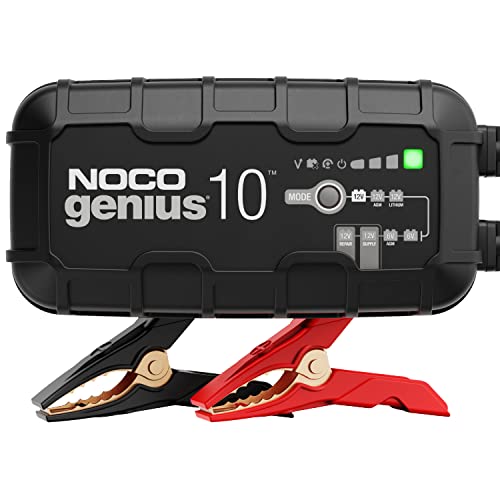
Best for general use with mixed battery types. The GENIUS10 is a versatile all-in-one solution—charger, maintainer, trickle charger, and desulfator—designed for 6V and 12V lead-acid varieties (AGM, Gel, SLA, VRLA) and LiFePO4 batteries. Its integrated thermal sensor adjusts charge with ambient temperature to reduce overcharging in heat and undercharging in cold, helping optimize battery longevity. Suitable for boats, cars, and seasonal equipment.
Who it’s best for: owners seeking a single device that handles charging and long-term maintenance across battery chemistries without swapping units. Avoid if you need separate outdoor-rated units for extreme environments; verify compatibility with your specific LiFePO4 battery model.
NOCO Genius GENPRO10X1: 1-Bank Onboard Charger

Best for compact, marine-focused installations. The GENPRO10X1 offers 10 amps per bank in a single-bank onboard charger, making it suitable for boats, starters, and deep-cycle systems that require precise, independent charging. It features selectable modes (12V, 12V AGM, 12V Lithium, and 12V Repair Mode) to optimize charging for each battery type. Its compact design is ideal where space is at a premium and harsh marine conditions are common.
Who it’s best for: sailors or boat owners needing a robust, single-bank charger with selectable chemistries. Better for environments where a compact, highly adaptable charger is prioritized. Limitation: as a one-bank unit, you won’t have simultaneous multiple-bank maintenance without a second unit.
COREBOX Battery Charger 10-Amp 12V/24V

Best for all-weather reliability with smart diagnostics. This charger provides 10A auto-detecting charging for 12V/24V systems and supports lead-acid and LiFePO4 chemistries. It emphasizes diagnostic features like real-time data on voltage, current, and power, plus triple protection (polarity, short circuit, and overload). The design includes a fireproof casing and a robust cold-to-warm climate range, making it suitable for outdoor or industrial use.
Who it’s best for: users who want a thorough, weather-ready charger with built-in diagnostics. Choose this if you need a maintenance unit that also helps revive or extend battery life through protective monitoring. Limitation: data-heavy feature set may be more than needed for casual users.
Battery Tender Power Tender 10 Amp

Best for large batteries and heavy-duty maintenance. The 10-amp output supports rapid recovery for 40Ah to 200Ah batteries, including AGM, Gel, and LiFePO4. It uses four-stage ISM (infinite sequential monitoring) charging that starts with bulk, moves through absorption, and ends in float maintenance. The IP67 waterproof rating makes it resilient for marine or outdoor installations, including bilge areas.
Who it’s best for: vehicle fleets, RVs, or boats with large battery banks that require reliable maintenance with long-term weather resistance. Limitation: designed to stay connected; disconnecting after full charge is recommended to avoid parasitic draw in some setups.
DeWalt DXAEC10 Battery Charger

Best for professionals needing a durable, multi-chemistry solution. The DeWalt DXAEC10 functions as a charger, maintainer, and trickle charger with compatibility for 6V and 12V AGM, GEL, or WET plus LiFePO4 batteries. It emphasizes fully automatic, high-frequency charging to restore engine-start performance and extend battery life.
Who it’s best for: contractors or workshop environments where a rugged, all-in-one maintenance unit is valued. Limitation: may be overkill for casual home use; ensure battery chemistry aligns with supported profiles.
Buying Guide
Do I need a multi-chemistry charger?
If you own different battery chemistries (lead-acid, AGM, LiFePO4, etc.), a multi-chemistry charger reduces the need for multiple devices. Look for models with auto-detect or selectable modes for each chemistry to avoid overcharging or undercharging.
Should I prioritize onboard (single-bank) or portable (multi-bank) systems?
Onboard solutions are ideal for boats or RVs with fixed charging needs, while portable units suit cars, trucks, and work sites where flexibility matters. Multi-bank units let you maintain several batteries simultaneously; single-bank units are compact and space-saving but may require more planning.
How important is temperature compensation?
Temperature compensation prevents overcharging in hot conditions and undercharging in cold weather. If you store or use batteries in garages, outdoors, or unheated spaces, choose a model with an integrated temperature sensor or compensation feature.
What warranties or supports should I expect?
Prefer models with stated safety protections (overload, reverse polarity, short circuit) and clear user manuals. Waterproof or weatherproof designs are valuable for marine or outdoor installations. Confirm ease of replacement parts, where applicable.
Maintenance vs. charging: what’s the difference?
A true maintainer keeps a full charge over long periods and protects against discharge. A charger often focuses on bringing a battery up from low voltage. A model labeled as both typically offers automatic maintenance after initial charging.
Installation considerations
For onboard or marine setups, check space, mounting options, and weather exposure. Ensure the device supports your battery bank size and can run safely in your environment. Electrical codes and manufacturer guidelines should guide installation.
Quick FAQ
- What is a 10-amp battery maintainer best for? It’s ideal for maintaining mid- to large-capacity batteries and for faster recovery during routine maintenance, especially when storage periods are long.
- Can these units revive sulfated batteries? Some models include a desulfation or repair mode designed to help partially revive sulfated cells. Effectiveness varies by battery condition.
- Are these suitable for LiFePO4 batteries? Several listed models support LiFePO4 along with lead-acid chemistries. Always verify compatibility with your specific battery model.
- Is waterproofing important for marine use? Yes. An IP rating (such as IP67) adds protection against water immersion and dust, beneficial in bilge and outdoor installations.
- Can I leave these devices connected all the time? Many units are designed for continuous maintenance, but always follow the manufacturer’s guidance to prevent parasitic drain or unnecessary cycling.