Best 12v PIR Motion Sensor Solutions for LED Lighting
Shopping for a 12V PIR motion sensor for LED strip lights? This guide highlights five reliable options that balance adjustable detection ranges, flexible delay timers, and durable build quality. Each product is suitable for cabinets, under-cabinet lighting, closets, and outdoor setups where hands-free lighting helps save energy. Read on for concise overviews, key features, and practical buying tips to help you compare swiftly and choose the right sensor for your space.
| Product | Brand | Key Benefit | Voltage/Current |
|---|---|---|---|
| Weewooday 3 Packs PIR Sensor Kit | Weewooday | Flexible multi-pack for several lighting runs | 12-24V, up to 6A |
| Yogcow DC PIR Motion Sensor Light Switch | Yogcow | Adjustable delay and light-sensitivity modes | 12-24V, variable current |
| HiLetgo Outdoor PIR Switch | HiLetgo | Outdoor-ready for flood lights and decks | 12V, 5W-30W load |
| QWORK 2 Pack Motion Sensor LED Switch | QWORK | Compact, 5-8m induction range | 12-24V, 6A |
| RAYZEEK Low Voltage Ceiling Sensor | RAYZEEK | 360-degree field with energy efficiency | 12-24V, 10A |
Note: The table highlights basic specs and typical applications. Always verify exact current ratings and installation requirements before wiring to your LED strips or fixtures to ensure safe operation and compliance with local electrical codes.
Weewooday 12V PIR Sensor Kit
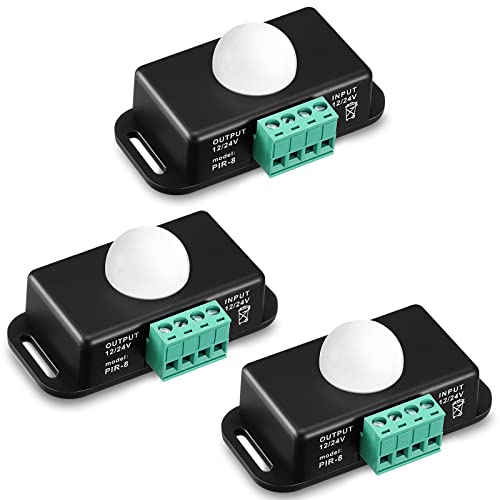
The Weewooday kit comes as a trio of adjustable PIR sensors designed for 12 to 24V LED strip applications. Each unit supports a current up to 6A, providing compatibility with multiple lighting solutions in a single project. Users can set a detention period using a back button to control how long the LED remains on after motion is detected, ranging from 1 to 10 minutes. The sensor features a 120° detection angle and a 5–8 meter sensing distance, enabling practical placement in cabinets, under-cabinet areas, or small rooms. This option suits DIY installations where multiple zones require independent control or rapid deployment across several lighting runs. The embedded probes make it convenient for flexible LED strip configurations, and the package often suits hobbyist or semi-professional setups looking for reliable, compact PIR control.
Yogcow PIR Motion Sensor Light Switch

The Yogcow sensor provides motion-triggered lighting with a 10–16 foot range and a choice of three light-sensitivity modes to adapt to different ambient conditions. It turns on automatically when motion is detected and remains on while movement continues, with a delay option to extend illumination after activity ceases. The product’s flexibility includes a selectable delay time (3 seconds, 45 seconds, or 4 minutes) to tailor runtime for under-cabinet or closet lighting. This makes it well-suited for spaces where ambient light varies, such as kitchens with windows or rooms with fluctuating daylight. The three sensitivity modes help avoid unnecessary activation in bright environments or near windows, delivering efficient, hassle-free operation.
HiLetgo Outdoor PIR Motion Sensor Switch

HiLetgo’s outdoor PIR switch is designed specifically for exterior lighting, with a 12V DC input and a load capacity suitable for outdoor LED flood lights. At its core, the sensor provides straightforward infrared detection to switch loads on or off based on movement. This unit is a practical choice for yard floodlights, porches, and entryways where weather resistance and reliable triggering matter. While the basic specification confirms outdoor usability, users should confirm enclosure ratings and wiring practices for exposed environments. The simplicity of the device makes it quick to install for those focusing on a single-area lighting upgrade rather than a multi-zone system.
hiBCTR Outdoor PIR Motion Sensor Switch

hiBCTR offers a two-pack outdoor PIR switch with adjustable sensitivity and delay timer, aimed at security lighting and broader area illumination. The product highlights include a wide detection angle (up to 140° horizontal and 90° vertical) with an impressive 10-meter range, plus IP44 weatherproof housing for outdoor use. The industrial-grade power specs support 12V DC input with a substantial load capacity, suitable for LED flood lights and similar fixtures. The two-pack configuration is beneficial for coordinating lighting across multiple exterior zones or for replacing aging units in multiple outdoor locations. Appropriate for homes and small businesses seeking reliable, weather-resistant motion sensing in outdoor lighting systems.
QWORK Dual Pack Motion Sensor LED Switch

QWORK’s two-pack motion sensor LED switches are designed for 12–24V operation with a 6A load rating. They provide an adjustable delay time from 1 to 10 minutes and an induction distance of 5 to 8 meters. The 60° field of view helps localize lighting control to a defined zone, making them ideal for LED strip lighting along stairways, hallways, or under cabinets where motion triggers a targeted glow. The compact form factor supports easy wall mounting and integration into existing lighting circuits. This option is suited for users who want a dependable, mid-range motion sensor with straightforward settings in a dual-pack configuration.
RAYZEEK 12V-24V Low Voltage Ceiling Sensor

The RAYZEEK ceiling sensor is engineered for 12–24V systems with a high sensitivity, offering a 360-degree field of view for comprehensive coverage in residential or commercial spaces. It claims an energy-efficient profile and a quick setup process through straightforward button adjustments. The device supports a 15-second to 1-minute to 30-minute time-delay range and a default ambient light sensor setting that can be customized. This model is well-suited for ceiling-mounted lighting schemes in offices, small retail spaces, or homes where uniform ceiling coverage and low-profile installation are priorities. Its PC fireproof construction adds an extra layer of safety for integration into building lighting networks.
Buying Guide: Choosing the Right 12V PIR Sensor for LED Lighting
- Detection range and angle: Consider the room size and placement. A wider field of view and longer range help cover larger areas, but may trigger in adjacent spaces. Look for a sensor with a 120°+ angle and a 5–8 meter range as a practical baseline.
- Power compatibility: Verify that the sensor supports your LED strip’s current draw. Most 12V devices handle up to 6A; ensure the aggregate load does not exceed the controller rating.
- Delay and sensitivity options: Adjustable delay (1–10 minutes or shorter) helps tailor lighting behavior to activity patterns. Light-sensing modes (dark, light, all-day) keep lights off in bright rooms and on when needed.
- Environment and mounting: Outdoor installations require weatherproof housing (IP44 or higher) and proper sealing. Indoor uses benefit from compact size and easy wall or cabinet mounting.
- Number of zones: For multi-zone setups, consider packages that include multiple sensors, or plan to deploy individual units with independent controls for flexible lighting layouts.
- Safety and maintenance: Confirm voltage stability (12V ±10%) and check for any enclosure or wire ratings that match local electrical codes. Regularly inspect wiring connections to prevent arcing or dinning.
- Installation complexity: Some units offer embedded probes and plug-and-play mounting, while others require routing wires through cabinets or ceilings. Choose based on comfort with electrical work and desired aesthetics.
- Durability and weather resistance: Outdoor-rated sensors should have robust IP ratings and corrosion-resistant housings to withstand temperature changes and moisture exposure.
Overall, the best choice depends on your space, whether you need indoor cabinet lighting or outdoor floodlights, and how many zones you want to control. Balancing detection characteristics with power handling and environmental suitability will yield a sensor that improves convenience while saving energy over time.