Best Solar Panel Home Setup Kits for Reliable Home Power
Turning sunlight into dependable home electricity is easier with all-in-one solar panel kits designed for households. This guide highlights five top ECO-WORTHY setups that optimize space, installation, and performance for residential use. Each option combines high-efficiency panels, robust inverters, and scalable batteries to support daily chores—from refrigeration to cooling and entertainment—while enabling parallel or grid-tied configurations as needed.
| Product | Output (Est.) | Battery Bank | Inverter / Controller |
|---|---|---|---|
| ECO-WORTHY 10KW Off-Grid Home Kit | ~9.36 KWh/day | 2x 48V 100Ah Li Batteries | 10kW Inverter, 120/240V AC, UL listed |
| ECO-WORTHY 4.68KWh Complete Kit | ~4.68 KWh/day | 1x 48V 50Ah Li Battery | 3500W Inverter, 48VDC to 110/120VAC |
| ECO-WORTHY 10,000W Complete Off-Grid Kit | ~40 KWh/day | 4x 48V 100Ah Li Batteries | 2x 5kW Off-Grid Inverters |
| [Ultra] ECO-WORTHY 1200W System | ~5.52 KWh/day | 2x 12.8V 280Ah Li Batteries | 3000W Inverter, MPPT Controller |
| ECO-WORTHY 400W RV / Off-Grid Kit | ~1.6 KWh/day | 1x 12V 100Ah Li Battery | 400W Inverter / Bluetooth MPPT |
ECO-WORTHY 10KW Off-Grid Home Kit

The ECO-WORTHY 10KW Off-Grid Home Kit combines a multi-panel 2340W array with a 10KW inverter for residential power reliability. It supports parallel expansion up to six units for greater capacity, and it offers a real-time CAN/RS485 battery monitor with a mobile app. UL certifications and CEC compliance are highlighted for safety and market access. Ideal for homes, cabins, sheds, or farms needing a strong energy backup with 240V split-phase support.
ECO-WORTHY 4.68KWh Solar Power Complete Kit

This 1200W kit features a high-efficiency 195W N-Type bifacial solar panel array and a 3500W inverter with built-in WiFi. It supports parallel connections of up to six units, enabling scalable 21kW total. The system is designed to power common 110V/120V appliances and can function as a reliable home backup or cabin/rV energy solution with easy monitoring and control through the app.
ECO-WORTHY 10000W Complete Off-Grid Kit

Designed for high-power homes or remote locations, this kit includes four 48V 100Ah Li batteries and two 5000W inverters for a combined 10kW output. The system can deliver up to 40KWh per day under optimal sun and supports app-based remote monitoring. It is suitable for households seeking robust backup power for appliances like large refrigerators, air conditioning, and additional critical loads.
[Ultra] ECO-WORTHY 1200W 24V System
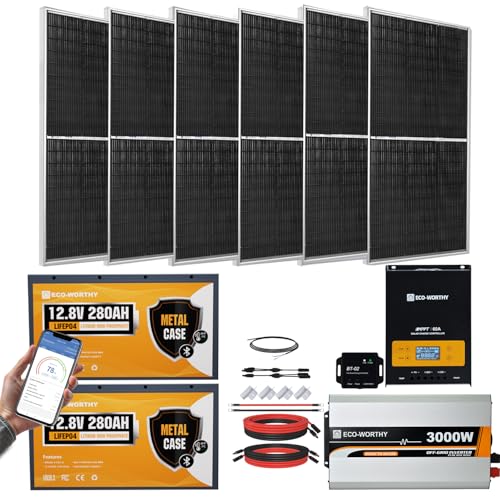
This compact off-grid kit uses six 195W panels to generate about 5.52KWh per day with dual-axis tracking to boost efficiency by over 40%. It includes two 12.8V 280Ah lithium batteries and a 3000W pure sine wave inverter, offering reliable power for RVs, sheds, or small cabins with secure BMS protection and robust charging control.
ECO-WORTHY 1.6KWh Complete Solar Kit For RV

This 400W system provides a practical entry point for RVs or small off-grid setups. It includes 12V 100Ah lithium storage, a Bluetooth-enabled MPPT controller, and a 400W inverter. The kit emphasizes efficiency, compactness, and user-friendly setup for remote locations or travel scenarios.
Buying Guide: Key Purchase Considerations For Home Solar Setups
- Power needs and daily energy use: Estimate your average daily consumption (in kWh) to match panel wattage, battery capacity, and inverter size. Higher consumption requires larger arrays and deeper battery banks.
- System topology: Decide between off-grid, grid-t-tied, or hybrid configurations. Off-grid provides independence but requires larger storage; grid-tied reduces storage needs with utility backup.
- Panel technology and efficiency: Monocrystalline panels offer better efficiency in limited space; bifacial designs can improve output in optimal orientations. Consider temperature and shading impacts.
- Battery chemistry and life: Li-ion/LiFePO4 offer longer life and deeper cycles than lead-acid but at higher upfront cost. Check cycle life, charging limits, and BMS features for safety.
- Inverter capabilities: Select inverters with sufficient continuous and surge power for your high-draw appliances (ACs, microwaves, pumps). Parallel capability enables future expansion.
- Monitoring and automation: Look for real-time status via mobile apps, Bluetooth/WiFi, and remote monitoring. This helps optimize charging, discharging, and alert you to faults.
- Installation footprint and aesthetics: Consider space for panels, mounting hardware, and ventilation for batteries. Some kits offer all-in-one enclosures for compact setups.
- Certifications and safety: UL/CE listings, CEC compliance, and proper enclosure ratings (IP ratings) matter for long-term safety and reliability.
- Maintenance and warranties: Check warranty lengths for panels, inverters, and batteries. Look for technical support and replacement policies from the manufacturer.
- Scalability: If you expect growing energy needs, prioritize kits that allow easy parallel expansion or modular battery additions.
These kits provide varying scales of off-grid capability and are designed to integrate with existing home electrical systems or serve as independent energy backups. Evaluate installation complexity, climate suitability, and potential grid interaction to choose the best fit for a home solar setup.