Best Low Voltage Remote Switches for Wireless Control and Convenience
When you want convenient, wireless control over low-voltage devices—from LED string lights to small motors—choosing a reliable remote switch is essential. This article highlights five top options that fit standard low-voltage systems, outlining each product’s key features and how they compare. Whether you need momentary or latching operation, these picks cover a range of applications from home lighting to security and automation. Read on to discover practical, long-range remote switches designed for low-voltage loads.
| Product | Brand | Notable Use |
|---|---|---|
| QIACHIP 1CH Wireless RF Remote Switch | QIACHIP | Low-voltage loads, safe DC control |
| RVBOATPAT Wireless Remote Switch 30A Relay | RVBOATPAT | High-power DC loads, long-range control |
| Mangood 3.3V–12V Micro Remote Relay | Mangood | Small, low-voltage switching |
| QOFOWIN Wireless Remote Switch | QOFOWIN | Low-voltage motors and luminaires |
| dstfuy Mini Wireless Switch | dstfuy | Compact, wall-friendly remote control |
QIACHIP 1CH Wireless RF Remote Switch

The QIACHIP 1CH is a compact wireless remote control switch designed for low-power DC loads with a maximum load of 2A. It supports DC voltages from 3.6V to 24V and is suitable for LED strings, small fixtures, or other low-voltage devices. A notable design feature is its negative-side switching, which means the controller switches the ground rather than the positive supply. This can help maintain a stable supply voltage and reduce stray currents in some setups. The kit emphasizes easy learning and relearning, making it straightforward to pair with a receiver. While optimized for low-power DC loads, users should consider an external relay for higher-power applications beyond 2A.
RVBOATPAT Wireless Remote Switch 30A Relay

The RVBOATPAT solution uses a 30A relay for higher-power DC loads, supporting a wide range of low-voltage devices. It employs a 433MHz RF signal with a claimed range up to 328 feet, capable of penetrating barriers like floors and doors. This makes it well-suited for accessible or hard-to-reach control points, such as garage doors, fans, or motorized components in a home or workshop. Installation is straightforward—place the switch between the device and power supply, then use the remote to toggle states. Users should ensure the total draw remains within the relay’s 30A rating for safe operation.
Mangood 3.3V–12V Micro Wireless Remote Relay

The Mangood micro remote relay focuses on compact, low-voltage switching. Operating between 3.5V and 12V, it supports up to 1A relay loads. The device emphasizes safety learn-code control, allowing you to add or remove remote access as needed. Its small footprint and low power consumption make it suitable for tight spaces and battery-powered projects. While designed for modest loads, it’s a practical choice for electronics enthusiasts working on hobbyist or small-scale automation projects where space and voltage constraints matter.
QOFOWIN Wireless Remote Switch

The QOFOWIN remote switch advertises a 433MHz wireless signal with a long-range capability, designed to control DC motors, luminaires, and other low-voltage devices. The documentation highlights easy installation: mount the receiver between the device and power, and use the remote for on/off control. Its emphasis on reliable signal penetration through common obstacles makes it suitable for installations where the receiver may be placed behind walls or furniture. This model is a versatile choice for light automation projects that require simple remote control at a distance.
dstfuy Mini Wireless Switch
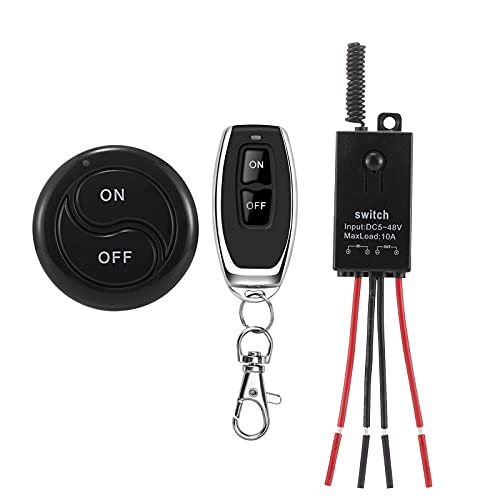
The dstfuy mini wireless switch is designed for compact, low-voltage control with a robust 328-foot range. It’s pitched for use with ceiling lights, lamps, and industrial control tasks, making it a flexible option for installations where space is at a premium. The device is easy to install—place the receiver between the device and the power supply. It supports standard RF transmission at 433MHz and is designed to pass through obstacles like walls and doors, ensuring reliable remote operation in typical home or office layouts.
Buying Guide
- Voltage compatibility: Confirm the switch supports your system’s voltage (common low-voltage ranges include 3.3V to 24V). Some devices are designed for even higher currents, so match the relay rating to the load.
- Current rating and load type: If you’re controlling LEDs or small motors, a 1A–2A rating is often sufficient. For high-power devices, look for switches with 30A relays or external relays as needed.
- Signal type and range: Most low-voltage remotes operate at 433MHz. Consider range expectations (up to 328 feet in typical listings) and whether walls or furniture may affect performance.
- Switch type: Decide between momentary, latching, or dimming capabilities. Some units offer dimming or memory functions for a preferred brightness level in lighting applications.
- Installation approach: Some switches install between the device and power supply; others may require wall plates or integration with existing control systems. Check receiver size and wire length to fit your space.
- Reliability and interference: If you have multiple RF devices nearby, ensure the chosen model uses learning code or has anti-interference features to avoid cross-talk with other remotes.
- Safety and heat: For outdoor or damp environments, verify weatherproof ratings and enclosure durability. Ensure heat exposure is within the receiver’s tolerance, especially near dimmers or gas appliances.
- Compatibility with existing systems: If you already use a smart home ecosystem, confirm whether the remote switch can be integrated via hubs or automation software, or if it remains a standalone control.
- Security considerations: Choose models with secure pairing and the ability to relearn codes to minimize unauthorized control.
When choosing among these options, map your application to the key factors above. For simple LED strings or small devices, compact 3.3V–12V remotes with modest current ratings are often sufficient. For lighting setups outdoors or in garages, consider weatherproof options with longer range and higher relay ratings. If you anticipate high-power devices, prioritize models with 30A-capable relays or external relays to avoid overheating.