Best 170 Watt Solar Panel Options for Off-Grid Power
If you’re shopping for a 170-watt solar panel, you want a compact, high-efficiency module that fits your space and delivers reliable off-grid power. This guide highlights five solid choices—each suited for RVs, vans, cabins, boats, or home off-grid setups. The top picks balance space efficiency, temperature tolerance, and installation ease to help you decide which panel is best for your application.
Summary Table Of Featured Products
- Topsolar 170W Monocrystalline Off-Grid Kit — Great all-in-one kit for homes and mobile setups
- Renogy 175W N-Type 16BB — Compact size with hot-climate efficiency advantages
- Rvpozwer 200W N-Type 18BB — High efficiency, easy installation, robust build
- Callsun 180W N-Type Bifacial — Higher output through bifacial design, ideal for sunny sites
- Renogy 200W N-Type 16BB — Slightly larger, flexible for 12V/24V systems, sturdy for vans
Topsolar Solar Panel Kit 170W Off-Grid System

Best for: Small to mid-sized off-grid homes, RVs, and boats needing a complete kit in one package. This 170-watt panel features high-efficiency monocrystalline cells, compatible with MC3 and MC4 connectors, and includes a 12V/24V charge controller with mounting hardware.
- Best for buyers who want an all-in-one solution with mounting brackets and cables included
- Better for setups requiring both 12V and 24V configurations
Selection note: The kit’s compact 12-inch profile helps fit tighter roof spaces while delivering robust performance. A potential limitation is that the included components may not cover every high-flex mounting scenario, requiring additional brackets for unusual roof angles.
Renogy Solar Panels 175W N-Type 16BB

Best for: Van life and small cabins where space is tight but power needs are consistent. This 175W panel uses 16BB cells with 25% efficiency and a favorable heat coefficient for hot climates.
- Best for: compact Class B vans due to its smaller, lighter footprint
- Better for hot climates thanks to improved temperature performance
Limitations: While efficient, installation may be more complex in very tight roof spaces, and the panel size may still require precise mounting alignment on curved roofs.
Rvpozwer 200W N-Type 18BB Solar Panel

Best for: Off-grid enthusiasts who need higher wattage in a single panel for camper trailers or home systems. The 200W panel uses 18BB cells with 25% efficiency and is designed for easy mounting with pre-drilled holes.
- Best for: those who want strong daily output in moderate sun
- Better for: straightforward installation with bracket compatibility
Limitation: The higher wattage panel may require sturdier mounting hardware to support its weight and wind load in some roof configurations.
Callsun 180W N-Type Bifacial Solar Panel
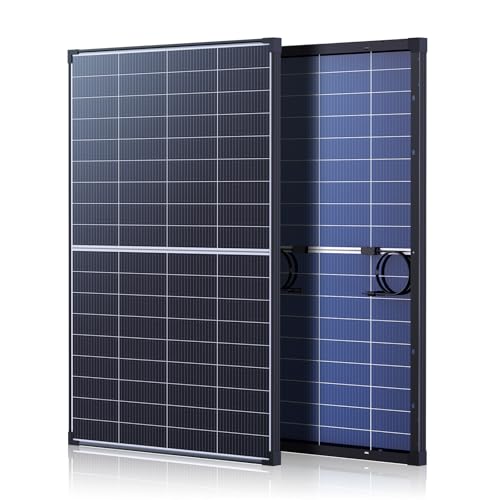
Best for: Roofs with light-colored or reflective surfaces, where bifacial design captures extra light. This model parks 180W with bifacial technology and 16BB cells to boost total output by up to 30% under ideal conditions.
- Best for: RVs or cabins in sunny, reflective environments
- Better for: maximizing output on roofs that reflect light back to the panel
Caution: Bifacial performance depends on rear surface reflection; if installation space is shaded or the back surface isn’t exposed to light, gains may be limited.
Renogy 200W N-Type 16BB

Best for: Larger off-grid setups where space allows a 200W module, including Class B vans and small cabins. It uses 25% efficiency with 16BB cells and works well with 12V or 24V systems.
- Best for: flexible voltage options for various battery banks
- Better for: longer-term reliability in hot climates
Limitation: Slightly larger than some 175W panels; ensure roof space and weight capacity meet installation needs.
Buying Guide
What to consider when choosing a 170-200W panel?
- System voltage and compatibility: Confirm whether your setup uses 12V or 24V systems and whether the panel supports both. N-Type panels with 16BB cells generally offer good efficiency and reliability across voltages.
- Space and mounting: Measure available roof space and consider pre-drilled holes and mounting brackets. Some kits include hardware; others require separate mounting gear.
- Efficiency and temperature: Panels with higher cell efficiency perform better in hot and high-irradiance environments. N-Type cells tend to handle heat more effectively than older P-type designs.
- Roof conditions and shading: Bifacial panels can add output when rear-surface reflection is favorable. If your roof is shaded or has limited light exposure, the gains may be reduced.
- Weight and wind load: Heavier panels require solid mounting and potentially reinforced supports. Check weight ratings for your vehicle or structure.
- Expandability: Some models are modular or expandable, enabling increases in capacity as needs grow. Consider whether you might add more panels later.
Practical pick guidance:
- Best for all-in-one kits: Topsolar 170W kit offers convenience for first-time setups.
- Better for vans and tight spaces: Renogy 175W N-Type and Renogy 200W N-Type panels are compact and efficient for mobile use.
- Best for high-output needs: Rvpozwer 200W and Callsun 180W bifacial panels maximize daily energy in sunny locations.
FAQ
- What is the typical daily output of these panels? Answer: Output depends on sun exposure; commonly around 4–6 hours of peak sun can yield roughly 800–1200 watt-hours per day for a 170–200W panel, under ideal conditions.
- Do bifacial panels require special installation? Answer: Yes, they benefit from reflective surfaces and rear exposure; shading or dark back surfaces can reduce gains.
- Can I mix different brands in a single system? Answer: It’s possible but not ideal; mismatched voltages and current can reduce overall performance. Prefer matched sets or consult an installer.
- Are these panels suitable for RV roofs? Answer: Yes, several products are designed with RV and van mounting in mind, offering compact size and pre-drilled mounting points.
- Do these panels include mounting hardware? Answer: Some kits include mounting hardware and cables; check product details for included components.
- What is N-Type versus P-Type cell technology? Answer: N-Type cells offer better performance, especially in high-temperature conditions and with reduced degradation over time compared to P-Type cells.