Best Mobile Electric Car Chargers for on-the-Go EV Charging
For EV owners who need charging flexibility beyond the driveway, a reliable mobile EV charger is essential. This guide highlights top portable options that cover Level 1 and Level 2 charging, compatibility with common outlets, and practical features like adjustable current, long cables, and on-the-road adaptability. Each model below is chosen for performance, ease of use, and wide compatibility with J1772 vehicles and many Teslas with adapters. Read on to compare capabilities and find the right charger for your lifestyle.
| Product | Brand | Key Advantage |
|---|---|---|
| EVDANCE Level 1 & 2 EV Charger | EVDANCE | Flexible 120V/240V operation with 25 ft cable |
| Raylix 32A Level 2 EV Charger | Raylix | Built-in display and fast charging |
| 2025 Upgraded Level 1 & 2 Portable EV Charger | Raylix | Smart scheduling and four current levels |
| 2025 New Portable Level 2 EV Charger (40A) | Tyocle | High-speed Level 2 charging with 40A |
| 2025 New Level 1 & 2 EV Charger (16A) | Tyocle | AI smart charging with Level 1 & 2 flexibility |
EVDANCE Level 1 & 2 EV Charger

The EVDANCE portable charger provides Level 1 and Level 2 flexibility with a 25-foot cable, suitable for J1772-compatible EVs and plug-in hybrids. It ships with a NEMA 6-20 to 5-15 adapter so users can switch between 240V (10-12 mph) and 120V (2-5 mph) charging. The unit supports both 120V and 240V outlets, but requires attention to outlet type for best performance. A compact carrying bag enhances portability for garage, driveway, or road use, and the charger is designed for straightforward operation without complex setup.
Raylix 32A Level 2 EV Charger
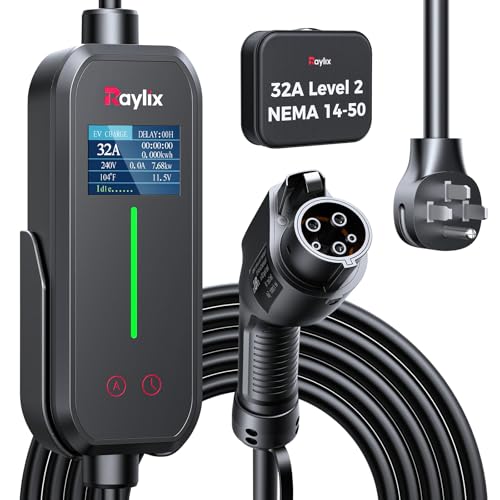
Raylix delivers a 32A Level 2 charger designed for 240V circuits, capable of charging at speeds around 34-39 miles per hour when connected to a NEMA 14-50 outlet. A key feature is the built-in display, which helps users monitor current settings and status at a glance. It requires a dedicated 240V circuit and a 14-50 outlet—an important consideration for homeowners planning a Level 2 setup. This model emphasizes fast charging and user-friendly visibility, making it suitable for home garages and on-the-go charging scenarios where quick top-ups matter.
2025 Upgraded Level 1 & 2 Portable EV Charger

Raylix’s upgraded charger offers four adjustable current levels (8A/10A/12A/16A) and a smart 1–12 hour delay timer, providing smart scheduling for off-peak charging. It is compatible with all SAE J1772 EVs and plug-in hybrids, delivering Level 1 and Level 2 flexibility in a single unit. The design targets home use and travel, enabling faster top-offs or longer sessions depending on the outlet and vehicle requirements. The integration of scheduling features helps users optimize energy costs and align charging with daily routines.
2025 New Portable Level 2 EV Charger (40A)

This Tyocle charger operates at Level 2 with 40A on 240V, delivering up to 9.6kW and an estimated 29–36 miles of range per hour. It includes eight current settings (8A–40A) and a delay charging function to enable off-peak charging, which can help reduce utility costs and balance home electrical load. The package notes a J1772 to Tesla adapter for Tesla compatibility, expanding vehicle compatibility beyond J1772-only models. The included 23-foot cable adds flexibility for garage or driveway use, and the unit is engineered for robust performance under mobility-focused charging needs.
2025 New Level 1 & 2 EV Charger (16A)

This Tyocle model provides Level 1 and Level 2 compatibility with a NEMA 6-20P plug for Level 2 charging and an adapter to NEMA 5-15P for Level 1. It features eight-stage smart current control and a delay charging function. The AI-driven charging approach aims to optimize grid usage and battery health by dynamically adjusting current based on conditions. The unit is presented as a portable, flexible solution for drivers who need both home and travel charging options, with emphasis on reliability and adaptable performance across different outlets.
Buying Guide
When choosing a mobile EV charger, consider these factors to align with your vehicle, wiring, and lifestyle needs:
- Outlet compatibility: Verify whether you have access to 120V, 240V, or both, and whether you need NEMA 5-15, 5-20, 6-20, or 14-50 outlets. A charger that supports multiple outlet configurations adds versatility for home and travel.
- Current and speed: Level 1 charging provides slower top-ups; Level 2 delivers significantly faster charging but requires a dedicated circuit. Look for adjustable current (8A–40A) and a smart timer to optimize charging windows.
- Cable length and portability: A longer cable (20–25 ft) increases flexibility for garages and driveways. A compact case or bag helps with storage and transport.
- Vehicle compatibility: Most J1772 chargers work with non-Tesla EVs. For Teslas, adapters or Tesla-specific plugs may be required. Confirm compatibility with your model and any adapters you rely on.
- Safety and certification: Check ETL or UL listings and any local electrical code requirements. A sturdy connector design, weather resistance, and robust cable materials improve durability for road use.
- Smart features: Built-in displays, delay timers, and app-based monitoring add control and transparency over charging sessions, potentially saving energy costs and reducing peak-load impact.
- Electrical load and installation: Level 2 charging often demands a dedicated 240V circuit (and potentially a professional installation). If you are in a rental or a shared space, confirm feasibility beforehand.
- Future-proofing: Consider whether the charger offers firmware updates, compatibility with future vehicle models, and the ability to function across different outlets while on the road.
Overall, the right portable EV charger balances charging speed, outlet availability, and practical features for your driving patterns. For travelers, a model with a long cable and universal compatibility provides the most flexibility. For daily commuters, a charger with smart scheduling and stable Level 2 performance offers the best efficiency. Always verify outlet compatibility and circuit requirements before purchasing to ensure safe, reliable operation in your specific environment.