Best Wiring Adapters for Trailer Lights: A Comprehensive Guide to Safer Towing
Choosing the right trailer wiring adapter can prevent lighting problems on the road and ensure your vehicle and trailer communicate correctly. This guide reviews five well-regarded adapters that cover common configurations, from 7-way RV plugs to 4- and 5-pin flat connectors. Each product section notes compatibility, key benefits, and practical considerations so American drivers can pick the right match for their setup.
| Product | Brand | Key Benefit |
|---|---|---|
| Oyviny 7 to 4 & 5 Pin Trailer Adapter | Oyviny | 2-in-1 design, secure fit, weatherproof housing |
| MECMO Multi-Tow 4-Way to 7-Way Adapter Kit | MECMO | Dual-output for versatile towing options |
| NEW SUN 3-Way to 2-Way Trailer Tail Light Converter | NEW SUN | Simplified 3-to-2 wiring with no heavy flasher |
| Siziviki Universal 4-Way to 7-Way Adapter | Siziviki | Durable dual-output design with dust protection |
| Hopkins Towing Solutions 7 Blade to 4 Wire Flat | Hopkins Towing Solutions | Plug-and-play with LED troubleshooting indicators |
Compatibility notes: The adapters listed work with common light setups found on American trucks, SUVs, RVs, and various trailers. When selecting an adapter, verify your vehicle’s connector type (7-way RV, 7-blade, 4-flat, etc.), the trailer’s wiring, and whether you need dual-output or a single-output solution for your towing tasks. Consider durability in exposed environments and whether dust covers or protective housings are included. The following sections summarize each option and how it can satisfy different towing needs.
Oyviny 7 To 4 & 5 Pin Trailer Adapter

The Oyviny adapter converts a 7-way RV-style connector to standard 4-pin or 5-pin flat trailer connectors, broadening compatibility across vehicles from Chevrolet and Ford to RAM and Toyota. Its 2-in-1 design minimizes the number of adapters you need, while the 7-to-5-pin fit ensures a secure connection without loose fitting. Built with a heavy-duty nylon housing, the unit is waterproof and temperature resistant, and brass terminals support reliable conductivity. The product includes two dust covers to protect terminals when not towing. This makes it a practical choice for frequent trailer users who require a durable, weatherproof solution.
Key considerations:
– Pros: Dual output, secure locking fit, weatherproof construction, protective dust covers.
– Cons: May require attention to compatibility with specific 7-way sockets in some vehicles.
– Best for: Mixed trailer loads and drivers who switch between 4-pin and 5-pin configurations.
MECMO Multi-Tow 4-Way To 7-Way And 4-Way
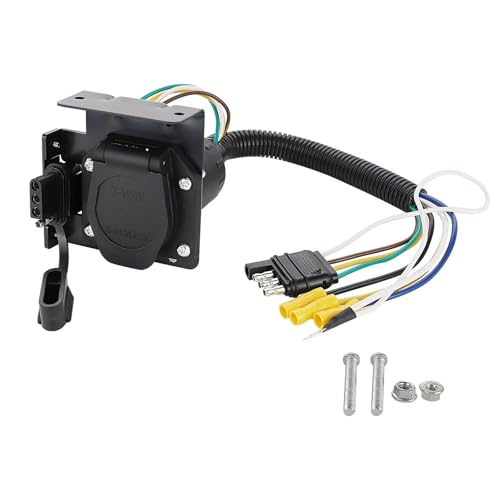
The MECMO Multi-Tow kit provides dual output: a 4-pin that can feed into both 4-way and 7-way configurations. It includes lead options for brake, reverse, and power functions, enabling a single vehicle-side 4-pin socket to power taillights, brakes, and auxiliary circuits on various trailers. The adapter supports mismatched trailer plugs and vehicle sockets, helping to reduce the need for multiple adapters. It’s designed for versatility where towing different trailer types is common.
Key considerations:
– Pros: Dual-output versatility, additional leads for brake/reverse/power, adapts mismatched plugs.
– Cons: Slightly larger harness, ensure mounting hardware is used if a dedicated bracket is not included.
– Best for: Vehicles that tow multiple trailer types or owners who frequently switch trailers.
NEW SUN 3-Way To 2-Way Trailer Tail Light Converter

NEW SUN offers a 3-to-2 wiring solution that converts a 3-wire vehicle system to a standard 2-wire trailer taillight setup. It’s particularly helpful when the front of the vehicle uses separate turn signals and braking signals, and the trailer operates on a 2-wire taillight arrangement. The design emphasizes universal compatibility with a broad range of trailers, eliminating the need for an additional flasher or battery connection. It supports functional turns and brakes, with notable emphasis on ease of installation.
Key considerations:
– Pros: Easy integration, eliminates heavy flashers, simple 3-to-2 conversion.
– Cons: 2-amp/7.5-amp limits may matter for larger taillight systems.
– Best for: Trucks and SUVs towing trailers with 2-wire taillight systems or converting older trailers.
Siziviki Universal 4-Way To 7-Way Adapter

The Siziviki adapter is built for universal compatibility with a dual-output approach. It converts a 4-way socket to a 7-way RV blade and 4-flat outputs, enabling a range of trailer connections. The unit uses ABS plastic for durability and includes a protective dust cover and wire loom to shield connection points from weather, dirt, and corrosion. The 19.69-inch connection length supports stable attachment and reduces strain on the vehicle’s wiring. It is particularly suitable for long-hail towing setups and environments where exposure to elements is common.
Key considerations:
– Pros: Durable housing, protective dust cover, stable locking mechanism.
– Cons: May be overkill for simple setups that only require a single output.
– Best for: Towing with multiple trailer types and weather-prone environments.
Hopkins Towing Solutions 7 Blade To 4 Wire Flat

This adapter is designed for universal compatibility with vehicles that have a 7-blade connector. It lets you convert to a 4-wire flat trailer setup quickly, enabling a straightforward plug-in experience. It includes LED indicators to help troubleshoot connection issues, providing a quick check for brake, turn, and taillight circuits. The kit is ideal when you need a simple, reliable way to adapt from 7-blade to 4-flat without extensive rewiring or additional components.
Key considerations:
– Pros: Quick plug-and-play, built-in LEDs for troubleshooting, broad compatibility with 7-blade systems.
– Cons: LED indicators may require a power source to function in certain setups.
– Best for: Casual towing where rapid changes in trailer types occur and quick diagnostics are beneficial.
Buying Guide: How To Pick The Right Trailer Wiring Adapter
Choosing the right wiring adapter involves understanding both your vehicle and trailer wiring standards. Here are essential considerations from multiple perspectives to help you select a fit-for-purpose adapter:
- Connector compatibility: Identify whether you need 7-way RV, 7-blade, 4-flat, or 5-pin outputs. Some adapters offer dual outputs to cover multiple trailer configurations in one unit.
- Durability and weather protection: For frequent outdoor use, prioritize devices with waterproof housings, dust covers, and corrosion-resistant terminals. Nylon or ABS housings tend to resist cracking in cold climates.
- Ease of installation: Look for plug-and-play designs with clear locking mechanisms and, if possible, LED indicators to troubleshoot connections quickly.
- Electrical capacity: Check current ratings for taillight, brake, and turn signals. Some accessories are designed for basic lighting, while others support higher-current taillight circuits and auxiliary power.
- Towing variety vs. simplicity: Dual-output adapters are valuable when towing different trailer types; single-output adapters keep things simple and compact.
- Protection against mismatches: A key benefit of dual-output adapters is bridging incompatible trailer and vehicle plugs without additional adapters.
- Installation environment: If you tow in harsh weather or off-road, select adapters with protective dust covers and robust housings to minimize exposure to moisture and dirt.
- Manufacturer warranties and support: Look for reputable brands offering clear guidance and replacement options if compatibility issues arise.
Practical tips:
– Always verify wiring color codes for your specific vehicle and trailer. Even when adapters are advertised as universal, some configurations require careful mapping of power, ground, and signal lines.
– If you notice dim or flickering lights after installation, recheck ground connections and inspect pin contacts for corrosion or debris.