Best Wireless Fire Alarm Panels for Safer Buildings
Answering the buyer’s search for reliable fire alarm solutions, this guide highlights strong options across wireless panels, annunciators, and compatible accessories. It helps facility managers, security coordinators, and property owners choose units that fit small to mid-size installations, while noting when wired components are better fits. The selected products emphasize clear signaling, easy integration, and practical limitations to consider before purchase.
| Product | Type | Best For | Key Benefit |
|---|---|---|---|
| Firelite MS-10UD-7 Conventional 10 Zone Fire Panel | Panel | Small to mid-size buildings needing 10 zones | Multiple zones with stable power supply |
| FIRE-LITE ANN80 LCD Annunciator | Annunciator | Centralized status at a single location | Clear, quick status readouts for operators |
| Swokely 3 Pack Wireless RF 433MHz Fire Alarm System | Wireless System Kit | Rapid deployment in retrofit projects | Wireless detection and alert capability |
| Silent Knight 6808 198-Point Addressable Panel | Addressable Panel | More complex or larger facilities | High point count and flexible expansion |
| System Sensor SWL White Fire Strobe | Strobe | Visual signaling for alarms | Bright, reliable alerting |
Note: Each product is evaluated for its suitability as a core component, with attention to whether a purely wireless solution is feasible or a hybrid approach is required. Where relevant, limitations are noted to aid clear comparisons.
Firelite MS-10UD-7 Conventional 10 Zone Fire Panel

Overview: This Firelite panel supports 10 zones and runs on a FLPS 7 power supply with 120VAC input. It is best for facilities needing a straightforward, multi-zone fire alarm controller with dependable power. The system is suitable for small to mid-size commercial environments where wired panel control remains the backbone of the setup.
Best for: Building managers seeking a compact, reliable 10-zone control unit for established wired networks. It suits schools, small offices, and retail locations with fixed infrastructure.
Why selected: It provides a clear zone structure, robust power, and a recognized brand in life-safety systems, aiding straightforward maintenance and integration with existing detectors and devices.
Caution: Data indicates a conventional (not fully wireless) architecture; ensure your installation plan accommodates wired wiring paths and sufficient enclosure space.
FIRE-LITE ANN80 LCD Annunciator

Overview: The ANN-80 annunciator provides a compact centralized readout for addressable Fire-Lite panels. It is best for operators who need quick status at a central location without returning to the main panel.
Best for: Facilities that require a dedicated operator station or a shared control point in a hallway or security room.
Why selected: Clear LCD feedback simplifies monitoring of multiple devices; it complements addressable systems by offering immediate visibility into fault and alarm conditions.
Caution: This unit requires compatible addressable panels; it is not a standalone fire alarm controller.
Swokely 3 Pack Wireless RF 433MHz Fire Alarm Panel
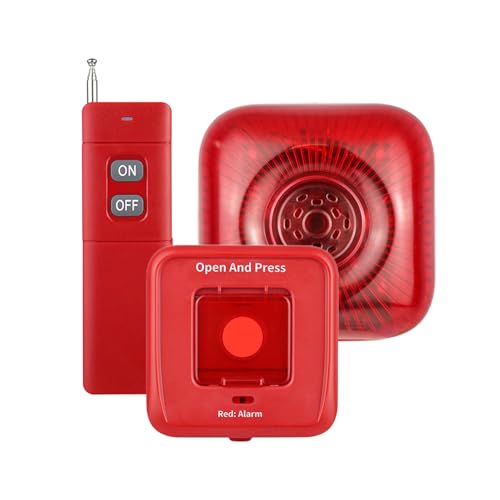
Overview: This 3-pack wireless system emphasizes rapid deployment with 433MHz RF communication. It includes a handheld or wall-mounted wireless alert capability and manual fire alarm bell integration, making it suitable for retrofits and smaller facilities seeking easier installation.
Best for: Retrofit projects, temporary setups, or spaces where running new wiring is impractical or costly.
Why selected: Wireless convenience reduces installation time and disruption. It helps bridge gaps where wiring is difficult while maintaining alerting capability.
Caution: Wireless systems may require careful interference management and range planning in larger or highly structured buildings.
Silent Knight 6808 198-Point Addressable Panel

Overview: The Silent Knight 6808 is a versatile addressable fire alarm control panel with extensive points for detectors, modules, and NAC outputs. It supports large facility networks and complex configurations.
Best for: Medium to large installations needing high point densities and robust modular expansion capabilities.
Why selected: Its flexible topology accommodates diverse detector types and modules, enabling scalable growth as building requirements change.
Caution: As an addressable system, setup and programming require expertise; consult integration documentation and professional installation when appropriate.
System Sensor SWL Fire Strobe

Overview: The SWL strobe delivers bright, effective visual signaling for alarms. It’s a useful addition to any fire alarm system where visual alerts are necessary, especially in noisy environments.
Best for: Areas needing enhanced visual notification, such as corridors, large open spaces, or accommodations for hearing-impaired individuals.
Why selected: Strobes are a key component for comprehensive alerting, complementing audible alarms for broad reach during emergencies.
Caution: Strobe placement and synchronization should align with local codes and panel capabilities to ensure proper signaling.
Buying Guide: Key Purchase Considerations
What type of system best fits the facility? A pure wireless setup speeds installation in retrofits, while a wired or hybrid approach offers reliability and easier long-term maintenance for larger buildings.
How many zones and devices are needed? Start with the maximum expected load and plan expansion, ensuring the selected panel supports future detectors, NAC outputs, and modules.
Are annunciators or remote signaling stations important? Annunciators improve operational efficiency by letting staff monitor status without returning to the main panel.
What accessories are essential? Visual signaling devices (strobes) and manual pull stations are common, but verify compatibility with the main control panel.
What are installation and maintenance considerations? Professional configuration, programming, and periodic testing are important for reliability and code compliance.
Frequently Asked Questions
- What is the difference between a wireless fire alarm panel and a wired one? A wireless panel communicates via radio signals, simplifying installation in retrofits, while wired panels rely on fixed wiring for signaling and power, often offering higher reliability in established infrastructure.
- Can I mix wireless devices with wired panels? Yes, many systems support hybrid setups, but ensure compatibility and proper programming to prevent signaling conflicts.
- What is an annunciator and when is it useful? An annunciator provides centralized readouts of alarms and faults, enabling faster response in control rooms or security stations.
- Do I need a professional installer for these panels? For addressable and high-point systems, professional installation is recommended to ensure correct wiring, programming, and code compliance.
- Where should strobes be placed? Place strobes in visible locations and ensure synchronization with other alarms to meet local safety standards.
- What should be considered when retrofitting? Assess existing wiring, building layout, and noise levels; wireless options can reduce disruption, but compatibility remains essential.