Best Window Heat Pump Air Conditioners for All-Season Comfort
Window heat pump air conditioners offer year‑round climate control by cooling in the summer and providing supplemental heat in cooler months. This guide highlights five reliable models ideal for different room sizes and needs, so you can choose based on efficiency, noise, smart features, and installation preferences. Best for: large rooms, quiet operation, smart control, or energy‑saving setups. The table below compares key aspects to help you decide quickly.
| Product | Best For | Notable Strength |
|---|---|---|
| Midea Inverter Window AC with Heat | Large rooms up to 550 sq ft | Energy Star, smart control, dehumidification |
| ZAFRO U Shaped Inverter Window AC | Quiet operation and steady temperatures | 32 dB noise, consistent ±1°F |
| GE Profile ClearView Inverter Window AC | Full window view and quiet performance | Ultra quiet, inverter efficiency |
| ROVSUN 8000 BTU Window AC With Heat | Compact rooms and smart control | All‑season heater and app/voice control |
| TCL 12000 BTU Q‑Series With Heat | Balanced power for up to 550 sq ft | Smart features, inverter efficiency |
Midea Inverter Window AC With Heat

Best for large rooms up to 550 sq ft, this unit combines strong cooling with dehumidification and supplemental heat for shoulder seasons. It features a digital LED display, 5 modes, 3 speeds, a 24‑hour timer, and ECO energy saver. Inverter technology supports up to 35% energy savings versus a conventional model. Control is available via control panel, remote, app, and voice assistants. Note: Heat pump operation excludes outdoor temperatures below 41°F.
Who should consider this: buyers needing a single, versatile unit for midsize to large spaces who value app control and energy efficiency. Caution: heat function is limited by ambient temperature as noted above.
ZAFRO U Shaped Inverter Window AC With Heat

Best for quiet operation in medium to large rooms, this unit uses a U‑shaped design with the compressor outside the window to minimize indoor noise to about 32 dB. It provides 12,000 BTU cooling (ASHRAE) and 8,000 BTU heating with inverter technology for stable temperatures. Energy cost is highlighted as low with smart features for remote control. Best for bedrooms or living spaces where noise is a priority. Limitation: the DOE rating differs from ASHRAE; check your local energy expectations when comparing to other models.
Who should consider this: buyers prioritizing whisper‑quiet performance and a clear outdoor view with strong year‑round climate control. Caution: DOE vs. ASHRAE BTU ratings can affect advertised capacity.
GE Profile ClearView Inverter Window AC
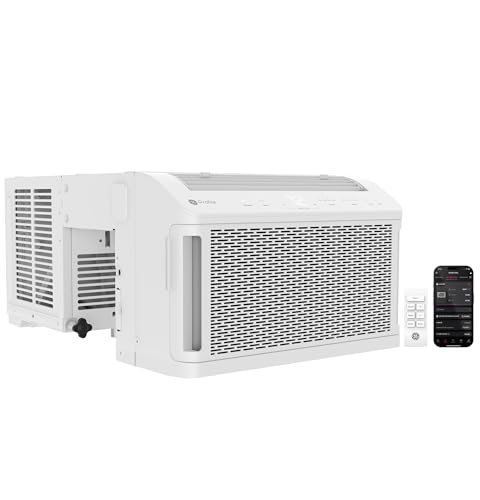
The ClearView model emphasizes preserving the window view while delivering inverter-driven performance. Designed for windows that can accommodate 20–40 inches in width, it aims for ultra‑quiet operation with sounds as low as 40 dB. It cools up to 450 sq ft and includes WiFi remote control for convenient access via smart devices. Best for spaces where natural light and view are valued alongside quiet operation. Caution: installation must fit the specified window dimensions for optimal performance.
Who should consider this: buyers who want a near‑silent unit that blends with decor and preserves sightlines. Caution: window size compatibility is a key consideration.
ROVSUN 8000 BTU Window AC With Heat

Best for compact rooms up to 350 sq ft, this all‑season unit combines cooling and heating with dehumidification and fan options. It offers five modes, three fan speeds, a 24‑hour timer, and ECO energy saver. It includes app and voice control compatibility for hands‑free adjustments. This model suits small apartments or offices seeking flexible climate control. Caution: the heating capacity is lower than some larger 12,000 BTU units, so verify seasonal needs.
Who should consider this: buyers wanting a budget‑friendly combo unit for smaller spaces with smart home compatibility. Caution: heating capacity may be insufficient in very cold climates.
TCL 12000 BTU Q‑Series With Heat

Best for up to 550 sq ft, this QT‑series window air conditioner includes heat capability, inverter efficiency, and remote control with compatibility for smart home devices and the TCL Home App. It balances cooling capacity with energy efficiency for larger rooms or open layouts. Consider this if you want strong seasonal performance and a modern control ecosystem. Caution: ensure your window and ducting can accommodate the Q‑Series profile.
Buying Guide: Key Purchase Considerations
What room size should guide BTU choice?
Match BTU to the room size. Larger spaces need higher BTU units for effective cooling and heating, while smaller rooms can run more efficiently on lower BTUs to reduce energy use.
Do you need full window view or minimized noise?
Some models like the GE Profile ClearView prioritize preserving the window view, while others such as ZAFRO emphasize ultra‑quiet operation. Consider your tolerance for noise and your preference for natural light when selecting.
Is inverter technology important?
Inverter units adjust compressor speed for smoother temperature control and higher energy efficiency. They typically offer better long‑term energy savings and a steadier climate.
How smart do you want your controls to be?
Smart control via apps, voice assistants, or integrated ecosystems can simplify adjustments when you’re away from home. Check compatibility with your preferred devices (Alexa, Google Assistant, TCL Home, etc.).
What are installation and window compatibility requirements?
Measure window width, height, and the available clearance. Some units require specific opening sizes or external clearance for condensate drainage and airflow. U‑shaped designs may alter outside window exposure and indoor space.
What are potential limitations to watch for?
Heat pump functionality can be temperature‑dependent. Some models have minimum outdoor temperatures where heating becomes unavailable or less efficient. Review specs for your climate zone and seasonal needs.
Frequently Asked Questions
- Do window heat pump units require professional installation?
- Can I use these units in rooms without existing window access?
- Are all models compatible with smart home systems?
- What is the typical operating noise level for these units?
- How does inverter technology impact energy savings?
- Can these units heat effectively in winter?