Best Wind and Solar Charge Controllers for Hybrid Off-Grid Power
When choosing a wind and solar charge controller, aim for devices that handle the power range you need, protect battery health, and optimize charging across wind and sun. For off-grid setups, these five models stand out for 12V/24V systems with reliable MPPT and PWM charging, suitable for homes, boats, or street lighting. The list below compares top features, ideal buyers, and practical cautions to help you pick the right hybrid controller.
Buying quick glance
| Product | Best For | Key Benefit | Limitations |
|---|---|---|---|
| Wind Solar Hybrid Charge Controller (WQV) | Small to mid-size off-grid setups | Boost MPPT for wind, PWM for solar | Wind input capped at 800W |
| Pikasola 1400W Hybrid Controller | Home or boat systems with balanced wind/solar | Automatic optimization for 12/24V with up to 800W wind | Limited to 800W wind and 600W solar |
| VQP 2000W Hybrid Controller | Mid-to-large off-grid installations | High combined input (up to 1000W each) | Requires careful wiring for 12/24V |
| iSunergy 1000W Hybrid Controller | Compact systems needing LCD readouts | Digital display for voltage and charge data | Limited data on max wind/solar specs |
| BKCEHCRS 3000W Hybrid Controller | Larger off-grid or commercial setups | Wide power range with MPPT and PWM | Complex installation for beginners |
Wind Solar Hybrid Charge Controller, 1400W by WQV

Features: Recognizes 12V/24V batteries and combines wind input up to 800W with solar up to 600W. It uses boosted MPPT for wind to maximize charging at low wind speeds and PWM charging for solar to safeguard panel health.
Who this is best for: Small homes, boats, or street-lighting projects needing a compact hybrid unit with clear wind and solar optimization. Why selected: It provides a balanced, cost-effective solution for moderate wind and solar sources with straightforward setup.
Caution: Wind input is limited to 800W; exceeding this can reduce efficiency or trigger protection features. Ensure battery type is set correctly for stable charging.
15000W Wind Solar Hybrid Controller (VNATWGOO)

Features: Supports 24V/48V systems, with hybrid MPPT boosting for wind and PWM for solar. LCD display and dump load functionality support stable off-grid operation and customization for battery types.
Who this is best for: Larger off-grid sites or fleets with extensive wind and solar capacity needing a scalable controller. Why selected: It addresses higher power demands and multiple configurations in one unit.
Caution: The system’s higher capacity requires careful wiring and protection design. Interface details such as dump load connections should be planned before installation.
Pikasola 1400W Hybrid Controller

Features: Matches 12/24V batteries including lithium, supports up to 800W wind and 600W solar. Wind charging uses MPPT for continuous charging in low wind; solar employs PWM with MOSFET in series for efficient panel charging. Auto parameter setting after battery selection, with room for user customization.
Who this is best for: Home or boat setups needing flexible battery chemistry and automatic optimization. Why selected: The unit emphasizes intelligent, automatic control that reduces manual tuning while delivering solid wind/solar integration.
Caution: System optimization relies on correct battery type selection. If you use unconventional batteries, verify compatibility before installation.
VQP 2000W Hybrid Controller
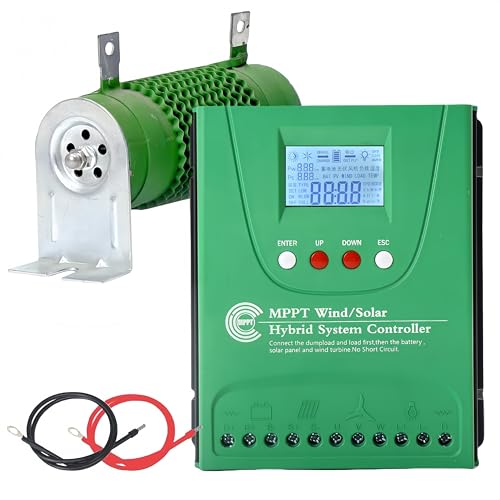
Features: Designed for 12V/24V systems with up to 1000W wind and 1000W solar inputs. It integrates boost MPPT for wind and PWM for solar, aiming at efficient energy capture in hybrid installations, plus a dump-load option for load management.
Who this is best for: Medium to larger off-grid installations needing higher wind and solar input tolerance. Why selected: It balances broad input capability with practical MPPT/PWM integration for reliable performance.
Caution: As power scales up, ensure wiring and fusing are appropriate for the combined voltage and current. Miswiring can compromise efficiency and safety.
iSunergy 1000W Wind Solar Hybrid Controller

Features: Combines wind and solar control for 12V/24V systems. Solar charging uses PWM via MOS tubes for efficiency, and an LCD displays battery voltage and charge status. Designed to be economical and practical with user-friendly operation.
Who this is best for: Budget-conscious users who want straightforward monitoring and stable charging for compact off-grid installations. Why selected: The LCD readout enhances visibility into system performance without extra peripherals.
Caution: The data on wind capacity is less explicit; verify the intended wind and solar inputs for your installation before purchasing.
BKCEHCRS Wind Solar Hybrid Controller 3000W

Features: Wide range controller supporting 24V/48V auto-match for wind up to 1500W and solar up to 1500W. It includes booster MPPT, PWM charging, and a dustproof/SLS-compliant circuit with loading control and external unloading device. LCD presence helps monitor performance.
Who this is best for: Larger off-grid systems or commercial setups needing robust wind/solar handling. Why selected: It offers broad capacity and flexible configuration for demanding environments.
Caution: Installation complexity is higher; ensure skilled wiring and proper cooling to maintain long-term reliability.
Buying Guide: What to Consider When Selecting a Wind Solar Hybrid Controller
- System voltage and battery chemistry: Confirm whether the controller supports 12V, 24V, or 48V and if it accommodates lithium or lead-acid batteries. This impacts charging voltage, efficiency, and compatibility with your storage.
- Power input ranges: Evaluate the maximum wind (W) and solar (W) inputs. Choose a unit that comfortably exceeds your expected peak generation to avoid throttling during windy or sunny days.
- MPPT vs PWM balance: MPPT improves charging efficiency at low wind or partial sun; PWM is simpler and cheaper but can be less efficient. For larger setups, MPPT-heavy controllers are typically preferred.
- Display and monitoring: LCD or digital displays help monitor voltage, current, and energy production. Consider models with clear readouts if you want quick, on-site system checks.
- Dump/load management: Dump-load or load control features help handle excess energy or prevent battery overcharging. Useful for hot, sunny days or high wind events.
- Ease of installation: Some units require advanced wiring and cooling considerations. If you’re new to off-grid systems, look for controllers with auto-configuration and straightforward manuals.
- Protection features: Overcharge, over-discharge, short-circuit, and reverse polarity protections protect both the controller and batteries. Verify these protections are present and reliable.
- Expansion and future proofing: If you plan to scale, select a controller that can handle higher wattage inputs or multiple battery banks without major rewiring.
- Physical size and cooling: Larger units may require adequate ventilation or mounting space. Consider enclosure and ambient temperature conditions when placing the controller.
Frequently Asked Questions
- What is the difference between MPPT and PWM in wind and solar controllers?
MPPT optimizes charging by adjusting voltage to maximize power transfer, especially at low wind or low sun. PWM provides straightforward regulation but can be less efficient at higher voltages or limited wind. - Can a wind/solar hybrid controller work with any battery type?
Many controllers support common 12V/24V batteries and some include lithium compatibility. Always verify battery type support in the product specs before installation. - Do I need a separate controller for wind and solar, or a hybrid controller suffices?
A hybrid controller integrates both wind and solar inputs in one unit, simplifying wiring and monitoring. For larger installations, dedicated controllers or additional units may be used for redundancy. - What maintenance does a wind solar hybrid controller require?
Routine inspection of wiring, fuses, and cooling; ensure connections are tight and free of corrosion. Periodic testing of the LCD display and protections helps prevent unexpected failures. - How do I choose the right size for wind and solar inputs?
Select a unit with higher maximum inputs than your current setup to allow future expansion and to minimize throttling during peak generation. - Is a higher-priced controller always better?
Not necessarily. Match features such as MPPT efficiency, display clarity, and protection options to your specific site conditions and expansion plans.