Best Water Cooled Electric Motors for RC Boats: Quiet, Efficient Power and Lasting Performance
Whether you’re chasing higher top speeds, longer run times, or cooler operation, water-cooled electric motors are a top choice for RC boat enthusiasts. This guide highlights five strong options, each chosen for reliability, cooling efficiency, and suitability to different hull sizes and power needs. The buyers best served are hobbyists building performance RC boats, sport racers, and DIY builders who want sustained output without overheating. Use this overview to compare cooling methods, KV ratings, and intended voltage ranges at a glance.
| Product | Brand | KV/Power Range | Best For |
|---|---|---|---|
| Spektrum Firma 3660 2400Kv | Spektrum | 2400Kv | High-torque NAMBA-legal races |
| Spektrum Firma 4685 740Kv | Spektrum | 740Kv | High-power marine setups |
| SUNGOOYUE 600W 1500KV | SUNGOOYUE | 1500KV | Balanced 450–550mm boats |
| equlup SL2862 1500KV | equlup | 1500KV | Durable dual-cooling systems |
| VGEBY 1500KV High-Performance | VGEBY | 1500KV | Racing and hobbyist builds |
Spektrum Firma 3660 2400Kv: Water-Cooled NAMBA Racing Motor

This motor is designed to maximize power while meeting NAMBA racing rules. Its water-cooled design lowers operating temperatures for sustained performance, and its 59.8mm length increases torque delivery. Best for competitive NAMBA-style boats that require high torque without overheating. Consider this option if you run high-current setups and need reliable temperature management under race conditions. Caution: ensure your water-cooling fittings and plumbing match your hull’s layout.
Spektrum Firma 4685 4-Pole 740Kv Marine Motor

This motor is tailored for high-power marine applications, with a larger 85mm length to increase torque and water cooling for maximum performance. Best for seriously powered boats that demand robust torque and reliable cooling over long sessions. Choose this if you need a balance of torque and cooling on bigger hulls. Limitation: higher inertia may affect rapid throttle transitions in very light hulls.
RC Boat Brushless Motor by SUNGOOYUE: 600W 1500KV Water-Cooled
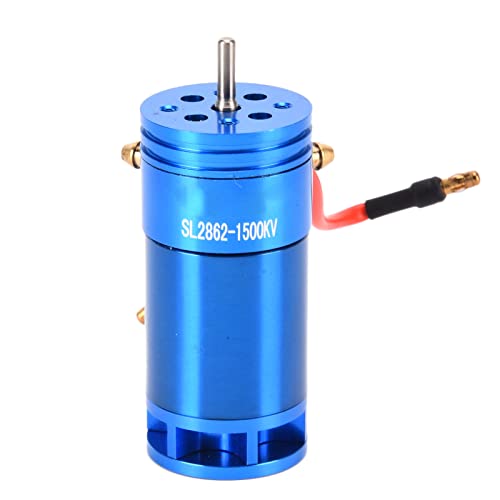
Equipped with a dual cooling system (air cooling fans plus water cooling), this 1500KV motor is designed for RC boats around 450–550mm in length and supports 2–6S. Best for hobbyists seeking a versatile, mid-range performance package with solid heat management. Better for boats where adding a water-cooling loop is feasible but a lighter air-cooled option is still desirable. Limitation: batteries and mounting hardware must suit 2–6S setups, which are not included.
MOTOULAX RC Boat Motor: Water-Cooled Aluminum Design

This motor emphasizes superior heat dissipation and a longer axle lifespan, with a stable, precision-engineered design for enhanced reliability in prolonged use. Best for builders who value durability and consistent performance over time, especially under tougher race conditions. Choose this if you want robust heat management and steady output, but verify compatibility with your boat’s mounting and propeller setup.
HY HUANYANG Huanyang Water Cooled CNC Spindle

Although marketed as a CNC spindle, this unit is noted for water cooling and high-speed operation, suitable for non-metallic engraving and small-scale projects requiring precise cooling. Best for hobbyists who need a compact, reliable water-cooled option for specialized builds. Limitation: designed for stationary CNC use rather than mobile RC boats, so integration into a boat may require custom mounting and control adaptations.
200A Electric Brushless Motor Controller for RC Boats

This is a water-cooled ESC built for RC boat use, offering plug-and-play setup and limited programming options. Best for hobbyists seeking straightforward control with robust cooling for higher-current setups. Avoid this if you require extensive ESC programming or advanced telemetry, as options are limited.
Buying Guide: Water-Cooled Motors for RC Boats
- What cooling approach suits your hull? Water cooling reduces operating temperatures, enabling higher current operation, but requires plumbing, seals, and compatible radiators. Air cooling is simpler but can limit sustained power in hot conditions.
- How to match KV and battery? Higher KV motors deliver quicker acceleration and higher RPM but demand more current and heat management. Pair with appropriate 2–6S batteries for balance between speed and runtime.
- Hull length and weight considerations: Longer, heavier hulls typically benefit from higher torque motors and robust cooling. Smaller boats excel with compact, efficient motors and lightweight components.
- Mounting and shaft compatibility: Verify shaft diameter, motor diameter, and mounting hole patterns. Some motors specify 3.175mm shafts and ~28mm diameters; others vary—confirm with your propeller and gearbox setup.
- System integration: Ensure the motor, ESC, water-cooling pump, and fittings fit within your hull’s internal space and available power connections. Consider filtration, routing, and potential leaks in sea water environments.
FAQ
- Q: Are water-cooled motors necessary for all RC boats?
A: Not always. They’re particularly helpful for high-power or endurance builds where overheating is a risk, but simpler air-cooled setups can suffice for casual use. - Q: What does KV indicate for RC boat motors?
A: KV indicates RPM per volt with no load. Higher KV means faster spins but more heat and current draw; lower KV provides more torque and cooler operation at given speeds. - Q: How do I know if a motor is compatible with my boat?
A: Check hull length, motor diameter, shaft size, and mounting points. Also confirm voltage range (2–6S or similar) and whether your ESC supports water cooling. - Q: What maintenance is needed for water-cooled setups?
A: Inspect water fittings for leaks, clean cooling lines to prevent blockages, and ensure the pump operates correctly. Periodically check for corrosion or wear on mounts and shafts. - Q: Can I mix different brands of motor and ESC?
A: It’s common to pair motors with compatible ESCs, but ensure current ratings, waterproofing, and cooling requirements align. Mismatched components can lead to overheating or failure. - Q: Is a dual cooling system always better?
A: Dual cooling provides extra reliability under demanding use but adds complexity. For simple or budget builds, a well-designed single cooling loop may suffice.