Best Voltage Testers for Cars: Quick, Accurate Car Electrical Troubleshooting
For car owners, DIY mechanics, and shop professionals, a reliable voltage tester is essential for diagnosing electrical issues safely and quickly. The following selections focus on 12V–72V systems, clear digital readouts, durable construction, and practical features such as polarity indicators and extended reach. Read on to compare top options and find the right tester for common automotive tasks like checking batteries, alternators, headlights, and circuitry.
| Product | Brand | Key Feature | URL |
|---|---|---|---|
| WINAMOO Automotive Test Light with 3-48V LED Digital Voltage Display | WINAMOO | Precise 0.1V readouts, polarity indicators, durable stainless probe | Amazon |
| MOTOPOWER MP0514A 12V Digital Car Battery Tester | MOTOPOWER | Plug-and-test setup, 0.01V precision, 8 LED indicators | Amazon |
| ANCEL BA101 Car Battery Tester | ANCEL | High-CCA range, 99.6% accuracy, multilingual display | Amazon |
| JASTIND Heavy Duty 3-65V Backlit Digital LCD Circuit Tester | JASTIND | Wide range, bidirectional polarity, extended wire | Amazon |
The table above highlights a mix of light-duty testers and heavier duty, high-coverage models suitable for shop use. The selections emphasize readability, safety features, and compatibility with a broad range of automotive electrical systems.
WINAMOO Automotive Test Light With LED Digital Readout

The WINAMOO tester covers 3V–48V systems, offering precise 0.1V digital readouts and polarity indication through red and green LED signals. Its bidirectional LED indicators assist in quick polarity checks, which is helpful when diagnosing circuits like headlights, taillights, and fuse connections. A stainless probe enables piercing insulation in tight spaces, while an anti-lost protective sleeve protects the probe during storage and transport. This device is well-suited for routine battery checks, alternator testing, and circuit verification on cars, trucks, SUVs, and marine setups where 12V–48V logic is common.
Key advantages include the bright display for improved readability in dim engine bays, a compact form factor for easy handling, and a probe design that reduces accidental damage to sensitive components. The product is presented as a practical, ready-to-use tester that minimizes the need for additional tooling during field diagnostics.
MOTOPOWER MP0514A 12V Digital Car Battery Tester
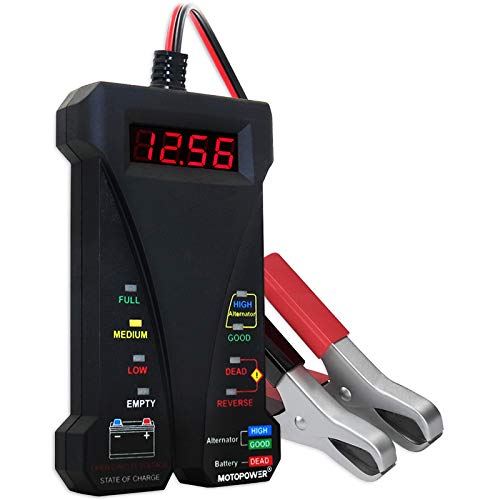
The MP0514A emphasizes a plug-and-test workflow with no complex setup. It lets users evaluate battery status without starting the engine and, after starting the vehicle, quickly assess the alternator condition. This makes it practical for everyday owners and automotive professionals who require fast, actionable data about charging systems and battery health. Its safety features include reverse-polarity and over-voltage protection, reducing the risk of damage from human error or accidental misconnection.
Readouts are digital with a 4-digit display that provides voltage readings with 0.01V precision. Eight LED indicators visually convey battery or alternator status, offering a quick at-a-glance assessment. The device’s design prioritizes simplicity and reliability for routine maintenance checks, jump-start decisions, and confirming charging system health between service visits.
ANCEL BA101 Car Battery Tester

The ANCEL BA101 is a versatile 12V diagnostic tool capable of quick battery health tests, voltage checks, and activation of charging and cranking analysis. Its crocodile clips provide a secure connection, and the copper conductors ensure solid conductivity for precise results. The tester features a robust intelligent chip to deliver accuracy around 99.6%, facilitating reliable assessments of battery condition and charging performance. Users should verify battery type and CCA/AH values, especially in colder conditions, to ensure readings are interpreted correctly.
Designed for one-handed operation, the BA101 includes a large LCD with adjustable contrast and backlight for clear readings in various lighting. Multilingual support broadens usability, making it a practical choice for shops and households with diverse users. Its blend of accuracy, ease of use, and broad application—from trucks to boats—positions it as a solid general-purpose automotive tester.
JASTIND Heavy Duty 3-65V Backlit Digital LCD Circuit Tester

This model expands the voltage testing range up to 65V, accommodating a broad spectrum of automotive circuits and even some heavier electrical systems. It features a bidirectional polarity indicator with two LED colors and audible feedback, enabling users to confirm polarity without ambiguity. The backlit LCD display provides readability in dim environments, and the extended 140-inch lead wire enhances accessibility in hard-to-reach areas. Made with a rugged body and a stainless steel probe, the unit is designed for durability in professional and hobbyist workflows alike.
For sensitive electronics, the tester minimizes current draw via a low-current circuit board, reducing the risk of damage to vehicle control units. It balances practical field practicality with precise digital readings, making it a versatile option for diagnosing lighting circuits, battery connections, and general wiring concerns across 12V–65V systems.
ANENG Car Battery Tester

The ANENG BT172 model provides a straightforward way to test 12V batteries across a broad range of vehicles, including motorcycles, boats, RVs, and more. With an accuracy around 0.01V, it yields dependable results for determining battery health and charge status. The device also analyzes the alternator’s output to prevent overcharging or insufficient charging, a common concern in aging electrical systems. The tester offers three operational modes: a real-time voltage readout, alternator status indicators, and a dedicated 12V battery test mode, simplifying interpretation for users new to vehicle diagnostics.
Connection is user-friendly, relying on proper clamp placement with red on the positive terminal and black on the negative terminal. Its design centers on simplicity and reliability, making it a practical daily-use tool for car owners who need quick, accurate snapshots of battery and charging system health.
Buying Guide: How To Choose The Right Automotive Voltage Tester
When selecting an automotive voltage tester, consider the following factors to tailor a choice to your needs:
- Voltage range and applications: If you work primarily on standard 12V vehicles, a tester covering 3–48V is usually enough. For trucks, boats, or RVs, a broader range (up to 65V or 72V) may be advantageous.
- Readout clarity and speed: Look for digital displays with high resolution (0.01–0.1V) and backlighting for readability in engine bays or dim garages. Quick, one-handed operation saves time during inspections.
- Polarity indication and alarms: Bidirectional polarity indicators (red/green LEDs) and audible alerts help confirm correct connections and prevent misreads that could cause damage to electronics.
- Durability and safety: A rugged body, stainless steel probes, protective sleeves, and safety features like reverse-polarity and over-voltage protection reduce the risk of accidents and equipment damage.
- Lead length and accessibility: Longer, flexible leads enable testing in hard-to-reach spots. Consider models with extended wires and robust clamps for reliability in professional environments.
- Portability and ease of storage: Compact designs with protective storage sleeves are beneficial for technicians who travel or work across multiple vehicles.
- Additional features: Some testers include alternator testing, multiple testing modes, and multilingual interfaces, which can improve usability in diverse settings.
- Compatibility with vehicles: Confirm whether the tester supports the voltage range and current draw typical of your fleet, including frequent testing of headlights, sockets, and fuse connections.
In practice, users should pair a voltage tester with a basic understanding of automotive electrical systems. For routine battery checks and quick alternator status readings, a plug-and-test model with clear LED indicators is often sufficient. For more in-depth diagnostics, a higher-precision unit with an LCD readout and broader voltage range provides more actionable data and reduces the likelihood of misinterpretation in challenging environments.