Best Voltage Meters for Golf Carts and Similar Battery Systems
Finding a reliable voltage meter is essential for keeping golf carts and other battery-powered vehicles running smoothly. This guide highlights top-rated meters that cover a wide range of voltages, durability, and ease of installation. Each product below is suitable for Yamaha, Club Car, EZGO, and other golf cart brands, as well as boats, RVs, and various battery chemistries. Read on to compare key features and determine which meter best fits your setup and maintenance routine.
| Product | Brand | Voltage Range | Waterproof / Durability |
|---|---|---|---|
| 10L0L 36V 48V Golf Cart Battery Meter | 10L0L | 36V-48V | IP67 waterproof design |
| Autokcan Battery Monitor Voltage Meter | Autokcan | 12V-84V (including 12V, 24V, 36V, 48V, 60V, 72V, 84V) | Waterproof capable, robust LCD |
| 10L0L 12V-72V Golf Cart Digital Voltmeter | 10L0L | 5-120V (DC range 5-120V) | Waterproof LED display |
| DROK 48V Golf Cart Battery Meter | DROK | 10-100V (12V-48V typical) | LCD display with backlight, rugged build |
| TRISCO 12V-72V Battery Gauge | TRISCO | 12V-72V | Three-color LED status display |
10L0L 36V 48V Golf Cart Battery Meter

The 10L0L voltage meter supports a broad audience beyond golf carts, including electric cars, trucks, and boats. It offers a wide application range and a highly waterproof design to resist rain and splashes. The device is hardened against shocks with a secure internal circuit board mounting. Installation is straightforward with only two connection wires: connect + to + and – to -. If using a key switch, wire + to the switch, switch to battery +, and – to the battery negative. This meter targets reliability in exposed outdoor environments.
Autokcan Battery Monitor Voltage Meter
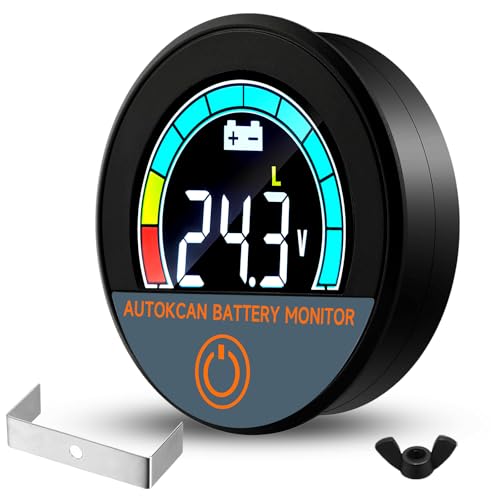
This monitor features a versatile LCD digital display that can show voltage, temperature, or battery percentage. Users can switch through displays with simple button presses and view modes as Voltage, Percentage, or Temperature. It supports a wide range of battery types, including various ternary lithium and lead-acid configurations (12V-84V). A low-power, high-contrast display improves readability, and a low-battery warning helps prevent unexpected outages during operation. Manual guidance is recommended for correct battery mode selection.
10L0L 12V-72V Golf Cart Digital Voltmeter

This meter covers a wide voltage spectrum from 5 to 120V DC, delivering broad compatibility with Yamaha, Club Car, EZGO, boats, RVs, and solar setups. Its IP67 waterproof housing makes it suitable for outdoor use in rain or dusty conditions. The bright LED display provides clear, glare-free readings day or night, with adjustable brightness and a compact form factor that fits easily on dashboards or panels. Real-time voltage tracking helps operators prevent unexpected drainage or mismatched charging routines.
DROK 48V Golf Cart Battery Meter

The DROK monitor is designed for 10-100V systems, supporting lithium, lead-acid, and lithium iron phosphate batteries. It can function as both a voltage meter and a battery capacity tester for cars, boats, RVs, and golf carts. An additional temperature gauge can display in Fahrenheit, providing a useful indicator of thermal conditions inside the battery module. It is well-suited for DIY projects or integrated battery management setups where precise voltage and climate data are needed.
TRISCO 12V-72V Battery Gauge
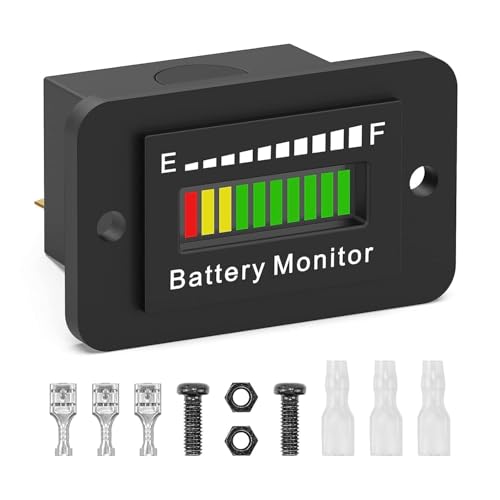
The TRISCO gauge covers 12V to 72V batteries and supports various chemistries, including lithium and lead-acid variants. Its three-color LED display (red, yellow, green) shows battery status across 10% increments, facilitating straightforward planning for charging cycles. The device is designed for automotive, marine, and golf cart applications, giving operators a concise readout of remaining energy and a simple way to schedule top-ups without over-discharging sensitive packs.
Buying Guide
Key considerations when selecting a voltage meter for golf carts and battery-powered vehicles include voltage range, battery chemistry support, display clarity, and weather resistance. Look for meters that explicitly support your system voltage (for example, 36V, 48V, or mixed 12V-84V ranges) and confirm compatibility with lithium, lead-acid, and LiFePO4 batteries if you mix chemistries. A bright, easy-to-read display with adjustable backlight helps in day or night use. Waterproof or IP-rated housings extend life in rain or dusty conditions. Installation simplicity—two-wire connections or switch integration—minimizes DIY time and reduces potential wiring mistakes. Some meters offer additional features like temperature sensing or battery percentage displays, which can be useful for proactive maintenance. If your setup requires long-term monitoring, consider meters with low power draw and clear alarms for low battery or abnormal readings. Finally, assess whether you prefer a universal meter with broad voltage support or a specialized unit tailored to a specific vehicle brand or system voltage.
To choose the best option, map your existing battery configuration, note the maximum and minimum voltages, and decide which data matter most for your operation: instantaneous voltage, remaining capacity, temperature, or a combination. If you manage multiple vehicles or different battery banks, a meter with a wide voltage range and durable construction will simplify inventory and maintenance tasks. Always follow the manufacturer’s wiring diagrams for safe installation and optimal performance.