Best Voltage and Current Data Loggers for Accurate Measurements
For engineers, electricians, and technicians, selecting a reliable voltage and current data logger is essential for diagnosing systems, monitoring energy use, and ensuring safety. This article reviews five well-regarded models, highlighting capabilities like true RMS measurement, data logging depth, and wireless or USB connectivity. Each option is suitable for professional work across residential, commercial, and industrial environments. Below you’ll find quick product summaries and a detailed look at features to help you compare performance and value.
| Product | Brand | Key Capability | Connectivity | Notes |
|---|---|---|---|---|
| Extech DL150 True RMS 110V AC Voltage/Current Datalogger | Extech | True RMS AC voltage (up to 600V) and current (up to 200A) | USB | Up to 100,000 readings; programmable sample rate |
| OWON CMS061 3-in-1 Bluetooth Clamp Meter | OWON | Clamp meter, oscilloscope, and data logger | Bluetooth (i-Meter app) | Real-time waveforms; 20,000 counts |
| Lascar EL-USB-3 USB Voltage Data Logger | Lascar Electronics | Voltage logging, 32,000+ readings | USB | One-year battery life |
| Supco DVCV True RMS Data Logger | Supco | Voltage and current with logging, warnings | USB | Graphical display and alarms; 18-month warranty |
| CrocSee AC 80-260V 100A CRS-022B | CrocSee | Voltage, current, and power parameters | Display with backlight | Multi-parameter readout with split-core CT |
Below is a concise look at each model’s strengths, helping you match a logger to your project requirements, whether you’re monitoring a motor, a power supply, or a building’s electrical load.
Extech DL150 True RMS Voltage/Current Datalogger
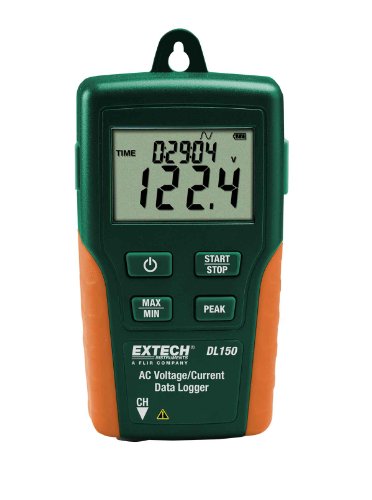
The Extech DL150 records true RMS AC voltage up to 600V and current up to 200A, enabling accurate power analysis for noisy circuits and variable loads. It can log up to 100,000 readings and supports programmable sampling from 1 second to 24 hours. Data is transferable to a PC via USB for analysis with the included software or export to spreadsheets.
OWON CMS061 3-in-1 Bluetooth Data Logger
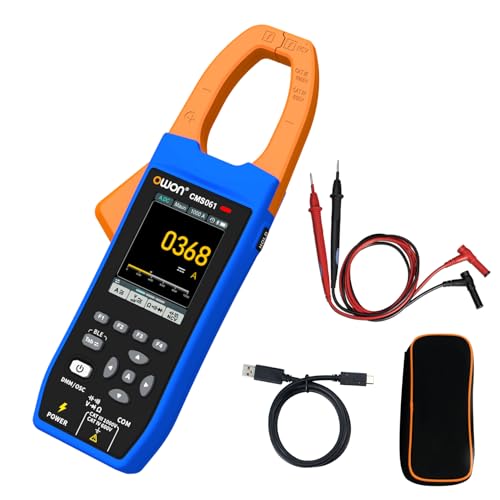
This 3-in-1 tool combines a 600A AC/DC True RMS clamp meter, an oscilloscope, and a data logger. It captures current and voltage waveforms in real time, enabling precise troubleshooting for motors, power supplies, and industrial equipment. Bluetooth enables wireless syncing to the i-Meter app for trend analysis and remote monitoring.
Lascar EL-USB-3 USB Voltage Data Logger

The Lascar EL-USB-3 provides straightforward USB voltage data logging with more than 32,000 readings and a long battery life. It is a compact, economical option for long-term voltage monitoring in lab, field, or equipment maintenance settings.
Supco DVCV True RMS Data Logger

The Supco DVCV logger delivers true RMS measurements for voltage and current with a graphical display, logging summary, and alarms for over- and under-range conditions. It emphasizes reliability with an 18-month warranty and software to review logged data and trends.
CrocSee AC 80-260V 100A CRS-022B

This multi-parameter meter reads active voltage, current, active power, cumulative energy, frequency, and power factor on a single display. It supports a wide AC range and uses a split-core current transformer for easy installation, with a backlit screen for readability in varied lighting conditions.
Buying Guide
Key considerations help tailor a logger to your application and budget. First, measurement type matters: True RMS is essential when dealing with non-sinusoidal loads or motors with PWM drives. If you only need voltage logging, a compact USB logger may suffice, but for comprehensive power profiling, a 3-in-1 device can save time.
Second, data depth and sampling rate affect analysis granularity. Look for models offering high maximum readings and flexible sampling intervals, especially if monitoring transients or fault conditions. Third, storage and connectivity influence workflow. USB loggers are simple for PC analysis, while Bluetooth or networked options enable remote monitoring and trend tracking.
Fourth, installation and form factor are important. Clamp meters with split-core CTs simplify insertion around existing conductors. Compact loggers help with confined panels, but ensure the device’s input range covers your mains voltage and fault scenarios. Finally, software support and warranty impact long-term value. A robust software package with export options eases reporting, and longer warranties reduce maintenance risk.
In practice, match the logger’s capabilities to your use case: motor troubleshooting in a factory may benefit from a 3-in-1 device with real-time waveforms, while on-site voltage monitoring over days might favor a USB logger with expansive internal memory. For mixed environments, a combination of a clamp-based data logger and a compact USB logger often provides the best balance of versatility and accuracy.