Best Variable Speed DC Gear Motor Solutions for DIY Projects and Small Automation
Looking for reliable variable-speed DC gear motors to power DIY robots, conveyors, or automation projects? This guide highlights five well-rounded choices, each suited to different needs—from high torque and precise control to compact form factors and easy mounting. Whether you’re building a small robot arm, a rotating table, or a lock-and-curtain system, these motors and kits offer clear advantages for the dedicated hobbyist and professional tinkerer alike. The top picks below emphasize quiet operation, durability, and easy integration with common controllers or wiring schemes.
Summary table of selected products
| Product | Best For | Key Reason | Brand | Power Range |
|---|---|---|---|---|
| 6v-22v Planet Gear Motor (DOCYKE) | High torque DIY projects | 8mm shaft, metal gearbox, flexible voltage | DOCYKE | 6V-22V |
| Sabary 12V Worm Gear Motor Kit | Complete motion-control kit | Includes PWM regulator and couplings | Sabary | 12V |
| Copkim 12V Kit With Mount | Easy install for hobby projects | All-in-one mounting hardware | Copkim | 12V |
| 12V DC Motor 200RPM (ZVKV) | Low-speed precision motion | 37mm eccentric shaft for oscillation | ZVKV | 12V |
| Greartisan All-Metal Geared Motor | Durable metal-gear reliability | All-metal gears, copper rotor | Greartisan |
6v-22v Planet Gear Motor With High Torque

The DOCYKE 6V-22V DC planet gear motor delivers high torque in a compact metal-geared package. It is suitable for DIY robots, rotating tables, door locks, curtains, and other small automation tasks that require robust torque and reliable wiring options. The 8mm output shaft and metal gearing ensure durability in continuous or intermittent use. This motor’s versatility makes it a strong fit for builders who want a single component adaptable to multiple voltages and applications.
Best for: hobbyists building small automation devices that need strong torque and flexible voltage operation. Choose this if you expect to run from a low-voltage supply yet still require high torque at the shaft. A potential limitation is the lack of built-in speed control—control is typically achieved through an external driver or wiring changes.
Notes: The motor supports wiring adjustments to alter rotation direction, which can simplify installation in tight or uniquely oriented projects. Applications span bank equipment, safes, automation accessories, paper handling, and smart curtains, among others. The 8mm shaft diameter is a common fit for many couplings and gear assemblies.
Sabary 12V Worm Gear Motor Kit

This Sabary kit bundles a 12V worm gear motor with a 20A PWM speed controller, rigid flange couplings, a hex wrench, and mounting screws. The worm gear design provides high torque at low speeds and a self-locking feature that helps hold position without back-driving. Copper windings contribute to stable performance and good conductivity. The kit’s modular nature is ideal for DIY automation and robotics projects where reversible rotation, precise speed control, and straightforward assembly are priorities.
Best for: builders who want an all-in-one control and drive solution, with robust torque and easy wiring reversal. Better for: projects requiring quick setup and repeatable motion profiles. Avoid this if you need a compact, single-molution motor (the kit is larger and requires a controller). A practical note: the included components ensure quick testing but do not replace a dedicated motor driver for complex profiles.
Copkim 12V Gear Motor Kit With Mount

The Copkim kit combines a 12V worm gear motor with a bracket, flange couplings, a wrench, and mounting screws. The design emphasizes easy installation and reliable transmission, with a 1:505 reduction ratio’s effect on torque and speed. It supports reversible rotation by wiring polarity changes and includes self-locking features, making it practical for hobby projects and motor replacements where straightforward mounting matters most.
Best for: users who want a ready-to-install gearing motor with mounting hardware included. This kit is a good match for small automation projects, model builders, or experimental setups. Caution: ensure that mounting surfaces can support the bracket and that the total torque does not exceed the bracket’s and couplings’ load ratings.
12V DC Motor With 37mm Eccentric Shaft

The ZVKV motor combines a 12V DC configuration with a 37mm eccentric output shaft, enabling oscillation and vibration-friendly motion. The compact gearbox and escentric shaft design yield useful low-speed performance for mechanisms requiring gentle, wavering, or periodic motion. Direction control is available via standard wiring options, and CW/CCW rotation modes can be adjusted as needed, though speed changes may be more limited compared to PWM-driven systems.
Best for: projects needing oscillatory or vibrating action, such as shaker mechanisms, linkages, or certain art installations. Choose this if the motion profile benefits from eccentric output rather than a perfectly centered shaft. Limitation: speed adjustability is typically achieved through external controls rather than built-in software speed control.
Greartisan All-Metal Gear Motor
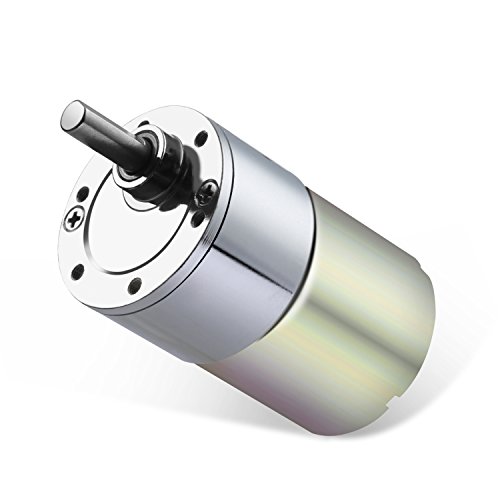
Greartisan’s model features all-metal gears and a copper rotor for efficient torque delivery and durability under load. The D-shaped output shaft improves coupling alignment and reduces slip under heavy torque. This motor is designed for high-temperature endurance and robust duty in compact packages, making it a strong candidate for longer-running DIY projects, automated feeders, or small robotics where stable power transfer matters.
Best for: applications emphasizing durability and continuous operation, such as long-running automation or robotics projects. Better for: users who need an all-metal gear train for reliability. Limitation: the exact voltage and speed ranges should be matched to your driver and supply; verify compatibility with your control system to avoid overloading the motor.
Buying Guide: Key Purchase Considerations
What should you check before buying a variable speed DC gear motor?
- Voltage range: Ensure the motor voltage aligns with your power source (commonly 6V–24V). A wider range offers more flexibility but may require different controllers.
- Gearbox type: Planetary gears yield high torque in compact form, while worm gears provide self-locking action and high torque at low speeds. Choose based on required speed control and holding force.
- Shaft size and mounting: 8mm vs 6mm shafts and the presence of brackets or couplings affect compatibility with your project frame and drivetrain.
- Rotation direction control: Some motors require wiring changes to reverse rotation, while others include controllers for easy forward/reverse switching.
- Integrated controllers: Kits with PWM controllers simplify speed control, but verify current ratings and compatibility with your motor’s torque profile.
- Durability and materials: All-metal gears and copper windings support higher torque and longer life in demanding environments.
- Physical footprint: Consider height, width, and mounting footprint to fit within your device enclosure or base plate.
How to choose between a motor kit and a standalone gear motor?
- Standalone motors are compact and straightforward when you already have a motor driver or speed controller in your setup.
- Motor kits provide ready-to-use mounting hardware and wiring options, which can save assembly time and ensure alignment for complex projects.
Best practices for integration
- Match the motor’s stall current to your controller’s current limit to prevent damage or unexpected shutdowns.
- Plan wiring routes to minimize resistance and allow for easy heat dissipation in compact enclosures.
- Use a proper heat sink or mounting to avoid overheating in high-torque tasks.
FAQ
- Q: Do these motors require a separate driver?
- A: Yes, most motors need a driver or PWM controller to set speed and direction, especially for precise control.
- Q: Can I use these motors for high-speed applications?
- A: These motors are optimized for low-speed, high-torque operations; check the no-load speed and gearing to ensure suitability for your task.
- Q: Are all these motors reversible?
- A: Reversibility depends on the motor design; many can reverse by changing polarity, while some kits include explicit reverse controls.
- Q: What mounting hardware is typically included?
- A: Some kits include brackets, couplings, screws, and wrenches; standalone motors may require separate purchase of mounts or couplers.
- Q: How do I select the right shaft size?
- A: Choose a shaft size that matches your couplings, pulleys, or gears; common options are 6mm and 8mm, with 8mm offering broader compatibility for higher torque.
- Q: Is all-metal gear better than plastic?
- A: All-metal gears generally offer higher durability and heat tolerance, especially in continuous or heavy-load use.