Best Variable Current Power Supply for Bench Testing and DIY Projects
If you need a reliable variable current power supply for lab work, hobby electronics, or education, these models cover a range of CV/CC capabilities, precise displays, and convenient controls. This guide highlights five options ideal for different buyers: students and hobbyists needing easy adjustment; technicians requiring rapid readouts and safety features; and professionals who prioritize compact form factors with versatile outputs. The summary below helps you compare at a glance.
| Product | Brand | Best For | Key Feature |
|---|---|---|---|
| Jesverty SPS-3010 (0-30V, 0-10A) | Jesverty | General bench work, CV/CC switching | 4-digit display with real-time V/A/W |
| NICE-POWER 30V/10A (0-30V, 0-10A) | NICE-POWER | Professional-grade readings, security features | Auto power calculation, output switch |
| NANKADF DC Power Supply (30V, 10A) | NANKADF | Precision control with encoder knob | High-precision encoder and output enable/disable |
| NICE-POWER 0~30V/0~10A (150W) | NICE-POWER | Compact, dual-mode outputs | 3-digit display with encoder and safety |
| WANPTEK POWER DC 0-30V/0-10A | WANPTEK POWER | Flexible outputs with USB/Type-C | Coarse & fine knobs, USB and Type-C charging |
NICE-POWER DC Power Supply Variable 30V 10A

The NICE-POWER unit offers a high-precision, 4-digit readout for voltage, current, and power with auto-calculation. It emphasizes safe operation through robust protection features and a clear, backlit display for low-light environments. Best for: technicians and researchers who need accurate readouts and secure switching between outputs. Limitation: safety warnings note 110V input only, which may constrain certain setups.
DC Power Supply Variable 0-30V 0-10A with Encoder and OCP

This model uses coarse and fine encoding knobs for exact voltage and current settings. It includes an overcurrent protection feature and a dedicated output enable/disable button, which helps prevent accidental load activation. Best for: users who value rapid, precise dialing and clear output control. Limitation: described as compact with a smaller footprint, which may limit heat dissipation in continuous high-load operation.
Jesverty SPS-6005 (0-60V, 0-5A)
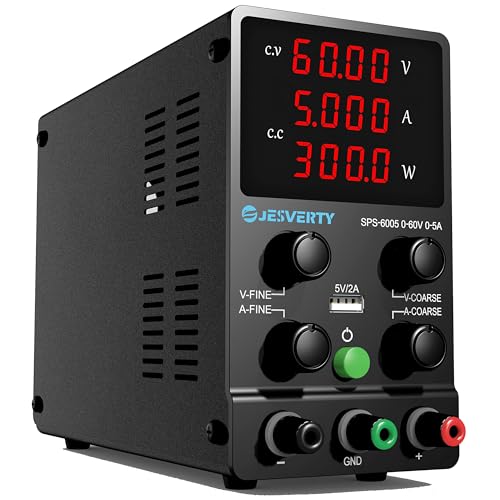
The Jesverty SPS-6005 provides a wide voltage range with a 4-digit display for real-time V/A/W. It automatically handles CV and CC modes as the load changes. Best for: users who need a broader voltage range for experiments or multipurpose lab tasks. Limitation: higher voltage potential requires mindful safety practices and proper wiring to avoid overvoltage risks.
Jesverty SPS-3010 (0-30V, 0-10A)

The SPS-3010 model emphasizes fast CV/CC switching with a precise 4-digit readout for voltage, current, and power. It includes a 5V/2A USB port for auxiliary devices and a dual adjustment mechanism for precise tuning. Best for: hobbyists seeking a versatile, easy-to-read bench supply. Caution: ensure you set CV/CC thresholds with the appropriate load to avoid premature mode switching.
DC Power Supply Variable with Encoder (NANKADF)

Featuring a high-precision encoder knob and an output enable/disable button, this model focuses on ease of use and safety. It includes overcurrent protection and straightforward operation for precise settings. Best for: makers and technicians who value crisp digit control and immediate output management. Limitation: encoder-based control may require a short learning curve for new users.
Buying Guide: Key Considerations for Selecting a Variable Current Power Supply
- Voltage and current range: Match the supply to your typical projects. Wider ranges offer more flexibility but may increase cost and size.
- Display and readout: Four-digit displays showing V, A, and W help reduce measurement errors. Backlit displays improve readability in workshops.
- CV/CC behavior: Look for automatic CV/CC switching with clear notes on crossover behavior to avoid surprises under load.
- Control interface: Coarse/fine knobs vs encoder knobs each suit different user preferences. Knob quality affects precision and workflow speed.
- Safety features: Overcurrent protection, short-circuit protection, and input safety warnings protect both the device under test and the power supply.
- Output enable/disable: A dedicated button or switch prevents accidental application of power to the load.
- USB Type-C or USB-A ports: If you plan to power auxiliary devices, built-in charging ports can be convenient.
- Form factor and cooling: Compact designs with efficient cooling are ideal for small workbenches, but ensure adequate ventilation for longer uses.
- Protection and certifications: Check for reliable protection circuits and any applicable safety certifications relevant to your region.
FAQs
- What is a CV/CC power supply?
CV stands for constant voltage and CC stands for constant current. These modes automatically switch based on load, maintaining either a stable voltage or current as needed.
- Who should use a variable power supply with encoder knobs?
Users who require precise, repeatable adjustments and quick changes between setpoints benefit from encoder knobs, especially in lab or development work.
- Is a higher wattage model always better?
Higher wattage provides headroom for more demanding loads, but consider heat, size, and cost. Choose a model that fits your typical load without excess capacity.
- What safety features matter most for bench use?
Overcurrent protection, short-circuit protection, proper isolation, and a clear output on/off control reduce risk to devices and the power supply itself.
- Can these supplies power USB devices?
Some models include USB or USB-C ports for charging or powering peripherals. Check output ports and safety notes for compatibility and limits.