Best Underground Cable Fault Locator Guide for 2026
Finding buried cables, irrigation lines, and underground wiring without digging is essential for safe maintenance and repairs. This guide reviews five top-rated underground cable fault locators, highlighting how they locate breaks, shorts, and faults quickly and accurately. Each product is evaluated for depth reach, signal clarity, ease of use, and versatility across different cable types. Use the buying guide to compare options and choose the right locator for your needs.
Summary Of Selected Products
| Brand | Product | Depth / Range | Key Benefit |
|---|---|---|---|
| NOYAFA | NF-826 Underground Cable Locator | 3–4 ft deep; up to 2000 ft length | Precise fault detection and multi-signal capability |
| TEMPO | PE2003-G Pulser Ground Fault Locator | Not specified (deep fault detection) | Accurate fault identification even for small breaks |
| Rocky Mars | NF826 Underground Wire Locator | 3–4 ft deep; up to 2000 ft length | Self-inspection and audible/visual indicators |
| TEMPO | 501 Tracker II | Up to 7 ft depth; up to 1 mile/1.6 km tracing | Dual-frequency with IntelliTrack noise rejection |
| SZJMS | NF-826 Underground Wire Locator | 3–4 ft depth; up to 3000 ft length | Professional-grade fault tracing with dual alerts |
Note: The table above compares five reliable options often used by professionals for locating underground cables, fences, irrigation wires, and related infrastructure. Each product supports identifying open circuits, shorts, and other faults without invasive digging, helping to protect walls, floors, and buried paths.
NOYAFA NF-826 Underground Cable Locator

NOYAFA NF-826 is designed to locate buried cables and pipelines, with a practical range up to 3–4 feet deep and an extensive length of up to 2000 feet. The system includes a transmitter and receiver, plus accessories, and employs digital circuit technology to deliver stable performance. It helps identify fault points in dog fences, irrigation lines, and underground wiring without extensive digging. The device supports single-core and multi-core cables and can detect metal pipes, which makes it suitable for inspecting safety circuits, wall sockets, and underfloor heating layouts. It also features adjustable sensitivity, auto or manual frequency selection, a flashlight, backlight, and an automatic shutdown after 10 minutes of inactivity. Optional transmitters extend or distinguish multiple signals for larger projects.
TEMPO PE2003-G Pulser Ground Fault Locator

The PE2003-G locator is focused on precise fault identification in buried wires and insulation breaks. It is designed to reduce time and cost by highlighting multiple faults on a single wire, guiding replacements rather than endless repairs. The tool ships with versatile test leads featuring heavy-duty alligator clips, enabling compatibility with various cable types and configurations. It excels in identifying small breaks and insulation faults, making it a strong choice for complex underground installations and retrofit projects where accuracy is critical.
Rocky Mars NF826 Underground Wire Locator

Rocky Mars NF826 locates cables, lines, and fuses underground or within walls, with a built-in AC/DC voltmeter and a 3–4 foot depth reach, up to 2000 feet in length. The device includes a backlit LCD display and a flashlight for low-light conditions. It provides a self-inspection function to verify transmitter status and supports testing both energized and non-energized lines. Its voltage measurement spans 12–400V AC/DC, enabling comprehensive voltage monitoring during fault tracing. Note that soil type can influence maximum test length and depth, and grounding may be required for certain multi-core tests.
SZJMS NF-826 Underground Wire Locator
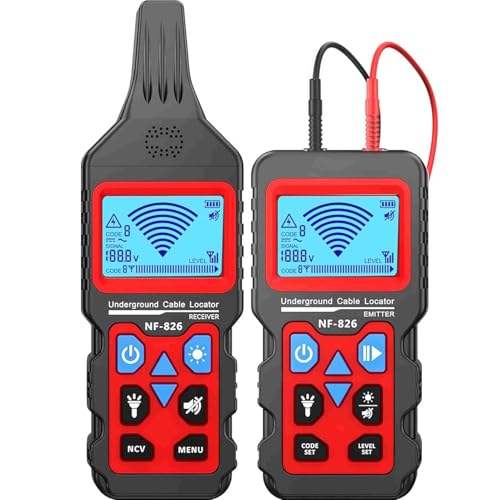
SZJMS NF-826 is a multi-functional underground cable locator designed to detect in-wall and underground cables, as well as short circuits and interruptions. The receiver’s sensitivity can be manually or automatically tuned, and the transmitter features self-inspection with a mute option. The device is capable of tracing both energized and non-energized wires, including floor heating systems and irrigation lines. It uses dual alerts (sound and LCD indicators) that grow closer to the target, helping pinpoint fault points with precision. The detachable rechargeable power setup supports extended field use, with typical operation around eight hours on a full charge.
Buying Guide: Key Purchase Considerations
- Depth and reach: Consider how deep buried cables or pipes typically are on your sites. Models advertising 3–4 feet depth with longer tracing lengths are well-suited for expansive yards, while deeper utilities may require more advanced units or professional-grade tools.
- Signal technology: Look for devices with adjustable sensitivity and multiple signal modes. Automatic frequency sweep, IntelliTrack, or dual-frequency systems help maintain accuracy in electrically noisy environments like near power lines or metal fixtures.
- Multi-core and energization: If you expect to test both single-core and multi-core cables, ensure the locator clearly supports these configurations and provides clear guidance for grounding and testing procedures.
- Voltage measurement capability: A built-in voltmeter (AC/DC 12–400V) helps verify live conductors and assess circuit health while tracing, reducing the risk of accidental shocks or damage.
- Usability features: Backlit LCDs, flashlights, mute options, and auto shutoff improve field usability. Self-inspection and status indicators help confirm proper device operation before starting a fault search.
- Portability and endurance: Rechargeable batteries with long life enable extended field use. Detachable transmitters or multiple signal capabilities support complex installations and longer runs.
- Application range: Some tools are optimized for fence lines, irrigation cables, and wall wiring, while others claim broader utility for underfloor heating, plumbing, and electrical infrastructure. Match the device to your typical tasks to maximize value.
- Soil type and environment: Soil composition, moisture, and underground conditions impact range and accuracy. If you work in challenging soils, prioritize tools that maintain performance with adaptive signal handling.
- Safety considerations: Prioritize tools with clear voltage readings and warnings to prevent working on energized equipment. Ensure you follow local regulations and safety guidelines when locating underground utilities.
Across these options, users should balance depth reach, ease of use, and diagnostic clarity. For routine residential tasks like locating dog fence lines or irrigation cables, compact models with straightforward testing and good battery life provide the best value. For more complex installations or frequent fault tracing in commercial settings, consider a dual-frequency or IntelliTrack-equipped locator that minimizes interference and improves precision in noisy environments.