Best Underfloor Heating Wireless Thermostats for Modern Homes
Choosing the right wireless thermostat for underfloor heating helps optimize comfort, energy use, and safety. This guide highlights five reliable options designed for American homes, covering features from dual sensing and GFCI protection to app control and quick installation. Each product is evaluated on compatibility, ease of use, and sensor accuracy to aid informed purchases.
Summary of Selected Products
| Product | Brand | Key Features | Voltage | Sensor Type |
|---|---|---|---|---|
| BOWSEN Programmable Thermostat | BOWSEN | Dual sensing, built-in GFCI, floor and air sensors | 120/240V | Air & Floor |
| AC11201 Floor Temperature Sensor | Valorup | Accurate floor readings, direct replacement for radiant heat wire systems | N/A | Floor |
| UTN4 Radiant Floor Heat Thermostat | OJ Microline | Class A GFCI, dual sensing, programmable ready | 120/240V | Air & Floor |
| meross Smart Thermostat | meross | Wi-Fi enabled, HomeKit/Alexa/Google, 120–240V | 120/240V | Air & Floor |
| UDG4 Touchscreen Thermostat | OJ Microline | Touchscreen, dual sensing, 3-year warranty | 120/240V | Air & Floor |
BOWSEN Programmable Thermostat For Underfloor Heating
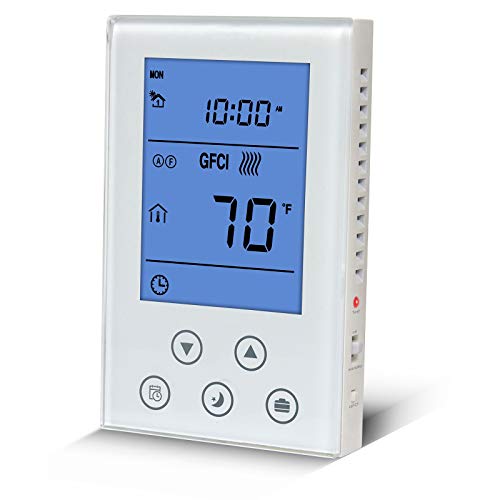
This underfloor radiant heating thermostat supports both 120VAC and 240VAC with a maximum current of 15A. It accommodates floor and air sensors and includes a built-in GFCI with test functionality. The unit emphasizes electrical safety, with clear guidance on GFCI trips and leakage checks. Its dual-sensing capability helps maintain even comfort by measuring ambient room conditions alongside floor temperature. A practical choice for safety-conscious installations in homes with radiant floor systems.
AC11201 Floor Temperature Sensor

The AC11201 sensor is designed as a direct plug-in replacement for radiant floor heating systems. It provides precise floor temperature readings (±0.5°C) to support optimal radiant heating performance. It’s compatible with popular Honeywell thermostat sensor configurations, enabling easy integration into existing setups. This sensor is ideal for homeowners seeking improved floor temperature accuracy without extensive rewiring.
OJ Microline UTN4 Radiant Floor Heat Thermostat

The UTN4-4999 model features a built-in Class A GFCI and dual sensing for enhanced safety and comfort. It is compatible with 120V and 240V circuits and is listed for USA and Canada. This simple, non-programmable thermostat focuses on reliable operation and quick setup, making it suitable for users who prefer straightforward control while maintaining safe underfloor heating performance.
meross Smart Thermostat For Electric Baseboard Heaters

The meross thermostat handles 120V–240V systems and supports multiple smart integrations, including Apple HomeKit, Alexa, and Google Home. It requires a four-wire setup for full functionality in high-voltage applications such as baseboard heating. It emphasizes remote control and energy-saving features, with guidance on installation and wire requirements to ensure proper operation of in-wall or inline baseboard heaters.
OJ Microline UDG4 Touchscreen Radiant Thermostat

The UDG4-4999 thermostat offers a responsive 3.5″ color touchscreen and dual sensing with a Class A GFCI. It provides programmable control for radiant flooring, enabling seven-day scheduling to balance comfort and energy use. The model supports 120V and 240V operation, and its warranty and US support policies provide added assurance for homeowners implementing in-floor heating systems.
6iE Smart WiFi Thermostat With SmartGeo Technology

This model focuses on energy efficiency with geolocation-based heating. It uses a smartphone app to control temperature, enabling location-aware adjustments that can reduce energy use by detecting when you’re away. Compatible with high-voltage systems, it supports touchscreen interaction and remote control through a connected app, appealing to users seeking advanced smart-home integration for underfloor heating control.
Buying Guide
Key considerations when selecting a wireless thermostat for underfloor heating include: compatibility with your system voltage (120V vs 240V), sensor configuration (air, floor, or dual), and safety features like Class A GFCI protection. If your setup uses floor heating wire or mats, ensure the unit supports direct floor sensing and appropriate power ratings to avoid overheating. For those seeking hands-off control, Wi-Fi or smart-home integrations (HomeKit, Alexa, Google) add convenience but require stable network connectivity and privacy considerations. Finally, evaluate installation requirements—some models need professional wiring, while others offer plug-and-play simplicity with self-contained sensors. Compare features, warranty terms, and customer support availability to choose a thermostat that balances safety, comfort, and energy efficiency for your space.