Best Grid-Tie Inverter Options for UL Listed Setups and Micro-Grid Projects
Looking for a reliable UL-listed grid-tie inverter to feed power back to the grid or to run off a home battery setup? This guide highlights five strong choices designed for residential, small commercial, and educational installations. Each option is evaluated for suitability by system voltage, output, and ease of installation. The buyers most likely to benefit are homeowners upgrading to rooftop solar, small business operators seeking steady grid feed, schools testing off-grid experiments, and hobbyists building micro-grid projects. A concise product table follows the introduction to help you compare at a glance.
Summary table of selected products
| Product | Best For | Key Advantage | Limitation |
|---|---|---|---|
| SBPKMARSCT Solar Grid Tie Micro Inverter WVC-1200W | Small homes and schools | High MPPT efficiency; 99.9% transmission rate | LCD is basic for monitoring |
| Y&H 1000W Grid Tie Inverter Power Limiter | Compact systems, limited loads | Limiter ensures load-based output | Startup voltage and panel specs must be matched |
| Y&H 2000W Grid Tie Inverter Power Limiter LCD Display | Medium systems needing more headroom | High power + limiter sensor | Requires appropriate 240V AC connection |
| Y&H 1200W Grid Tie Inverter Power Limiter | Mid-range solar setups | LCD display; limiter ensures safe output | Best used with compatible voltages |
| Lumicasaler 1000W Solar Micro Inverter Grid Tie | Rugged, compact setups | IP65 rated; pure sine wave | May require multiple units for larger loads |
SBPKMARSCT Solar Grid Tie Micro Inverter WVC-1200W

The SBPKMARSCT WVC-1200W is a high-efficiency micro grid-tie inverter with built-in maximum power point tracking (MPPT). It aims to optimize solar power collection and can reportedly improve generated energy by over 25%. It also features a high transmission rate to the grid and an LCD display for real-time readings. Best for compact solar arrays on homes, schools, and small offices where direct grid export is desired. Limitations include that LCD visibility depends on ambient lighting and the device relies on compatible panel voltages.
Who it’s best for: small-scale residential or institutional installs needing reliable MPPT and a clear display. Why selected: strong MPPT performance combined with a robust grid-transmission capability supports steady energy inflows for modest systems.
Caution: Ensure your solar array voltage aligns with the inverter’s input range to avoid underperformance.
Y&H 1000W Grid Tie Inverter Power Limiter DC25-60V
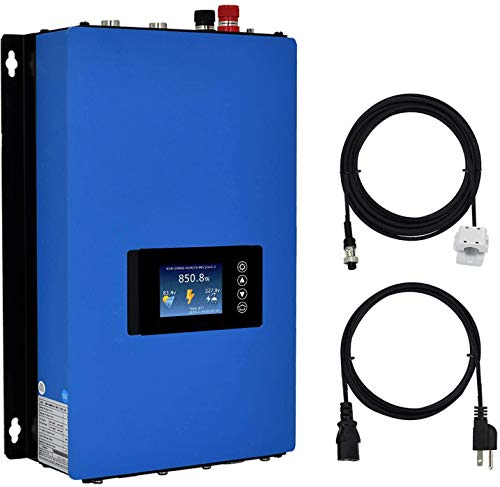
This 1000W grid-tie model includes a power limiter and MPPT technology, designed to extract maximum energy from solar panels while maintaining safe operation. It supports DC input in the 25–60V range, suitable for smaller 36V or 48V battery configurations and 110V/220V AC outputs. Best for compact rooftops or portable solar rigs where load-aware output is important. Limitation: ensure the solar array’s open-circuit voltage stays within the specified 38–60V range for optimal efficiency.
Who it’s best for: homeowners and small installations needing reliable limiter-based control. Why selected: the limiter feature helps prevent overloading circuits and improves system safety.
Caution: match the solar panel specification and ensure a proper overcurrent protection device is in place.
Y&H 2000W Grid Tie Inverter Power Limiter LCD Display

This 2000W grid-tie inverter offers an LCD display, a powerful MPPT-enabled design, and a limiter sensor to automatically adjust load output. It is compatible with higher voltage panels and is oriented toward American 240V AC installations, with a battery-ready option for some configurations. Best for mid-to-large rooftop or remote installations requiring higher power in a single unit. Limitation: requires careful wiring and matching to 240V systems; stacking multiple units is possible but requires planning.
Who it’s best for: mid-size solar projects and schools needing substantial grid export. Why selected: higher capacity without sacrificing MPPT efficiency makes it versatile for expanding arrays.
Caution: ensure concurrent protection devices and safe wiring practices when combining multiple inverters.
Y&H 1200W Grid Tie Inverter Power Limiter

This 1200W unit features a limiter sensor and an LCD that shows operating status. It supports DC inputs in the 55–90V range and provides AC output suitable for 110V systems. The limiter helps control energy to protect devices and wiring. Best for homes with modest 48V battery banks or grid-tie configurations where precise output control is desired. Limitation: relies on correct MPPT range and panel voltage; misalignment can reduce efficiency.
Who it’s best for: homeowners and small installations needing straightforward limiter-based control. Why selected: robust openness to mixed loads with a visible display enhances operator confidence.
Caution: verify panel Open-Circuit Voltage stays within the inverter’s MPPT window to maintain efficiency.
Lumicasaler 1000W Solar Micro Inverter Grid Tie

The Lumicasaler 1000W grid tie micro inverter claims over 99% efficiency with MPPT and a pure sine wave output. It provides complete electrical isolation between input and output, which increases system safety. It’s IP65-rated for weather resistance and includes a compact form factor with smart cooling. Best for rugged outdoor installations, small shops, or educational setups where space is limited. Limitation: a single unit may not be enough for larger loads; multiple units can be deployed for higher total output.
Who it’s best for: compact, outdoor solar projects requiring reliability and weather resistance. Why selected: IP65 protection and pure sine wave output make it suitable for sensitive electronics and mixed-use spaces.
Caution: plan for heat dissipation in warm climates, as continuous running can raise temperatures in small enclosures.
Buying Guide: Grid-Tie Inverter Essentials
- System voltage and compatibility: Match the inverter’s DC input range and AC output voltage to your solar array and local grid requirements. Many units favor 36–60V input and 110/120V or 220–240V output depending on your region.
- MPPT and efficiency: Look for MPPT-enabled devices with high efficiency (ideally 99% or higher) to maximize energy harvest under varying light conditions.
- Limiter or load-based control: In some setups, a limiter helps protect batteries and wiring by delivering only the power the load requires.
- Weather and installation environment: For outdoor use, consider IP ratings (IP65 is common for rugged micro inverters) and enclosure protections against rain and dust.
- Monitoring and display: LCD or data monitoring features aid maintenance, allowing you to track voltage, current, and power in real time.
- Scalability: If you anticipate expanding capacity, verify whether multiple inverters can be stacked or paralleled and what wiring changes are required.
- Safety and compliance: Ensure the inverter complies with local electrical codes and safety standards for grid-tied systems.
Frequently Asked Questions
- What is a grid-tie inverter? A grid-tie inverter converts DC power from solar panels to AC power that can be fed back into the grid or used by a home, typically with a 110–240V output depending on the region.
- Do I need an MPPT feature? MPPT (Maximum Power Point Tracking) improves energy harvest by adjusting the electrical operating point of the modules, especially under partial shading or changing temperatures.
- Can I use multiple inverters together? Yes, many systems support stacking or paralleling units, but this requires correct wiring, protections, and sometimes specific models.
- What is a power limiter? A limiter restricts how much power an inverter exports to prevent overloading loads or batteries, which can improve safety and battery longevity in certain setups.
- Is IP65 protection enough for outdoor use? IP65 indicates protection from dust and water jets; it is suitable for many outdoor installations, but consider enclosure placement and heat dissipation.
- How do I choose among these models? Choose based on system size, voltage, desired monitoring features, and whether you need a weatherproof unit for outdoor use or a compact indoor solution.