Best Dual Power Transfer Switches for Reliable Back-Up Power and Seamless Transitions
Seeking a dependable two-way transfer switch to manage primary and backup power sources? This guide highlights five top options, tailored to different needs—from compact residential setups to industrial-grade transfer protection. We’ll explain which buyer each product suits best, compare capabilities, and note any limitations. The included table summarizes key specs to help you decide at a glance.
Product Comparison Snapshot
| Product | Voltage / Amperage | Modes | Best For |
|---|---|---|---|
| 110V Dual Power Automatic Transfer Switch (Zgqmcgy) | 110V, 63A | Automatic & Manual | Small to mid-size homes or offices needing quick switchover |
| 2P 63A 110V Dual Power Automatic Transfer Switch (JANGHEXOUNG) | 110V, 63A | Automatic & Manual | Residential and light commercial with rapid switching |
| 125 Amp 3P Dual Power Automatic Transfer Switch (JINDOUZI) | 120/240V, 125A | Automatic with lockable safety | Industrial, commercial, or larger homes needing robust protection |
| Dual Power Automatic Transfer Switch 2P 63A (Ketofa) | 110V, 63A | Automatic & Manual | General residential or small business power management |
| 110V 20A Dual Power Automatic Transfer Switch With IoT (ZXWATC) | 110V, 20A | Automatic with IoT remote control | Smart home setups needing remote control and scheduling |
110V Dual Power Automatic Transfer Switch, 2P 63A
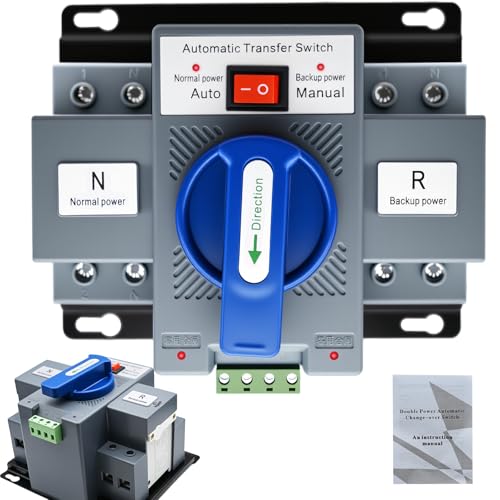
Best for compact living spaces or small offices that demand reliable automatic switchover in under two seconds. This Zgqmcgy unit supports automatic and manual operation, monitoring only Phase A for voltage loss or phase loss to minimize interruptions. It includes robust protections against short circuits, overloads, and undervoltage, making it a solid choice when simple, fast switching is the priority.
Who it’s best for: homeowners or small business operators needing fast, automatic transfer with straightforward setup.
Caution: Ensure compatibility with your load profile; rated 63A may be insufficient for higher-demand equipment simultaneously running on both sources.
2P 63A 110V Dual Power Automatic Transfer Switch (JANGHEXOUNG)

This model emphasizes dual-mode smart operation with rapid 2-second switching and comprehensive safety protections. It automatically shifts load circuits when it detects failures in the primary or backup source by monitoring voltage loss or phase loss on Phase A. Manual mode adds emergency control for flexibility. Best for: homes or small offices needing dependable automatic transfer with solid safety features.
Best for: those who want a clear automatic/ manual workflow and strong protection against common electrical faults.
Caution: Like other 2P switches, verify your electrical panel compatibility and space for installation in constrained areas.
125 Amp 3P Dual Power Automatic Transfer Switch (JINDOUZI)

Designed for higher demand environments, this 125A, 3P unit is built for seamless transitions across mains and standby power in industrial, commercial, or larger residential settings. Features include a lockable safety mechanism to prevent accidental activation and several safety protections to minimize overload, short circuits, and electrical faults. Best for: users needing stronger capacity and enhanced security in dual-source power setups.
Best for: installations where space allows a larger switch and where load profiles justify a higher amperage
Caution: More complex to install than 2P models; ensure proper enclosure and professional wiring practices for safety and compliance.
Dual Power Automatic Transfer Switch, 2P 63A (Ketofa)

Ketofa’s model emphasizes easy operation with automatic and manual modes and 2-second switching, ensuring uninterrupted power to connected circuits. It tests the voltage on Phase A to detect losses and then switches automatically. It also highlights multiple protection functions including short circuit, overload, and under voltage protection. Best for: users who want a reliable, straightforward 2P switch with solid protective features.
Best for: residential users or small offices seeking a balanced mix of automation and protection in a compact form factor.
Caution: Depending on your load, you may need additional protection devices for complex or heavy-use systems.
110V 20A Dual Power Automatic Transfer Switch With IoT Remote Control

This model adds IoT remote control and scheduling to the dual power feature, enabling control from anywhere via a dedicated app. It supports countdowns, timers, custom loops, and auto on/off for tailored energy management. With ultra-fast 0.015-second transfer, it keeps critical devices—such as routers, CCTV, DVRs, or PLCs—operational during source changes. Best for: smart homes or offices seeking remote operation and precise timing for power reliability.
Best for: environments where remote monitoring and automation are essential to maintain continuous operation.
Caution: The 20A rating means it’s best for lighter loads; verify this matches your most power-hungry devices and overall circuit demand.
GEYA Manual Transfer Switch Dual Power (2P-63A-240V)

GEYA’s manual transfer switch is designed for straightforward manual operation with a handle-based transfer. It suits scenarios where a reliable, non-automatic backup path is preferred, using either city grid power or an AC generator. It’s compatible with residential, commercial, RV, or other dual-circuit systems where continuous power matters. Best for: users who want deliberate manual control and a robust protection profile.
Best for: setups prioritizing explicit manual switching and clear isolation between sources.
Caution: This is a manual-only approach; automatic backup may be limited depending on the exact model and wiring arrangement.
Buying Guide: Key Considerations For Choosing A Dual Power Transfer Switch
- Load compatibility: Match amperage and voltage to your total load. Choose higher capacity if you plan to run several major devices simultaneously.
- Number of poles: 2P units are common for simple residential use; 3P units suit larger homes or commercial installations with three-phase systems.
- Automatic vs manual: Automatic transfer is ideal for uninterrupted power, but manual switches provide a controlled fallback in certain setups.
- Safety protections: Look for short-circuit, overload, phase loss, and undervoltage protections. Consider additional grounding and enclosure requirements for outdoor or industrial use.
- Installation environment: Indoor vs outdoor, weather resistance, and enclosure size influence your selection.
- Smart features: IoT remote control and scheduling add convenience for smart homes or monitored facilities, but verify network reliability and security features.
- Certification and frequency: Some models support 50Hz/60Hz; confirm compatibility with your locale or equipment.
Frequently Asked Questions
- What is a dual power transfer switch used for? – It automatically or manually transfers electrical load between two power sources to ensure continuous operation during power outages or failures.
- What does “2P” or “3P” mean? – It refers to the number of poles; 2P handles two conductors, while 3P handles three in a three-phase setup or more complex configurations.
- Can I install a transfer switch myself? – Installation should follow local electrical codes; consult a licensed electrician for safety and compliance, especially for higher amperage or outdoor units.
- What is “automatic mode” vs “manual mode”? – Automatic mode detects power faults and switches automatically; manual mode requires user intervention to transfer loads.
- Do these switches protect against all electrical faults? – They offer several protections (short circuit, overload, phase loss, undervoltage), but additional protective devices may be recommended depending on your system.
- Will a transfer switch affect my generator or main grid connection? – A properly installed transfer switch isolates sources to prevent backfeeding and protect equipment during transitions.