Best Trolling Motor Battery Recommendations for Reliable Boat Power
Answer: For dependable trolling motor power, choose sealed AGM or LiFePO4 batteries with high cycle life and suitable capacity. This guide highlights five top options, clarifying who each is best for, plus a concise buying table. Ideal buyers include casual weekend lake anglers, portable kayak setups, and larger boats needing extended run times. The selections emphasize safety, weight, and maintenance considerations to help you pick the right fit without overpaying.
| Product | Type | Approx. Capacity | Best For |
|---|---|---|---|
| Newport 12V50Ah Deep Cycle AGM | AGM Deep Cycle | 50Ah | Lightweight boats, easy transport, plug-and-play trolling motor setups |
| Newport Trolling Motor Smart Battery Box Power Center | Battery Box + Center | Integrated with 12V system | Neat, organized power hub for kayaks and small boats |
| GOKWH 12V 100Ah LiFePO4 | LiFePO4 | 100Ah | Bluetooth monitoring, expandable systems, long life |
| BUKNUWO 12.8V 100Ah LiFePO4 | LiFePO4 | 100Ah | High cycle life, expandable series/parallel |
| DC HOUSE 12V 100Ah LiFePO4 | LiFePO4 | 100Ah | Bluetooth monitoring, multiple ports |
Newport 12V50Ah AGM Deep Cycle Battery

The Newport 12V50Ah Deep Cycle AGM battery is designed for trolling motors with a lightweight, sealed construction. Weighing around 32 pounds, it aims to balance portability with steady, reliable on-water performance. Best for anglers who fish from small to mid-sized boats or kayaks and want straightforward installation without extra maintenance. If space is limited or you routinely swap batteries, this model keeps weight manageable while delivering solid trolling power. A potential limitation is that AGM chemistry, while robust, may offer shorter cycle life than high-end LiFePO4 under heavy daily use.
Newport Trolling Motor Smart Battery Box Power Center
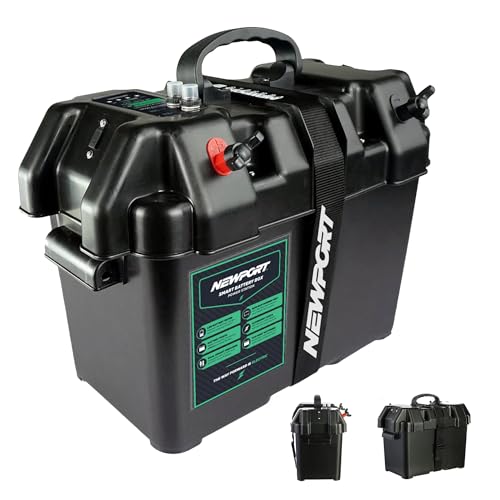
This all-in-one power hub is designed to keep a trolling motor setup clean and simple. It bundles a 12V system with external terminals, a USB port, and a 12V DC port, reducing exposed wiring and clutter on the boat. Best for kayaks, jon boats, and compact watercraft where quick, organized connections matter. A caveat is that it does not replace a dedicated high-capacity battery; pairing it with a suitable battery is essential for longer runs.
GOKWH 12V 100Ah LiFePO4 Marine Battery

This 12V 100Ah LiFePO4 battery adds advanced Bluetooth monitoring, allowing real-time checks of voltage, current, and temperature from your phone. It supports expansion up to a large system and delivers high energy density with a lighter form factor compared to traditional lead-acid. Best for boaters who want remote monitoring, longer run times, and scalable configurations for evidence-based planning. The system may require compatible charger/charging setup to maximize cycle life and efficiency.
BUKNUWO 12.8V 100Ah LiFePO4

BUKNUWO’s 12.8V 100Ah LiFePO4 battery emphasizes long cycle life, with a BMS that protects against overcharge, over-discharge, and temperature extremes. It supports high-density energy and includes expandable series/parallel connections for larger energy needs. Best for mariners who plan on extended days on the water or off-grid setups. A noted limitation is the requirement for compatible charging practices to maximize the stated cycle lifespan and performance.
DC HOUSE 12V 100Ah LiFePO4 With Bluetooth

DC HOUSE offers a Bluetooth-enabled 12V 100Ah LiFePO4 battery with SOC indicators, USB-A, USB-C, and DC ports. Built-in 100A BMS provides protection and easy smartphone monitoring. Best for boaters who want real-time power status and multiple charging options on board. This model suits users who value on-deck battery insight, but users should confirm charger compatibility and temperature handling for specific climates.
Buying Guide: Key Purchase Considerations
What battery chemistry fits your trolling motor needs? AGM batteries are robust and maintenance-free, but LiFePO4 cells offer lighter weight, longer life, and expandable configurations for higher efficiency and longer days on the water. Consider capacity (Ah or Wh) relative to your trolling motor’s current draw and anticipated run time. For larger boats or frequent daytime use, LiFePO4 often provides better life-cycle cost despite higher upfront price.
How important is weight and mounting space?
LiFePO4 batteries are typically lighter for the same capacity, which improves handling and reduces load on the boat’s transom or mounting area. If space is tight, a compact LiFePO4 pack can free up room for other gear. AGM units can be bulkier but are straightforward to install in most setups.
Should you prioritize built-in monitoring?
Bluetooth or app-based monitoring helps prevent unexpected power loss. Models with BMS protections and temperature controls reduce the risk of damage from overcharge, over-discharge, or thermal issues. If you operate in remote locations, real-time SOC and health data are valuable features.
What about charging and cycles?
Consider your charger compatibility and charging environment. LiFePO4 batteries commonly support 4,000–15,000 cycles under proper use, far exceeding typical AGM lifespans. Ensure your charger and solar setup (if applicable) are compatible with LiFePO4 chemistry and BMS requirements to maximize lifespan.
Is expandable configuration important?
Some LiFePO4 batteries support series/parallel expansion, enabling higher voltage or capacity as your needs grow. This is useful for larger vessels, more powerful trolling motors, or off-grid applications like RVs and solar setups. If future upgrades are likely, choose an expandable option.
Safety and maintenance considerations
Look for sealed, leak-proof designs and robust BMS protection. Maintain clear ventilation and avoid physical damage to batteries. AGM units are generally rugged and low-maintenance, while LiFePO4 systems require cautious handling of charging environments but offer higher long-term reliability and safety features.
FAQ
- What is the best battery type for longer trolling times? LiFePO4 batteries typically provide longer cycle life and lighter weight, translating to more run time per charge.
- Can I mix battery types in one trolling motor setup? It is not recommended to mix chemistries due to different charging profiles and voltage characteristics.
- Do I need a separate battery box or power center? A box or center helps organize connections and reduce exposed wiring, especially on small boats or kayaks.
- How do I know when a LiFePO4 battery is fully charged? Most include BMS indicators or mobile app monitoring showing voltage and state of charge. Always refer to the manufacturer’s charging guidelines.
- What happens if the battery is not used for a while? LiFePO4 batteries hold charge better over time, but it’s still best to store properly and periodically top off with an appropriate charger.