Best Timer Switches for Water Heaters: Efficient Hot Water Control
The following timer switches represent a range of reliable options for controlling electric water heaters. This guide focuses on models that balance ease of use, reliability, and smart or mechanical timing capabilities to help manage hot water schedules while conserving energy. Each product is linked to its Amazon listing for quick access to specifications and compatibility.
| Product | Brand | Key Feature |
|---|---|---|
| Intermatic WH40 Electric Water Heater Timer | Intermatic | 40A, external override, high wattage capacity |
| DEWENWILS 24-Hour Mechanical Timer Switch | DEWENWILS | 2 on/off programs, 40A, durable enclosure |
| YIFAN 40Amp Smart Water Heater Switch | YIFAN | Smart app control, voice assistants, 40A |
| Aquanta Smart Water Heater Timer | Aquanta | Auto-learn schedules, remote control |
| BSEED Smart Water Heater Switch | BSEED | Alexa/Google control, timer function, 40A |
The products below are selected for reliability, compatibility with various water heater setups, and ease of integration into homes that seek either mechanical or smart timer solutions. Each section provides a concise overview, compatible use cases, and essential features.
Intermatic WH40 Electric Water Heater Timer

The Intermatic WH40 is a robust, hard-wired timer designed for electric water heater control. With a 40-amp capacity and 250-volt 60Hz compatibility, this unit supports up to 10,000 watts, making it suitable for larger homes or higher-demand installations. It features an external override switch for manual operation, allowing quick changes without bypassing the timer programming. This model excels in reliability and straightforward scheduling, delivering dependable daily activation and deactivation of hot water use without requiring smart connections.
DEWENWILS 24-Hour Mechanical Timer Switch

This heavy-duty mechanical timer offers automatic 24-hour control with two on/off programs per day. Its 40A, 240V capacity is suitable for water heaters, pool pumps, lights, and fans. The enclosure is metal and designed for durability in indoor or outdoor applications. The design emphasizes simplicity, with clear setting guides for fast installation and reliable, repeatable daily cycles that help align hot water availability with household needs.
YIFAN 40Amp Smart Water Heater Switch
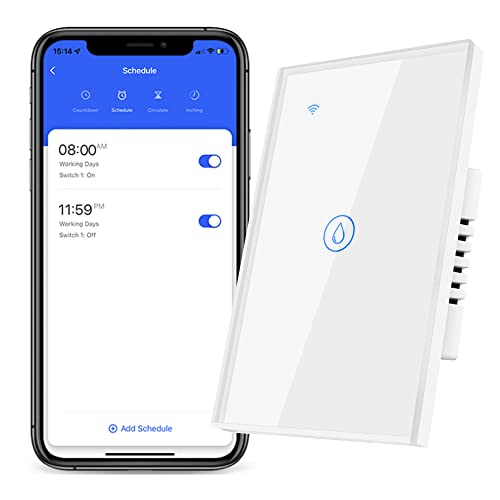
The YIFAN smart switch supports up to 40A and 100/240V with 8000W capacity. It requires a neutral wire for installation and enables remote control via a mobile app, plus voice control through Alexa and Google Home. The device includes scheduling and timer modes for daily activation and deactivation, enabling precise hot water management. This option suits homes looking to integrate water heater control with broader smart-home routines and voice-activated commands.
Aquanta Smart Water Heater Timer

The Aquanta timer adapts by learning usage schedules, enabling automated hot water readiness without manual input. It supports remote control via a smartphone and integrates with broader smart-home ecosystems. The emphasis is on convenience and energy efficiency, especially for households that want a hands-off approach to hot water management while preserving the simplicity of standard storage-style water heaters.
BSEED Smart Water Heater Switch

BSEED’s 40A smart switch enables control via Alexa and Google Assistant. It includes Smart Life app integration with timer functionality for scheduled activation, and group sharing for family members. The device is designed for straightforward installation in standard wall boxes, making it suitable for bedrooms, bathrooms, or other living spaces where remote or voice-enabled control improves convenience and energy awareness.
Buying Guide
Key considerations when choosing a timer switch for a water heater include:
- Power handling: Ensure the unit supports the water heater’s amperage and voltage. Higher-demand systems may require 40A or more and compatible 240V wiring.
- Control type: Mechanical timers work well for simple daily schedules and high reliability; smart timers offer remote management, app control, and integration with voice assistants.
- Installation compatibility: Check if a neutral wire is required, the fit in standard wall boxes, and whether the enclosure is indoors or rated for outdoor use.
- Programming flexibility: Consider the number of on/off programs, scheduling granularity, and whether features like countdown, cycle, or DST support are needed.
- Manual override: An external override or easy manual control can be important for emergencies or quick adjustments without altering the schedule.
- Reliability and protection: Look for units with solid build quality, wiring clarity, and protection against short circuits or moisture where appropriate.
- Smart integration: For homes with existing smart ecosystems, verify compatibility with platforms like Alexa, Google Assistant, or Smart Life to ensure seamless operation.
For varied use cases, weigh the trade-offs between mechanical robustness and smart convenience. Homes prioritizing reliability and straightforward operation may favor a mechanical timer like the DEWENWILS or Intermatic options, while tech-forward setups might lean toward the YIFAN, Aquanta, or BSEED models to maximize automation and remote control.