Best Time on Delay Relay Solutions for Precision Control
Time on delay relays provide precise start or stop timing for machines, lighting, and pumps. This guide highlights five reliable options ideal for different applications—from industrial automation to automotive and DIY projects. It explains who each product is best for, plus practical pros and limitations to help you decide quickly.
| Product | Best For | Delay Range | Voltage |
|---|---|---|---|
| IGEYAPA GRT8-M1 | Industrial equipment and motors requiring versatile timing modes | 0.1 seconds to 10 days | AC/DC 12-240V |
| GODIYMODULES Delay DC 12V Relay | Small control boards and hobby projects needing short delays | 0.1s to 1 hour | DC 12V |
| Aharon 12V 30A Time Delay Relay | Automotive and marine circuits with high inrush protection | 10 seconds (delay-on) | 12V |
| GRT6-M1 | Similar to GRT8 for compact DIN rail setups | 0.1 seconds to 10 days | AC/DC 24-240V |
| DROK 12V Timer Relay | General electronics projects needing multiple trigger sources | 0.1 seconds to 999 minutes | 12V |
IGEYAPA GRT8-M1 Multifunction Time Relay

The GRT8-M1 is a multifunction timer relay with a wide delay range from 0.1 seconds to 10 days and a 16A rating. It supports five timing functions controlled by power supply voltage and four by control input, plus a latching option. Best for equipment that requires flexible startup or shutdown sequencing, such as conveyor lines or lighting systems. The 1SPDT output (1NO1NC) covers common control needs. Best for industrial settings where precise, programmable delays are critical.
Who it’s best for: OEMs and maintenance teams needing a single device to handle multiple delay modes. Why selected: wide timing range, clear LED indicators, and comprehensive function set reduce the need for multiple modules. Caution: setup instructions are detailed; misadjustment of knobs can lead to undesired timing. Refer to the included guide for correct function selection and timing steps.
GODIYMODULES Delay DC 12V Relay

This 12V DC timer switch module offers eight selectable time ranges, from 0.1 seconds up to 1 hour. It includes protection against reverse polarity and supports higher-load connections (up to 10A at 250V AC or 10A at 30V DC). Best for compact control panels or projects needing a quick, configurable delay with solid protection. Better for: hobbyists and small automation tasks where a simple, reliable timer is sufficient. Choose this if you need an easy-to-wire solution with robust reverse-protection and a mid-range load.
Limitation: the module’s timing cover is not as long-range as some DIN-rail relays, so for very long delays this may not be the ideal choice.
Aharon 12V 30A Time Delay Relay
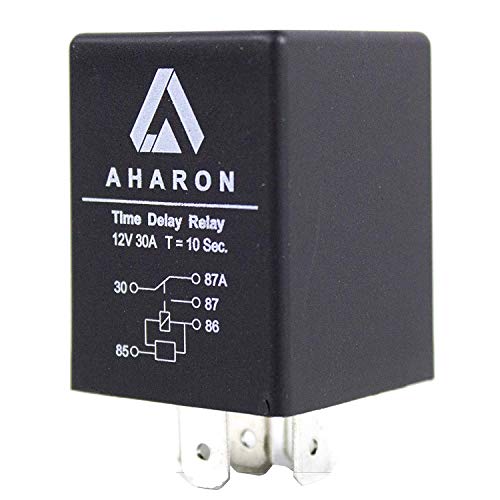
This automotive-grade relay provides a 10-second delay-on function and a true SPDT configuration, with a high 30A switching rating. It is ideal for engine cranking surges and protecting sensitive electronics by delaying accessory activation. Best for vehicles and power systems needing a robust delay-on trigger that safely isolates high-draw components from the start sequence.
Why selected: combines a practical startup delay with a strong mechanical rating. Limitation: intended for triggering secondary relays rather than direct control of very heavy loads; check your load profile to avoid overheating or overcurrent conditions.
IGEYAPA GRT6-M1 Multifunction Time Relay

The GRT6-M1 mirrors the GRT8-M1 in functionality but in a more compact DIN-rail form factor, with a 0.1-second to 10-day delay range and 10A rating. It suits control panels with limited space while offering five functions via supply voltage and four via input control, plus a latching option. Best for smaller automation racks needing flexible timing without extra bulk.
Best for: space-constrained installations and standard industrial timers. Caution: ensure the compact housing still accommodates all wiring clearance and heat dissipation needs in your panel.
DROK 12V Timer Relay with LED Display

DROK’s 12V timer relay features four modes and a broad timing range from 0.1 seconds to 999 minutes, triggered by various inputs including power, button, PNP sensors, or PLC signals. It’s well-suited for generic electronics labs, hobbyist projects, and educational setups requiring flexible trigger sources and a long, adjustable delay. Best for: multi-source triggering needs and quick prototyping. Limitation: not a heavy industrial timer; verify the load and environment compatibility for permanent installations.
Buying Guide: Key Considerations for Time On Delay Relays
- Delay range needs: Do you require seconds, minutes, or days of delay? Some models offer long ranges (0.1 seconds to 10 days), while others are focused on shorter delays.
- Voltage compatibility: Choose AC, DC, or both. If your system uses 12-24V control circuits, prefer DC options; for mains-powered equipment, select AC capable relays.
- Load current and type: Check the relay’s contact rating (amps) and whether it supports resistive or inductive loads, motors, or heating elements. Higher loads may require relays designed for 16A or more.
- Configuration flexibility: Multi-function relays offer different timing modes (delayed ON, delayed OFF, cyclic timing). Decide which modes fit your control logic.
- Wiring and form factor: DIN-rail mounting is common in panels; compact timers fit tight spaces but ensure adequate wiring space and heat dissipation.
- Indications and troubleshooting: LED indicators help verify operation. Review the instruction materials for proper function selection and timing steps.
- Protection features: Look for reverse-polarity protection, isolation, and surge handling, especially for automotive or industrial environments.
Frequently Asked Questions
- What is a time on delay relay?
A time on delay relay delays the activation of a circuit after a trigger or power is applied, allowing controlled startup sequencing.
- How do I choose the right delay range?
Match the required startup or cooldown period to the circuit’s needs. For long cooldowns, choose relays with extended ranges; for quick gating, short delays suffice.
- Do these relays support AC and DC loads?
Some models support both AC and DC, others are DC-only or AC-only. Verify the voltage rating and load type before wiring.
- Can I use a timer relay for automotive applications?
Yes, but choose devices rated for automotive surges and ensure proper isolation and protection for vehicle electrical systems.
- What is SPDT in a timer relay?
SPDT means single-pole double-throw; the relay can switch between two outputs using a common input, enabling versatile control logic.
- Are green LEDs always on a sign of healthy power?
Typically, a steady green LED indicates power is on; other color patterns may indicate faults or active timing, depending on the model. Always refer to the device manual for LED meanings.