Best Time Delay Relay Switches for Precise Automation at Home or Lab
Time delay relays offer precise control over electrical circuits by delaying actions after a trigger. This article highlights five reliable options from credible brands, detailing their timing ranges, input voltages, triggering methods, and notable features. Readers will gain a clear view of how these modules suit DIY projects, smart home setups, and industrial tasks alike.
Summary Table
| Product | Brand | Voltage Range | Timing Range | Key Feature |
|---|---|---|---|---|
| DROK Timer Relay With LCD | DROK | DC 6-30V | 0.01s-9999mins | LCD display, auto-save |
| DROK 12V LED Display | DROK | 12V | 0.1s-999min | 4-mode delay, various triggers |
| Timer Relay Module 12V | Yosoo Health Gear | DC 12V | 1-10s | Easy trigger + wide application |
| GRT8-M1 Multifunction Timer | IGEYAPA | AC/DC 12-240V | 0.1s-10d | 4 time functions + latch |
| Valefod 2 Pack 6-30V | Valefod | DC 6-30V | 0.1s-999mins | Micro USB power; reverse protection |
DROK Timer Relay With LCD Display (5V/12V/24V)

The DROK Timer Relay combines independent parameter blocks for OP, CL, and LOP, with auto-save on power loss. It supports a wide voltage range and a clear LCD display that shows current mode and parameters, enabling quick verification during setup or troubleshooting. The device can be powered via USB or a compatible DC supply, and its LCD readout helps ensure accurate timing for automation tasks.
DROK 12V Timer Relay With LED Display

This 12V relay offers four timing modes and a wide delay range from 0.1 seconds to 999 minutes. It supports multiple triggering sources, such as power-supply triggering, button, sensors, and PLC signals, making it versatile for automotive projects, automation experiments, and testing rigs. The optocoupler isolation enhances interference resistance for stable operation in electrically noisy environments.
Timer Relay Module, DC 12V Adjustable

With precise timing control, this 12V module allows a 1–10 second delay and is suitable for robotics, smart home automation, and PLC development. It features a trigger button for easy manual activation and supports typical load types, enabling straightforward integration into existing systems. Its documentation emphasizes reliability across amateur and professional projects, making it a practical choice for quick prototyping and controlled automation.
Ferwooh NE555 Delay Timer Module

Powered by the NE555 timer IC, this 12V module allows 0–10 second delays and supports control of AC loads up to 250V/10A or DC loads up to 30V/10A. A high-precision potentiometer adjusts delay, and an indicator LED shows the relay status. It is designed for automotive and electronics projects requiring compact, dependable delay timing with straightforward adjustment.
IGEYAPA GRT8-M1 Multifunction Timer Relay

The GRT8-M1 combines multiple timing functions with adjustable ranges from 0.1 seconds to 10 days and supports AC or DC operation (12–240V). It includes 1SPDT output and a visual indicator for status. Four main timing functions can be controlled by power and control inputs, with an additional latching relay option, offering a flexible solution for industrial equipment, lighting control, and automation sequences.
Valefod 2 Pack: DC 6-30V Timer Relay
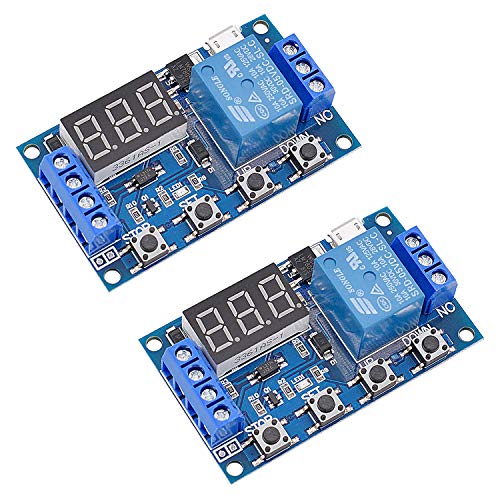
This set provides programmable delay with a timing range of 0.1 seconds to 999 minutes. It supports micro USB 5V power input and includes reverse polarity protection for safer operation in varied setups. The compact design suits smart home controllers, irrigation systems, and hobby electronics where fast or delayed switching is required.
Buying Guide: Key Purchase Considerations
- Voltage and power supply: Match the relay’s input voltage (DC 6-30V or 12V variants) to your system’s supply. Some models support USB power, which simplifies integration with microcontrollers and USB-enabled devices.
- Timing range and granularity: Consider whether you need sub-second precision (0.01s) or longer delays (seconds to days). Some relays offer continuous, adjustable ranges, while others emphasize fixed or multi-mode timing.
- Triggering options: Evaluate high-level, low-level, switch, button, or sensor triggers. Multi-trigger models provide flexibility in automation projects, from manual control to remote sensing.
- Isolation and load capacity: Opt for opto-isolated outputs when electrical noise might affect performance. Check the load current and voltage limits to avoid overloading relays (AC vs DC ratings differ).
- Indication and diagnostics: LCD or LED indicators help monitor the current mode and status, reducing debugging time during setup.
- Mounting and enclosure: If using DIN rail or panel installations, ensure the module dimensions and mounting method fit your enclosure and space constraints.
- Power-fail behavior: Some models auto-save settings or retain configurations after power loss, which is useful for unattended installations.
- Cost vs features: Prioritize essential features (timing range, triggering method, and load capacity) to balance performance and budget for your application.
- Safety and compliance: For high-voltage or critical systems, review certifications and ensure appropriate safety practices during wiring and testing.
Selected time delay relays provide a versatile set of options for hobbyists, makers, and professionals. When choosing, align the device’s timing capabilities, voltage, and triggering methods with the specific automation task to ensure reliable and repeatable results.