Best Thermostat for Floor Heating: Smart Control for Cozy Floors
Choosing the right thermostat is essential for comfort, safety, and energy efficiency in radiant floor heating systems. The options below focus on reliability, floor- and air-sensing capabilities, dual voltage support, and connectivity for remote control. This guide highlights five top thermostats that work well with electric floor heating, including models with built-in GFCI, smart features, and robust installation versatility.
Summary of chosen products
| Product | Brand | Voltage | Smart Features | Key Benefit |
|---|---|---|---|---|
| Programmable Thermostat for House Radiant Underfloor Heating | BOWSEN | 120/240V | Built-in GFCI, dual sensing, self-adaption | Safety and flexibility for diverse flooring setups |
| SunStat ConnectPlus | SunTouch | 120/240V | Wi‑Fi, remote access, floor & air sensing | Smart scheduling and energy monitoring |
| SunStat CommandPlus | SunTouch | 120/240V | Wi‑Fi, voice compatibility, floor & air sensing | Future-ready voice and remote control |
| OJ Microline UDG4 | OJ Microline | 120/240V | Color touchscreen, dual sensing, GFCI | User-friendly interface with adaptive programming |
| Nuheat Element | Nuheat | 120/240V | Floor sensor, built-in GFCI, programmable | Reliable radiator of comfort with broad compatibility |
Note: All products listed are suitable for electric floor heating systems and support dual voltage where indicated. Features are drawn from product descriptions and may vary by model or region.
Best Versatile Underfloor Thermostat With GFCI
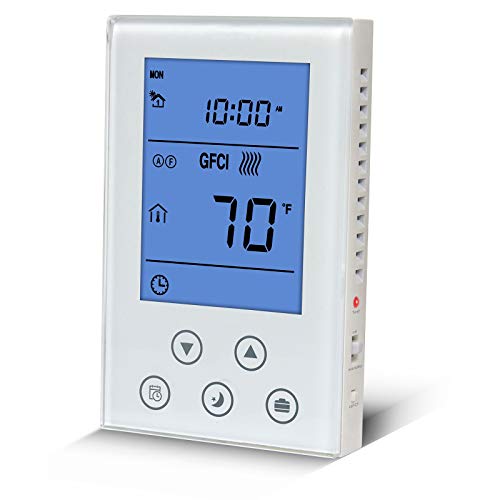
The BOWSEN programmable thermostat supports 120VAC and 240VAC with a maximum current of 15A per voltage and a max power of 1800W at 120V or 3600W at 240V. It features floor and air sensors, a built-in GFCI, and a safety-testing function. This model is designed to protect occupants from electric shock and reduce fire risk by monitoring leakage and tripping the GFCI when anomalies are detected. It is suitable for diverse floor coverings and wiring layouts, making it a flexible choice for retrofit or new installs.
SunStat ConnectPlus Touchscreen And Wi‑Fi Thermostat

The SunStat ConnectPlus offers a 4.3″ touchscreen with remote access via Wi‑Fi. It includes floor and air sensing control, a 7-day programmable schedule, and energy monitoring. Smart Start adjusts heating to pre-warm floors, ensuring comfort when you arrive home. It supports voice assistants like Alexa and Google, and provides weather and outdoor temperature displays. This makes it a strong option for users seeking an integrated smart home experience with reliable floor heating management.
SunStat CommandPlus For Electric Floor Heating

The SunStat CommandPlus adds a robust touchscreen experience with remote access. Like ConnectPlus, it includes floor and air sensing, a 7-day schedule, and energy monitoring, but emphasizes expanded features and a slightly different design. Its compatibility with popular voice ecosystems makes it convenient for households integrating smart home routines, while maintaining strong control over floor heating performance and safety.
OJ Microline UDG4 Touchscreen Thermostat

The OJ Microline UDG4 provides a 3.5″ color touchscreen, dual voltage (120V/240V), and dual sensing (air and floor). It includes a built-in Class A GFCI and a floor sensor. The adaptive function learns and adjusts to reduce energy usage while maintaining comfort. This model suits users who want an intuitive interface and energy-saving programming without sacrificing safety and compatibility across common flooring types.
Nuheat Element: Non-Programmable Yet Reliable

The Nuheat Element is a non-programmable, dual-voltage thermostat that includes a floor temperature sensor and built-in GFCI. It supports 120-240V floor heating cables and is designed for straightforward operation with reliable temperature control. It works well in installations where a simple, steady baseline heating profile is preferred, while still offering safety features and compatibility with common radiant floor components.
Buying Guide
Key purchase considerations help compare options across safety, usability, and integration with home systems:
- Voltage compatibility: Ensure the thermostat supports your system’s voltage (120V or 240V, or both) and the heater wattage you plan to run.
- GFCI and safety: Built-in GFCI protection is vital for wet or humid environments. Look for Class A GFCI or UL-listed protections and clear test procedures.
- Floor and air sensing: Dual sensing improves comfort and stability by balancing floor temperature with ambient room conditions.
- Smart features: Wi‑Fi connectivity, mobile apps, voice assistant compatibility, and energy monitoring can significantly reduce energy use and simplify control.
- Programming flexibility: A 7-day schedule, away modes, and adaptive features help tailor heating to daily routines while avoiding unnecessary warmth.
- Installation and compatibility: Check wiring requirements, mounting compatibility with your flooring type, and compatibility with existing floor heating mats or cables.
- Safety and maintenance: Consider ease of testing the GFCI function and the availability of user support or warranties for ongoing reliability.
- User interface: A clear display, intuitive controls, and responsive touchscreen can reduce setup confusion and improve daily use.