Best Thermoelectric Power Generators for DIY Energy Projects
Choosing a thermoelectric power generator (TEG) module involves balancing size, temperature range, and electrical output. The top picks below suit hobbyists, makers, and compact power needs. If you want a compact, low-heat-differential option, start with a small module. For higher temperature operation, consider larger, robust models. The following five products were selected for their practical form factors, clear data, and relevance to a range of heat sources.
| Product | Brand | Best For |
|---|---|---|
| Cwmiibili 16Pcs 40X40mm SP1848-27145 Peltier TEG Module | Cwmiibili | Multiple small power points, compact arrays |
| Envistia SP1848-27145 4.8V Seebeck Thermoelectric Power Generator | Envistia | Low to moderate temperature differentials |
| Bolsen TEG1-199-1.4-0.5 40×40 High Efficiency | Bolsen | Standard single-layer power generation |
| SP1848-27145 TEG Peltier Module High Temperature 40×40 | Bewinner | High-temperature environments |
| Bolsen High Efficiency TEG1-287-1.4-1.5 | Bolsen | Higher power output in controlled temps |
Cwmiibili 16Pcs SP1848-27145 TEG Module

The Cwmiibili SP1848-27145 module group is designed for compact, scalable power generation. Key specifications include a lead length of about 30 cm and a thermal conductivity around 15–16 x 10^-3 W/C. This option is best suited for projects requiring multiple small generators in parallel to increase voltage or current. Choose this if you need modular expansion for heat-to-electricity experimentation. A limitation is that individual module output depends on the temperature differential and may require careful heat sinking.
Envistia SP1848-27145 4.8V Seebeck TEG

The Envistia SP1848-27145 module operates as a semiconductor-based Peltier device that self-generates electricity from a temperature difference. With a size of 40x40x4 mm and a broad operating range (-30°C to +120°C), it is suitable for small heat sources and educational demonstrations. Best for hobbyists who want a straightforward, single-module solution. Limitation: voltage output is highly sensitive to delta-T and may be modest at small temperature differences.
Bolsen TEG1-199-1.4-0.5 40×40 High Efficiency
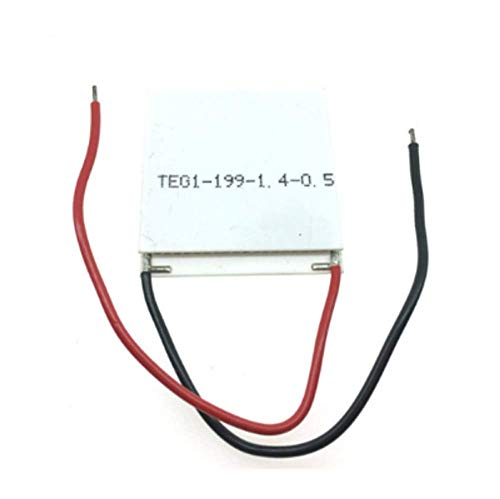
This Bolsen module is a standard single-layer TEG suitable for base-level energy harvesting. It emphasizes ease of use and reliability, with a common 40×40 mm footprint. It’s best for learners and light-power projects where a simple, predictable output is desired. Caution: performance is contingent on effective heat transfer; poor contact can reduce voltage generation significantly.
Bewinner SP1848-27145 TEG Peltier Module

The Bewinner module emphasizes simple operation and portability. It features a straightforward setup with red and black leads for positive and negative connections. It’s best for quick demonstrations or small-scale power generation experiments. Limitation: while usable for educational projects, it may have limited output for larger loads without multiple units in parallel.
Bolsen TEG1-287-1.4-1.5 High Efficiency

This Bolsen model represents a higher-efficiency, single-layer TEG option with a larger potential output in the 40×44 mm range. It’s best for projects requiring more power from a compact footprint, such as small-scale cooling or energy harvesting from hotter heat sources. Limitation: higher performance typically demands better thermal interfaces and heat sinking to realize the full voltage and current potential.
Buying Guide
What size TEG do I need? Start with a module that fits your available heat source and target power. Smaller modules are easier to manage, while larger ones deliver more power but require better heat exchange.
How does delta-T affect performance? Higher temperature difference between hot and cold sides yields more voltage. Ensure your setup maximizes delta-T with effective heat sinks or coolers.
Should I use multiple modules in parallel? Yes, if your goal is higher current or voltage. Parallel connections can add outputs, but you must manage heat distribution and electrical balance.
What are common installation considerations? Proper electrical insulation, stable mounting, and reliable thermal contact are essential. Avoid gaps under the hot side that reduce heat transfer efficiency.
What safety considerations apply? Hot surfaces and electrical wiring require caution. Insulate exposed contacts and use heat-resistant materials in contact areas.
FAQ
- What is a thermoelectric power generator (TEG)?
- What determines TEG output?
- Can TEGs power a device directly from a heat source?
- Do I need a heat sink?
- Are TEGs suitable for DIY projects?
- Can multiple TEGs be connected together?
A TEG converts a temperature difference directly into electrical energy using the Seebeck effect.
Output depends on delta-T, module size, material properties, and thermal contact quality.
Yes, but most small modules supply limited current. They are often used to harvest energy or power low-draw sensors.
Yes. Efficient heat dissipation on the hot side and cooling on the cold side improve performance and longevity.
Yes. They are widely used in experiments, educational kits, and compact energy harvesting setups.
Yes. Serial connections increase voltage; parallel connections increase current. Ensure compatible voltage and current ratings.