Best Thermal Transfer Oil Coolers for Industrial Hydraulics and Machinery
When selecting a thermal transfer oil cooler, choose models designed for your flow range, pressure, and mounting needs. This guide highlights five Thermal Transfer units that cover a broad spectrum of applications—from compact hydraulic circuits to heavier-duty industrial systems. The top picks are best for maintenance shops, construction equipment, and manufacturing lines where reliable cooling prevents overheating and improves system life.
| Product | Best For |
|---|---|
| Thermal Transfer DH Series DH-194-1-1 | Compact hydraulic lines with moderate flow |
| Thermal Transfer M Series M-25 | Medium-duty hydraulic systems with fan-assisted cooling |
| Thermal Transfer DF Series DF-11-1-4A | Smaller footprint cooling for compact installations |
| Thermal Transfer MF Series MF-30-1-4A | Mid-range flows with compact depth |
| Thermal Transfer MF Series MF-60-1-4A | Higher flow hydraulic cooling with robust performance |
Thermal Transfer DH Series DH-194-1-1

Best for light to moderate hydraulic cooling tasks with 2–15 GPM capacity and oil flows up to 150 GPM. It features a 300 PSI operating limit and a 1.15 square inch face area, with 3/4″ NPT ports. This unit is well-suited for smaller machines or retrofits where space is at a premium and simplicity matters.
Who this is for: shops needing a compact, dependable cooler for standard hydraulic circuits. Why selected: offers a balance of flow range and compact footprint without complicating installation.
Caution: Ensure port sizing and mounting space match your existing setup to avoid clearance issues.
Thermal Transfer M Series M-25

Best for standard hydraulic cooling with a built-in 12V DC fan to augment heat rejection. It handles 6–60 GPM in regular operation and can reach up to 100 GPM maximum flow, making it suitable for mid-size industrial or agricultural equipment. The rugged steel manifolds with aluminum fins support durability in demanding environments.
Who this is for: equipment with steady 12V power and routine cooling needs. Why selected: integrates a fan for enhanced cooling in hot ambient conditions.
Caution: Fan power draw adds a small electrical consideration; ensure wiring and voltage compatibility with your system.
Thermal Transfer DF Series DF-11-1-4A
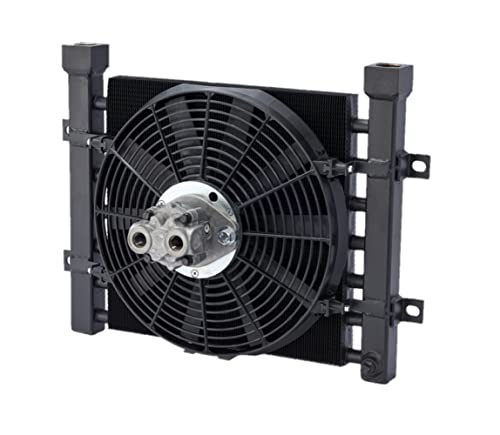
Best for compact installations with modest to mid-range flows: 3.5–27 GPM, oil flows up to 110 GPM, 12V operation, and 0.75″ tubing with 1″ NPT ports. Its shallower design helps fit tighter spaces while maintaining solid cooling performance.
Who this is for: space-constrained setups needing reliable cooling without large footprint. Why selected: compact depth and straightforward electrical needs.
Caution: Check tube sizing compatibility with your plumbing to prevent flow restrictions.
Thermal Transfer MF Series MF-30-1-4A

Best for mid-range to higher flows with 5–90 GPM capability and oil flows up to 150 GPM. It uses 12V power, 300 PSI operating pressure, and a 3/8″ tube size with 1 1/2″ NPT ports. The MF-30-1-4A balances performance and installation footprint for many industrial applications.
Who this is for: systems needing reliable cooling across a broad flow band. Why selected: versatile flow handling in a compact package.
Caution: Verify port connections to avoid misalignment with existing hoses or fittings.
Thermal Transfer MF Series MF-60-1-4A

Best for higher-capacity cooling with 10–175 GPM flow range and oil flows up to 175 GPM. It features 12V operation, 300 PSI operating limit, 3/8″ tube size, and 1 1/2″ NPT ports. A strong choice for demanding hydraulic systems in manufacturing or heavy equipment.
Who this is for: high-flow systems needing robust cooling and longer service intervals. Why selected: higher flow tolerance and solid construction support demanding environments.
Caution: Larger footprint means it requires more installation space and robust mounting.
Buying Guide
What to consider before buying
Key specifications include flow range, maximum pressure, port size, tube diameter, and overall footprint. Match the cooler’s flow capacity to your hydraulic system’s typical GPM to prevent under- or over-cooling.
Do you need an integrated fan?
For hot ambient conditions or high-load applications, a unit with an integrated electric fan can improve cooling efficiency and stabilize operating temperatures. Consider power supply availability and wiring complexity.
Mounting and space considerations
Check mounting requirements and depth. Some units are compact, while others are deeper and may require additional clearance. Ensure there is space for hoses and service access.
Material and durability
Most units use aluminum fins and steel manifolds. Durability matters in harsh environments, so verify corrosion resistance and mounting bracket strength for your application.
Installation and integration
Assess tube sizes and port threads (NPT or other standards) to ensure compatibility with existing hydraulic lines. Look for units that offer straightforward installation without extensive retrofitting.
Maintenance and reliability
Choose a cooler with accessible service points and documented maintenance considerations. Regular inspection of fittings, leaks, and fins cleanliness helps sustain performance over time.
Frequently Asked Questions
- What is an oil cooler used for? It removes heat from hydraulic or transmission oil to maintain safe operating temperatures and extend component life.
- How do I choose the right cooling capacity? Compare your system’s typical GPM and the oil’s maximum operating temperature; select a unit that maintains below the oil’s limit under peak load.
- Are integrated fans necessary? They help in hot environments or high-load conditions, but add electrical considerations. Choose based on ambient temperature and system availability.
- What port sizes should I expect? Common options include 3/4″ and 1″ NPT. Verify compatibility with your hoses and adapters.
- Can I install an oil cooler in tight spaces? Yes, if you choose a compact model with a suitable footprint. Measure depth and clearance before purchase.
- Do these coolers require special maintenance? Regular inspection for leaks, cleaning fins, and ensuring secure mounting can preserve performance and longevity.