Best Temperature and Pressure Gauges for HVAC, Industrial and More
When monitoring systems that require precise readings, choosing the right temperature and pressure gauge is essential. The following selections cover commercial Tridicators, thermo-manometers, and thermal pressure gauges designed for gas, liquid, and boiler applications. This guide highlights capability, mounting options, dial sizes, and temperature/pressure ranges to help you compare models at a glance.
| Product | Brand | Dial Size | Key Range |
|---|---|---|---|
| PIC Gauges TRI-RC-254R1.75-D Commercial Tridicator | PIC Gauges | 2.5″ | 0/75 psi, temperature option |
| MEASUREMAN Tridicator Thermo-Manometer | MEASUREMAN | 2.5″ | 0-160 psi / 30-250 °F |
| MEANLIN MEASURE 0-160Psi Thermal Gauge | MEANLIN MEASURE | 2.5″ | 0-160 psi / 0-250 °F |
| MEASUREMAN Tridicator, Thermo-Manometer | MEASUREMAN | 2.5″ | 0-160 psi / 30-250 °F |
| GlowShift Digital Dual Temperature & Pressure Gauge Kit | GlowShift | 2.062″ | 0-145 psi / 68-302 °F (digital) |
The following sections present five relevant products, detailing their strengths, mounting options, and suitable applications. Each item is evaluated for clear readability, robust construction, and practical use in systems requiring simultaneous temperature and pressure measurement.
PIC Gauges TRI-RC-254R1.75-D Tridicator

The PIC Gauges model combines pressure and temperature indications within a compact 2.5″ dial. Features include a black steel case and bezel for durability, with bronze internals and a plastic lens with a red indicator. The unit can be supplied with a 1/2″ NPT adapter and offers a 0/75 psi range suitable for compact applications where both readings are needed in a single instrument. Its dual-reading capability streamlines monitoring in boilers and mechanical rooms.
MEASUREMAN Tridicator Thermo-Manometer

This 2.5″ dial Tridicator from MEASUREMAN is silicone oil-filled for vibration damping, featuring dual readings for pressure (0-160 psi) and temperature (30-250 °F). The stainless steel case supports rugged environments, and the 1/4″ NPT lower mount makes installation straightforward in pipelines and pump rooms. It is designed for gases or liquids that are not corrosive to brass, with a focus on readability in vibration-prone settings.
MEANLIN MEASURE 0-160Psi Thermal Gauge

This 2.5″ thermal pressure gauge from MEANLIN MEASURE operates at 0-160 psi and up to 250 °F. It is a lower-mount unit with 1/4″ NPT, and is designed for boiler and process applications where both pressure and temperature change tracking is essential. The model is noted for straightforward installation and a compact profile that fits smaller instrument panels or controls cabinets.
MEASUREMAN Pressure And Temperature Test Kit

This test kit from MEASUREMAN provides 0-100 psi/Ft H2O/kPa/meters H2O ranges with 0-220 °F and -40 °F to 160 °F thermometers. The 1/4″ NPT bottom gauge adaptor allows quick integration into pipelines or test loops. It is ideal for startup checks, commissioning, and periodic verification of heating, cooling, or refrigeration systems where precise readings are necessary for safe operation.
MEASUREMAN Tridicator Thermo-Manometer (Back Mount)

This MEASUREMAN Tridicator combines pressure and temperature readings in a 2.5″ dial with a black iron case and 1/4″ NPT back mount. The unit measures 0-160 psi and 30-250 °F, providing a robust solution for gas and liquid systems sensitive to vibration. The back-mount configuration is common in panel installations and industrial control panels where spacing is limited and readability is critical.
GlowShift 10 Color Digital Dual Gauge Kit
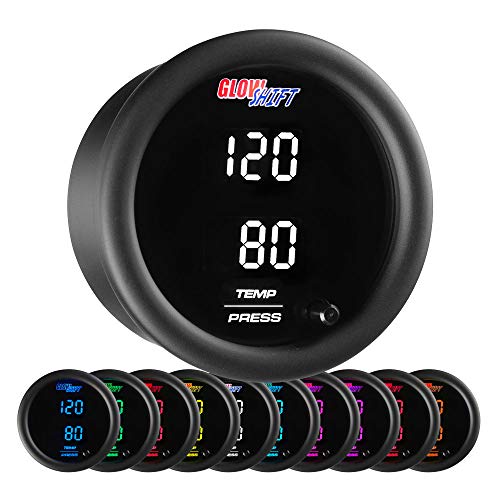
The GlowShift kit provides a digital multi-parameter readout for both temperature and pressure. It supports dual sensing with a 0-145 PSI pressure range and a 68-302 °F temperature range, delivering quick, color-coded readings. The 2-1/16″ (52mm) gauge format and LED display allow rapid monitoring across engine bays, HVAC installations, or industrial plants. It includes sensors and wiring for easy integration and configuration.
Buying Guide
Key purchase considerations help users pick the right gauge for their application. The following perspectives cover reliability, mounting, readability, and maintenance needs.
- Application and medium: Choose gauges designed for the reading environment (gas, liquid, non-corrosive brass, or high vibration). For corrosive fluids, verify wetted parts compatibility and material choices (brass, stainless steel, bronze).
- Mounting style: Lower mount and back mount configurations suit different panel layouts. Consider space constraints and how easy it is to read the dial in the intended position.
- Dial size and readability: Larger dials (2.5″) offer easier reading in busy control rooms. Digital displays provide quick, unambiguous numbers but may require power and sensors.
- Temperature and pressure ranges: Ensure the device covers your system’s operating window. Dual-readout meters save space and simplify monitoring in boilers or chillers.
- Vibration and pulsation handling: Oil-filled or stiffer cases reduce needle flutter in mechanical rooms or pumps, improving longevity and accuracy in noisy environments.
- Maintenance and calibration: Some units include easy-access reset indicators or built-in calibration references. Consider models with straightforward field service options.
- Installation complexity: Look for common fittings (1/4″ NPT, 1/2″ NPT) and adapters to minimize additional hardware and potential leak points.
- Cost versus functionality: Digital dual gauges offer richer data yet may incur higher upfront costs and power needs. Analog tri-readouts are traditional, robust, and simple to interpret at a glance.
When selecting, balance the need for dual readings (temperature and pressure) with the installation environment, required readability, and maintenance plans. Using a single instrument with dual capabilities can reduce panel clutter, but ensure sensor accuracy is suitable for your process, and verify compatibility with the media and operating temperature range.