Best TDR Cable Fault Locator for Fast Cable Fault Finding
The right Time Domain Reflectometry (TDR) tool helps technicians quickly locate faults, determine cable length, and identify bridge taps or shorts in coaxial, network, and fiber-related cabling. This article highlights five top TDR and related fault locator products from trusted brands, explaining how each model works, what makes it stand out, and how to choose the best option for your needs. Use these insights to compare performance, compatibility, and application scope across simple home wiring to professional telecom deployments.
Summary of chosen products:
| Product | Brand | Key Benefit | Typical Use |
|---|---|---|---|
| TL280 Cable Fault Tester TDR Cable Fault Locator (1km) | GOYOJO | Digital Gain Automatic Control, ARM+FPGA speed, automatic waveform recognition | Short-to-mid-range fault locating on coaxial cables |
| TL280 Cable Fault Tester TDR Cable Fault Locator (4km) | GOYOJO | Extended range with same smart gain and waveform recognition | Longer cable runs and more complex layouts |
| TS100-PRO-BT-TDR Cable Fault Finder | Fluke Networks | Bridge tap detection, tone generator, multi-criteria cable testing | Professional network and cabling installations |
| EVERSECU OTDR/TD/R Tester w/ CCTV | EVERSECU | Multi-function OTDR, fiber and network testing, 1310/1550 nm | Fiber, CCTV, and mixed cable networks |
| NOYAFA NF-8506 Network Cable Tester with IP Scan & TDR | NOYAFA | IP scan, PoE test, TDR length and fault distance |
TL280 Cable Fault Tester TDR 1km

GOYOJO’s TL280 1km model employs a Digital Gain Automatic Control (DAGC) system to dynamically adjust signal gain. This feature reduces waveform distortion caused by manual knob adjustments and supports pure linear tuning for precise manual testing. An ARM CPU paired with FPGA technology enables rapid execution of complex operations and accurate fault waveform determination. The device also offers digital waveform automatic recognition to help identify waveforms that may be challenging for human observers, enhancing fault localization in tight or cluttered signal environments.
The compact form factor makes it suitable for field technicians who need dependable TDR measurements over medium-length runs. While it emphasizes ease of use and measurement speed, users should assess whether 1 km range suffices for their typical test scenarios, or if the extended-range model better matches their infrastructure.
TL280 4km TDR Cable Fault Locator

This longer-range variant preserves the same DAGC and ARM+FPGA core as the 1 km model, enabling rapid fault waveform analysis across extended cable runs. The 4 km capability makes it advantageous when testing long coaxes, campus networks, or outdoor installations where faults can occur far from the access point. Users benefit from the automatic waveform recognition features that help distinguish reflections from noise and from legitimate fault signatures, reducing interpretation time in the field.
As with any longer-range tester, calibration and proper probe selection are essential to maintain measurement accuracy. The tool is best deployed in scenarios where cable runs exceed typical indoor lengths or when multiple bridge taps may complicate waveform interpretation.
Fluke Networks TS100-PRO-BT-TDR Cable Fault Finder

The Fluke TS100-PRO-BT-TDR Kit specializes in finding faults in telecom and data cabling, with a focus on identifying open and short circuits, measuring cable length, and locating multiple bridge taps. Its ABN and piercing pin clips enable access to individual wire pairs for precise testing. The device reports distance to taps and the end of the cable, even in longer runs up to thousands of feet, making it a staple for professional installers who require robust fault localization across extended networks.
In addition to TDR fault finding, this model offers tone generation and a practical test lead kit, which supports everyday diagnostics. Users should consider whether the built-in voltage sensing and bridge-tap visibility align with their typical work environment and whether an integrated testing lead set meets their常用 workflow preferences.
EVERSECU OTDR & TDR Tester with CCTV Support

This multifunction tester blends OTDR and TDR capabilities with CCTV testing, supporting 1310/1550 nm dual wavelengths and a wide range of fiber-related tests. An 8″ Retina touch screen provides detailed views of testing curves, distance-based attenuation, and failure locations, while the device supports USB storage for test reports and a wide feature set that includes PoE testing, WiFi analysis, and even PTZ camera control. The bundled functions are valuable for network deployment, maintenance, and monitoring projects that require cross-technology diagnostics in one handheld instrument.
For purchasers, the breadth of capabilities can offer time-saving convenience, but it also demands familiarity with fiber testing concepts and a longer learning curve. It’s best suited for field teams that routinely manage fiber networks, CCTV systems, and mixed-cable environments where integrated testing improves workflow efficiency.
NOYAFA NF-8506 Network Cable Tester with TDR and IP Scan

The NF-8506 combines traditional network testing with TDR-based fault distance measurement, IP scanning, PoE testing, and a robust cable-length feature. It measures cable length, detects faults, and can perform network tests including Ping, port status, and IP address discovery. The tool’s portability makes it suitable for network installation professionals who need on-the-spot validation of copper cabling and its integration with IP-based networks. The inclusion of a flashlight and compact form factor adds practicality for field use in varied environments.
Users should evaluate whether the 8.2 ft to 656 ft (2.5 m to 200 m) testing range aligns with their typical cable runs and whether the IP scan capability adds measurable value for their operations, especially in enterprise networks where device discovery and PoE testing are common tasks.
NOYAFA NF-826 Underground Cable Locator

NOYAFA’s NF-826 focuses on precise detection of faults in underground wires and in-wall cables without destructive digging. It supports directional fault detection and multi-purpose tracking for underground cables, in-wall wiring, irrigation lines, and other concealed systems. The tool integrates a voltage measurement function that spans 12V to 400V AC/DC, providing real-time voltage changes and safety status during diagnostics. This combination makes NF-826 a practical option for electricians dealing with concealed infrastructure in homes, commercial buildings, or outdoor installations.
Potential buyers should consider the utility of underground tracking in their typical job scope, the sensitivity required for locating subtle faults, and how well the device’s voltage readouts integrate with their standard safety checks and workflow protocols.
KOLSOL NF-8209 Network Cable Tester with TDR
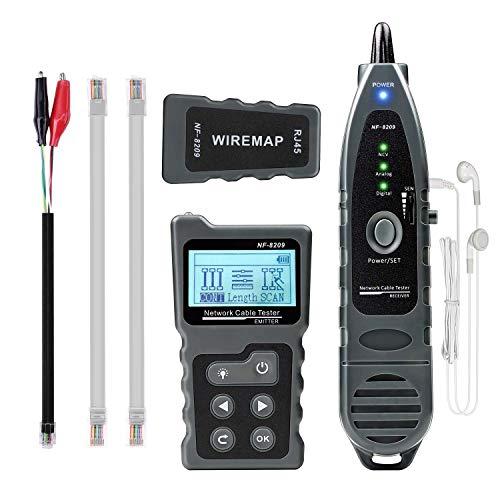
The KOLSOL NF-8209 provides digital cable scanning with AC filtering, three testing modes (AC filter, analog, and PoE), and a dedicated fault distance feature for RJ45/CAT5/CAT6 networks. It can measure cable length and locate faults up to a 200 m range, making it a practical tool for cabling engineers working on enterprise networks or large residential deployments. Its emphasis on PoE testing and NCV (non-contact voltage) detection supports comprehensive safety-conscious testing during installations.
Users should assess if the three-mode operation and NCV function match their job requirements, and whether the 200 m fault-distance limit aligns with their typical cable layouts and the density of network installations they manage.
Buying Guide: Key Purchase Considerations
- Range and application: Choose a model with a range that fits your typical cable lengths. Short, medium, and long-range variants serve different field needs—from residential troubleshooting to campus or industrial deployments.
- Target media: For copper-focused cabling, prioritize TDR/cable tester features with clear fault distance reading. For fiber networks, consider OTDR/TDR hybrids with wavelength support and event analysis.
- Waveform handling: Tools with digital gain control, automatic waveform recognition, and robust bridge-tap detection help reduce interpretation time and improve accuracy in noisy environments.
- Portability and power: Field work benefits from lightweight devices with rechargeable batteries, simple test lead kits, and rugged housings. Some models include Bluetooth or USB for data transfer and reporting.
- Safety and compatibility: Look for voltage range coverage (AC/DC), NCV features, and compatibility with common connector types (SC/ST/FC, RJ45, etc.).
- Integrated features: Some testers combine TDR with IP scanning, PoE testing, or CCTV/UTP analysis. Consider whether these multi-function capabilities save time and reduce tool count for your typical projects.
- Learning curve and support: Professional-grade tools may demand more training. Check for manufacturer documentation, tutorials, and local support options to maximize return on investment.
In choosing among the highlighted options, align device capabilities with your primary use cases: copper cable fault localization, mixed-fiber and copper testing, and underground or in-wall wiring inspections. Consider whether you need extended range, bridge-tap visibility, or network-focused features like IP scanning and PoE testing. A buyer’s decision should factor in the common environment (indoor/outdoor, clutter, electrical noise) and the typical lengths of cable runs you service.